Buying guide
Orient Mako 40 Review
Orient does not sell a watch called the Mako 40. Retailers named it; the reference is the AC0Q Diver. Knowing that is the difference between buying this watch and accidentally buying a Mako II.
Search for an "Orient Mako 40" and you will find listings, forum threads and retailer pages using that name freely. Orient does not. On Orient Watch USA the model is the AC0Q Diver, sold under references beginning RA-AC0Q, and the word Mako appears nowhere on its specification page. That is not a small detail when the actual Mako II is a different watch with a different movement sitting beside it at a similar price.
What the AC0Q actually is: a 200m automatic diver with a sapphire crystal, a screw-down crown, a 120-click unidirectional bezel and Orient's in-house caliber F6722, in a 39.9mm case on ordinary 20mm lugs. Every figure below comes from Orient's published specification for the reference we checked or from the F6722 caliber reference, and the scoring follows our method.
Disclosure
Some links here are affiliate links — mostly to Amazon. If you buy through one we may earn a small commission, at no extra cost to you. It never changes which watch we pick or the price you pay. Prices are pulled live and date-stamped; where we can't verify one, we show none. Full disclosure.
Orient
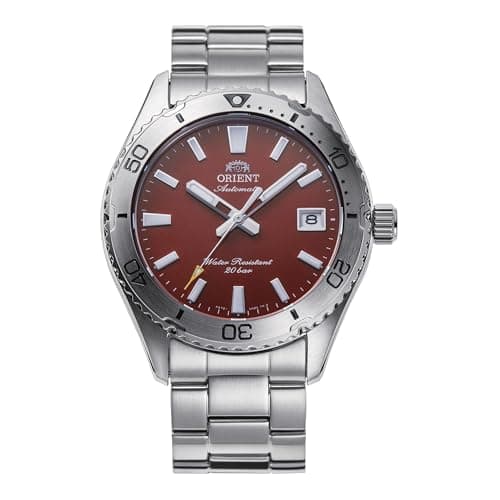
Orient Mako 40 (AC0Q Diver)
Sapphire, 200m and the in-house F6722 in a 39.9mm case on 20mm lugs — the Orient diver that takes an ordinary strap and reads smaller than a Kamasu.
Price as of Sep 23, 2026. Prices change — Amazon's is the one that counts.
#ad · we may earn a commission from this link to Orient Mako 40 (AC0Q Diver)
Specs at a glance
| Official name | Orient AC0Q Diver (ref. RA-AC0Q09R30B) |
|---|---|
| Movement | Orient F6722, in-house automatic, hand-winding, hacking |
| Jewels / beat | 22 jewels, 21,600 bph (caliber reference) |
| Power reserve | Approximately 40 hours |
| Accuracy spec | Not published by Orient for this reference |
| Complications | Date only, at 3:00 |
| Case | Stainless steel, 39.9mm diameter, 12.8mm thick |
| Lug to lug / width | 46.5mm / 20mm |
| Crystal | Sapphire |
| Water resistance | 200m, screw-down crown |
| Bezel | Stainless steel, 120-click unidirectional |
| Bracelet | Steel, foldover clasp with safety |
First, the name - because it costs people money
Orient's diver line is a naming mess, and this is the worst of it. The brand sells the Mako, the Ray, the Kamasu and the Kano under names used on the dial or in its own marketing. The AC0Q carries none of them. It is listed by Orient as the AC0Q Diver and identified by a reference code - RA-AC0Q09R30B for the red dial we checked, with siblings in the same case running RA-AC0Q01B, RA-AC0Q02L, RA-AC0Q03S and RA-AC0Q05P.
Third-party sellers filled the gap with "Mako 40", which is reasonable shorthand - it is a 40mm Orient diver - and a genuinely risky thing to shop by, because the Mako II and the Ray II are also on sale, also around 41mm, and use a different caliber. Buy the reference number, not the nickname: if the listing does not show an RA-AC0Q code, it is not this watch. The same discipline is what Orient's Bambino versions demand, for exactly the same reason.
The size: 2mm smaller, half a millimeter shorter
The obvious reason to want this watch is that 39.9mm sounds meaningfully smaller than the Kamasu's 41.88mm. On the wrist the gap is far narrower than that, and the number that explains why is the one almost no listing quotes.
| Measurement | AC0Q Diver | Kamasu |
|---|---|---|
| Case diameter | 39.9mm | 41.88mm |
| Lug to lug | 46.5mm | 47mm |
| Case thickness | 12.8mm | 12.8mm |
| Lug width | 20mm | 22mm |
| Crystal | Sapphire | Sapphire |
| Water resistance | 200m | 200m |
| Caliber | F6722 (date) | F6922 (day-date) |
Two millimeters off the diameter buys you half a millimeter off the lug-to-lug, and nothing at all off the thickness. Lug-to-lug is the measurement that decides whether a case overhangs the flat of your wrist, so if the Kamasu was too long for you, this will be too. What genuinely changes is how the watch reads - a smaller dial inside nearly the same footprint - and the strap width. Twenty millimeters is the most common size there is; 22mm is not. Our sizing guide sets out the wrist numbers, and the strap guide covers the swap.
For scale, the Seiko Prospex Turtle runs a 47.7mm lug-to-lug in a 45mm cushion case. The AC0Q is the shortest 200m diver case we list, but the margin over the Kamasu is about half a millimeter, not a size class.
The F6722 is not the F6922, and the difference is a day window
Orient's divers usually run the F6922: in-house, 22 jewels, hacking, hand-winding, and a day and date at three o'clock. The AC0Q runs the F6722 instead. It is the same family and the same grade of movement - in-house, 22 jewels, 21,600 bph, Seiko Diashock, roughly 40 hours, hacking and hand-winding both present - but it drives a date only.
Whether that is a loss depends entirely on whether you use a day window. Plenty of people never look at it and prefer the cleaner dial. If you do use it, the Mako II, the Ray II and the Kamasu all keep it, and our day-date list covers the caliber rule across brands.
The second difference is a documentation gap rather than a mechanical one. Orient publishes no daily accuracy tolerance for this reference- the spec table gives the caliber, the reserve and the functions, and stops. Orient's F6922 divers are documented at -15 to +25 seconds a day, tighter than Seiko's -35 to +45 for the 4R36, and that figure is one of the strongest arguments for buying Orient at all. We are not going to transfer it to a caliber Orient has not applied it to. Expect Orient's usual standard, verify your own watch over a full week, and read the accuracy guide before you judge it.
One more honest caveat: the F6722 caliber reference lists its known models as the Symphony III and the RA-AC0E Classic, not this diver. Orient's own specification page for the watch is what names the F6722, and a manufacturer naming the caliber in its own spec table is the better authority. We flag it because a reader who finds both pages will wonder.
Something on Orient's own page does not add up
The AC0Q listing's marketing paragraph describes the dial as carrying a "day display". Its own technical specification, two blocks lower on the same page, lists the features as "Date, Luminous Hour Markers and Hands" - and the F6722 is a date-only caliber. Those cannot both be right.
The specification table and the caliber agree with each other, so that is what we have published: this watch has a date, not a day-date. It is a small thing, but it is the second time we have found Orient's US pages contradicting themselves - the Bambino Open Heart prints its caliber as FT622 where the references catalog it as F6T22 - and on this brand the spec table beats the sales copy.
Sapphire and 200m, which is the actual value story
Strip out the naming and the movement footnote and what is left is a strong offer. A sapphire crystal is standard here, not an upgrade, and it is the difference between a watch that still looks new after three years and one that has collected hairlines from door frames. The Mako II and Ray II ship mineral at a similar price, so the AC0Q sits with the Kamasu on the right side of that line. The crystal guide explains exactly what you are trading.
The dive hardware is real: 200m, a screw-down crown and a 120-click unidirectional bezel that can only under-report elapsed time, never over-report it - how to use a dive bezel explains why that matters. Orient does not advertise ISO 6425certification for it, which is the standard that governs the word "diver" formally. For a certified watch, the Citizen Promaster Fugu is the pick on our dive list. For swimming, snorkeling and showering this is comprehensively over-specified - what the ratings permit has the detail.
What it gives up
- The day window. Date only. If your current watch has a day-date, you will notice its absence in the first week.
- A published accuracy figure. Orient states one for its F6922 divers and not for this one.
- Thickness. 12.8mm, identical to the Kamasu. A smaller diameter does not make a slimmer watch, and this still sits proud under a cuff.
- Lume.Orient lists luminous hands and markers but publishes no compound and makes no claim about duration. Seiko's LumiBrite remains the class benchmark - the lume shortlist ranks that honestly.
- The clasp.A foldover clasp with a safety catch, in line with the rest of Orient's divers. Functional, not a highlight, and it will need sizing on day one.
Which Orient diver should you actually buy?
Buy the AC0Q if you want sapphire and 200m, you prefer a smaller dial, and 20mm straps matter to you - which they should, if you plan to swap them. It is the easiest Orient diver to live with alongside a strap drawer.
Buy the Kamasu if you want the day-date and the published accuracy spec and the extra 2mm of dial does not bother you. It remains our overall value diver, and Kamasu vs Mako II lays out the rest of that family decision.
Buy the Mako II or Ray II if the budget is tight and you will genuinely accept a mineral crystal to save the difference.
And if you have not settled on Orient at all, Seiko vs Orient is the fork most people are actually standing at, while the under-$300 list puts this price band in context.
Questions
FAQ
Is the Orient Mako 40 the same as the Orient Mako II?
No. "Mako 40" is a retailer nickname for the watch Orient calls the AC0Q Diver, reference RA-AC0Q. It has a sapphire crystal and the date-only F6722. The Mako II is a different reference with a mineral crystal and the day-date F6922. Shop by the RA-AC0Q code rather than the name.
Does the Orient AC0Q Diver have a sapphire crystal?
Yes. Orient's specification for the reference lists a sapphire crystal as standard, which puts it alongside the Kamasu and above the Mako II and Ray II, both of which ship mineral.
Does it have a day-date?
No, date only. The F6722 drives a date at three o'clock. Orient's marketing paragraph on the product page mentions a day display, but its own specification table and the caliber both say date, and that is what we have gone with.
How accurate is the Orient F6722?
Orient publishes no daily tolerance for this reference. Its F6922 divers are documented at -15 to +25 seconds a day and the F6722 is the same in-house family running at 21,600 bph, but we will not transfer a figure Orient has not applied. Measure your own over a full week - the accuracy guide shows how.
Will a 39.9mm Orient diver fit a small wrist?
Better than the Kamasu, but not dramatically. The lug-to-lug is 46.5mm against the Kamasu's 47mm and the thickness is identical at 12.8mm. Lug-to-lug decides overhang, so if 47mm was too long for you, 46.5mm will be too. The small-wrist list has genuinely smaller options.
Can you dive with the Orient AC0Q?
It has the hardware - 200m, a screw-down crown and a 120-click unidirectional bezel - which covers swimming and snorkeling with a large margin. Orient does not advertise ISO 6425 certification for it, so for actual scuba we would point you at a certified watch such as the Citizen Promaster Fugu.
Specs & sources
Specifications on this page are compiled from manufacturer datasheets, official product pages, and published standards. Prices are pulled live from Amazon and date-stamped; nothing is invented.
- Orient AC0Q Diver 40mm, RA-AC0Q09R30B (official) ↗
- Orient caliber F6722 reference (in-house, 22 jewels, 21,600 bph, hacks + hand-winds, date only) ↗
- Orient Kamasu RA-AA0003R39B, official specifications (41.88mm, 47mm lug to lug, 12.8mm) ↗
- Orient caliber F6922 reference ↗
- Orient movements explained (F6922/F6724) ↗
- ISO 22810 / water-resistance meaning ↗
Keep reading