Buying guide
Seiko Prospex Turtle Review
The cushion-case diver that Seiko fans keep coming back to. Class-leading lume, a genuine 200m case and a shape nothing else has — set against a 45mm footprint and a crystal that isn't sapphire.
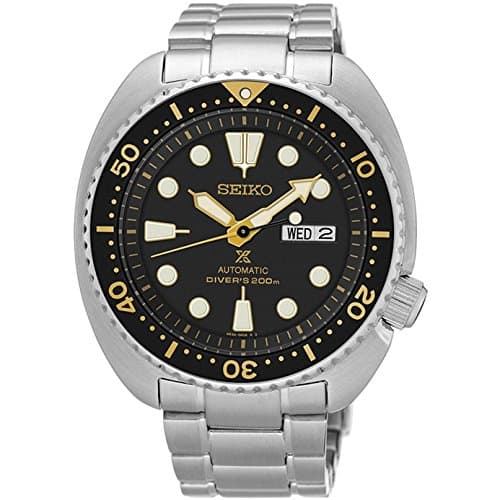
The Turtle is the watch people mean when they say "Seiko diver." The cushion case dates back to Seiko's 1970s dive watches, and the modern Prospex Turtle keeps the shape while adding the 4R36 movement that hacks and hand-winds. It is, along with the Orient Kamasu, one of the two watches we recommend most often to someone who wants a real dive watch without spending real dive-watch money.
It's also the pick most likely to be the wrong size for you, and that's where this review spends most of its time. Specs come from Seiko's published product data and the 4R36 caliber reference; we haven't pressure-tested a sample, and we say so. The price shown is live from Amazon and date-stamped — note that street prices for the Turtle have drifted around the $500 line, so check the number rather than trusting any list that quotes one from memory.
Disclosure
Some links here are affiliate links — mostly to Amazon. If you buy through one we may earn a small commission, at no extra cost to you. It never changes which watch we pick or the price you pay. Prices are pulled live and date-stamped; where we can't verify one, we show none. Full disclosure.
Seiko
Seiko Prospex Turtle SRP775
A real 200m ISO-style diver with the 4R36 and Seiko's cushion 'Turtle' case, and still the best lume in the class. But Seiko has discontinued the standard SRP Turtle: check availability and the live price before you count on this reference.
Price as of October 21, 2026. Prices change — Amazon's is the one that counts.
#ad · we may earn a commission from this link to Seiko Prospex Turtle SRP775
Specs at a glance
| Movement | Seiko 4R36, 24 jewels, automatic |
|---|---|
| Winding / hacking | Hand-winding + hacking (yes to both) |
| Stated accuracy | -35 / +45 sec/day (factory) |
| Power reserve | ~41 hours |
| Case | 45mm cushion case, ~47.7mm lug-to-lug |
| Crystal | Hardlex |
| Water resistance | 200m, screw-down crown |
The size question, first, because it decides everything
The Turtle is 45mm across — a number that scares people off — but its lug-to-lug is roughly 47.7mm, which is short for that diameter because the cushion case has no protruding lugs. The strap curves down almost immediately. That means it wears meaningfully smaller than 45mm suggests, and plenty of 6.75-inch wrists carry it happily.
What it can't hide is thickness. This is a chunky watch that sits high, catches shirt cuffs and makes its presence felt. On a wrist under about 6.5 inches it's simply too much watch, and no amount of clever lug geometry fixes that. If you're near that line, read the sizing guide and measure before you buy.
The lume is genuinely class-leading
Seiko's Lumibrite is the single clearest advantage the Turtle has over its rivals. Give it a few minutes of daylight and it will still be legible in the middle of the night — not "faintly visible," properly legible. Nothing at this price from Orient or Citizen matches it. If you've ever squinted at a watch in a dark cinema or on a night shift, this is the feature you'll notice most.
The 4R36 does the two things that matter
It hacks and it hand-winds — the two capabilities the old 7S26 in the SNK809lacks. Factory accuracy is a loose −35/+45 seconds a day, which sounds bad next to Orient's −15/+25 and is worth being honest about: Seiko's spec is a wide guarantee, not a promise of poor performance, and owner-reported rates usually land well inside it. But if published tolerance matters to you, Orient states a tighter one. What these numbers mean in practice.
Hardlex, not sapphire — and why Seiko chose it
The Turtle's crystal is Seiko's Hardlex, a hardened mineral glass. It resists impact better than sapphire but scratches far more easily. On a dive watch that rationale holds up: a shattered crystal underwater is a much worse outcome than a scratched one. For most owners — who will never dive with it — sapphire would be the better trade, which is exactly the gap the Kamasu exploits. Our sapphire list lays out the alternatives.
Living with it
The Turtle rewards a strap swap more than almost any watch we cover. Its 22mm lugs and cushion case suit rubber, nylon and leather equally well, and because the case is so distinctive, changing the strap genuinely changes the watch's personality — a black rubber strap makes it a tool, a tan leather one makes it look forty years old in the best way. It ships on a variety of bracelets and straps depending on reference; if the one you find is on a bracelet you don't love, that's a $25 problem, not a reason to skip it. Here's how to do it without scratching the lugs.
Day to day, the 4R36 hand-winds, so a stopped Turtle takes fifteen seconds to bring back — twenty or thirty crown turns, set, done. The screw-down crown needs unscrewing first and screwing back after, which becomes muscle memory quickly and is the single habit that keeps a dive watch dry. The ~41-hour reserve means a weekend off the wrist ends with a stopped watch; that's normal, harmless, and not a reason to buy a winder.
The price has moved, and that matters
One practical warning that applies to the Turtle more than most watches here. Seiko's affordable Prospex line has crept upward over the last few years, and street prices for the Turtle now sit at the $500 mark rather than comfortably under it. That changes the calculus: at $350 the Turtle was an obvious buy against the Kamasu; at $500-plus you're paying a real premium for lume and the Seiko name while giving up sapphire.
This is exactly why every price on this site is pulled live and date-stamped rather than typed in from memory — a roundup that quotes a two-year-old figure will tell you the Turtle is a bargain when today it may not be. Check the number above, compare it against the Kamasu, and let the current gap decide. If we can't verify a price, we show none; our method explains why. Our buy link points at whichever Turtle reference is actually in stock — the cushion case, the 4R36, the Hardlex crystal and the 200m rating are shared across the line, so the dial and bracelet are what change between them.
Who should buy it
Buy the Turtle if you want the best lume in the class, the Seiko name and its resale strength, and a watch with genuine character — the cushion case looks like nothing else and people who know watches recognize it instantly. It's also the right pick if you want a 200m diver that can take a beating and be serviced anywhere in the world.
Who should skip it
Skip it if your wrist is under about 6.5 inches; skip it if you want sapphire; skip it if you want a slim watch that disappears under a cuff. And skip it if the live price has drifted well above the Kamasu's — the two are close enough on merit that price should break the tie. We compare them directly here.
Alternatives worth comparing
- Orient Kamasu — sapphire, smaller at 41.8mm, tighter accuracy spec, usually cheaper.
- Seiko 5 Sports— the same 4R36 in a slimmer 100m case, if you don't need a true dive rating. Compared here.
- Citizen Promaster Fugu — an ISO 6425 dive rating and sapphire, at a higher price.
Questions
FAQ
Is the Seiko Turtle too big?
It depends on your wrist, not the 45mm number. The cushion case has no protruding lugs, so the lug-to-lug is around 47.7mm — short for the diameter — and it wears smaller than it reads. But it's a thick watch that sits high, and on a wrist under about 6.5 inches it's too much.
Does the Seiko Turtle have a sapphire crystal?
No — it uses Seiko's Hardlex, a hardened mineral glass that resists impact better than sapphire but scratches more easily. If you want sapphire on a 200m diver at a similar price, the Orient Kamasu is the alternative.
Is the Seiko Turtle a real dive watch?
Yes. It has 200m water resistance, a screw-down crown and a unidirectional rotating bezel — the three things that define a genuine dive watch. That's a real step above the Seiko 5 Sports, which looks similar but is rated 100m.
Specs & sources
Specifications on this page are compiled from manufacturer datasheets, official product pages, and published standards. Prices are pulled live from Amazon and date-stamped; nothing is invented.
Keep reading