Buying guide
Automatic vs Quartz
Quartz is more accurate and cheaper to own. Automatic is the craft, the sweeping seconds, the no-battery machine. Here's the honest trade-off — and which to buy for your reasons.
This is the most important decision before you spend a cent, and most sites get it wrong by quietly rooting for the more expensive answer. So let's be blunt: on pure accuracy and cost of ownership, quartz wins. A $50 Casio keeps time better than a $5,000 Rolex. If timekeeping performance is all you care about, buy quartz and walk away happy.
But performance isn't why people buy mechanical watches. An automatic is a tiny machine you wear — no battery, a sweeping seconds hand, a movement you can watch through the caseback, and a thing that can be serviced and passed down for decades. That's the trade, and it's a real one. Here's the whole picture so you can pick for your reasons.
Disclosure
Some links here are affiliate links — mostly to Amazon. If you buy through one we may earn a small commission, at no extra cost to you. It never changes which watch we pick or the price you pay. Prices are pulled live and date-stamped; where we can't verify one, we show none. Full disclosure.
The contenders
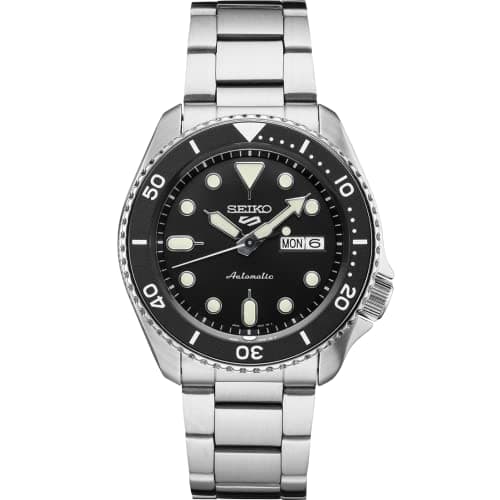
Seiko
Seiko 5 Sports SRPD55
No buyable offer at the last price check (Sep 8, 2026). We show nothing rather than a stale number.
#ad · we may earn a commission from this link to Seiko 5 Sports SRPD55
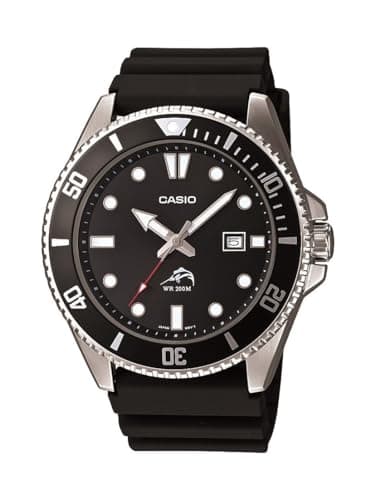
Casio
Casio Duro MDV106
$84.9522% off
Price as of Sep 8, 2026. Prices change — Amazon's is the one that counts.
#ad · we may earn a commission from this link to Casio Duro MDV106
The comparison, plainly
| Factor | Automatic | Quartz |
|---|---|---|
| Accuracy | ~ -20 to +40 sec/DAY | ~ ±15 sec/MONTH |
| Power source | Motion of your wrist (no battery) | Battery (2-5 years) |
| Maintenance | Service every ~5-8 years | Battery swap; little else |
| Seconds hand | Smooth sweep | Ticks once per second |
| Lifespan | Decades, serviceable | Long, but often disposable |
| Price floor | ~$100 (Invicta 8926) | ~$25 |
| The feeling | A machine on your wrist | A tool that just works |
Buy quartz if…
- You want to put it on and forget it — no winding, no daily drift to reset.
- Accuracy genuinely matters to you day to day.
- You want maximum toughness-per-dollar (the Casio Duro is a 200m diver for under $60).
- It's a knock-around watch for the gym, the beach or travel.
Buy automatic if…
- You want the craft — a mechanical movement, no battery, a sweeping seconds hand.
- You like the idea of a watch you wind, service and keep for decades.
- You want to fall down the hobby rabbit hole (fair warning). Start with our first-watch guide.
Our pick of each
For automatic, the Seiko 5 Sports is the safe default. For quartz, the Casio Duro MDV106 is the value benchmark the whole affordable-automatic world is measured against. Both are shown below with live prices — buy the one that matches your reasons, not the one that costs more.
One nuance worth knowing: accuracy on an automatic isn't fixed. How you store it overnight affects its daily rate, and a watch that's running fast or slow can often be regulated. We cover that in automatic watch accuracy.
Questions
FAQ
Is an automatic or quartz watch more accurate?
Quartz, by a wide margin. A typical quartz watch is accurate to about ±15 seconds a month, while a good affordable automatic runs roughly −20 to +40 seconds a day. If pure accuracy is your priority, quartz wins — automatic is about the mechanical experience, not precision.
Do automatic watches need a battery?
No. An automatic winds itself from the motion of your wrist and stores that energy in a mainspring. Quartz watches run on a battery you replace every few years. See how automatic watches work.
Is it worth paying more for an automatic over quartz?
Only if you value the mechanical craft — the no-battery movement, the sweeping seconds, the serviceable machine you can keep for decades. You are paying more for the experience, not better timekeeping. If you just want an accurate, tough, cheap watch, quartz is the smarter buy and there's no shame in it.
Specs & sources
Specifications on this page are compiled from manufacturer datasheets, official product pages, and published standards. Prices are pulled live from Amazon and date-stamped; nothing is invented.
Keep reading