Buying guide
Orient Bambino Open Heart Review
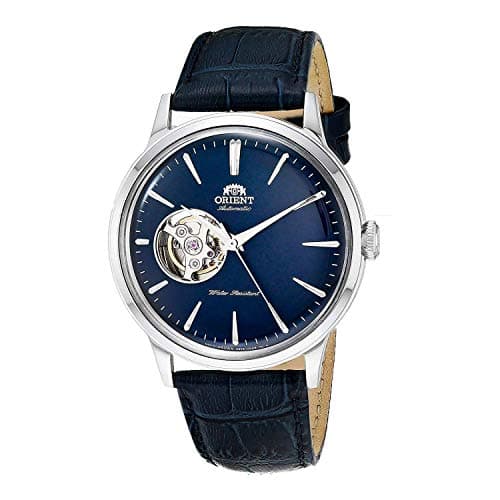
A hole cut through a Bambino dial so you can watch the balance wheel work - on a case that measures 40.5mm and wears smaller than the 42.5mm Bambino most people buy instead.
Almost every open heart watch under $500 has the same problem: the brand will show you the balance wheel but will not tell you what it belongs to. Bulova publishes a jewel count and stops. Fossil publishes nothing at all. Orient is the exception - it builds its own open-heart caliber, lists it by number on its own product page, and states that it hacks and hand-winds. That is why the Bambino Open Heart tops our open heart shortlist, and why it earns a page of its own.
What follows is compiled from Orient's published specification for this reference, the caliber reference for the movement inside it, and the fit math those numbers make possible - judged by our method, not by a week on a timegrapher we do not own. The price below is live.
Disclosure
Some links here are affiliate links — mostly to Amazon. If you buy through one we may earn a small commission, at no extra cost to you. It never changes which watch we pick or the price you pay. Prices are pulled live and date-stamped; where we can't verify one, we show none. Full disclosure.
Orient
Orient Bambino Open Heart 40.5mm
The Bambino case with an aperture cut for the balance wheel, and the only open-heart watch here whose caliber is published, hacks and hand-winds. The default pick in this category.
No buyable offer at the last price check (October 21, 2026). We show nothing rather than a stale number.
#ad · we may earn a commission from this link to Orient Bambino Open Heart 40.5mm
Specs at a glance
| Movement | Orient F6T22, in-house automatic - 22 jewels, 21,600 bph |
|---|---|
| Winding / hacking | Hand-winding + hacking (Orient states both) |
| Stated accuracy | Orient publishes no daily tolerance for this caliber |
| Power reserve | Approximately 40 hours |
| Case | Stainless steel, 40.5mm - 12mm thick, lug-to-lug 46mm |
| Lug width | 21mm |
| Crystal | Domed mineral |
| Water resistance | 30m, push/pull crown |
| Features | Open heart aperture and an exhibition caseback |
| Strap | Leather with a pin buckle |
It wears smaller than the Bambino you were going to buy
This is the fact that decides the watch, and it reads backwards. The Open Heart is 40.5mm across with a 46mm lug-to-lug. The standard 42.5mm Bambino V4 - the one almost everybody buys - has a lug-to-lug of roughly 49mm. So the open-heart version is two millimeters smaller in the measurement people shop on, and about three millimeters shorter in the measurement that actually decides whether a watch fits.
Lug-to-lug is the distance from the tip of one lug to the tip of the opposite one, and it determines whether the case overhangs the flat part of your wrist. Diameter only tells you how big the dial looks. A 46mm lug-to-lug sits properly on wrists from about 6.5 inches upward, which is a materially wider audience than the V4 serves - our sizing guide explains how to measure your own and why the diameter in the listing keeps misleading people.
At 12mm thick it is also thin enough to go under a shirt cuff without a fight, which is the other half of the dress-watch test. If you passed on the standard Bambino because 42.5mm was too much watch, this one deserves a second look before you drop to the 38.4mm V7 - the versions guide sets out how the references map to sizes.
The caliber, and the name on Orient's own page
Inside is Orient's in-house open-heart automatic: 22 jewels, a 21,600 beat-per-hour rate, roughly 40 hours of reserve, and Seiko Diashock protection - the shock system you would expect from a company that sits inside Seiko Epson. It hacks and hand-winds, and Orient says so in writing on the product page rather than leaving you to find out.
Both of those matter more than they sound. Hacking stops the seconds hand when you pull the crown, so you can set the watch to the second rather than to the nearest minute. Hand-winding means you can start it from a drawer without shaking it for two minutes. Hacking and hand-winding explained covers why so many cheap automatics do neither, and what the jewel count means is worth two minutes if 22 reads to you like a quality score rather than a bearing count.
One piece of housekeeping. Orient's US product page prints the caliber as FT622; the caliber references catalog the same movement as F6T22. It is one movement with two characters swapped in one of those two places, not two different watches - we mention it only so a listing that disagrees with a datasheet does not send you hunting for a variant that does not exist.
What Orient does not publish is a daily accuracy tolerance for this caliber. Its F6724 and F6922 movements carry a stated -15 / +25 seconds a day; this one carries no published figure at all, and we are not going to borrow a number from a sibling caliber and print it as a specification. Time your own example over a week using the method in automatic watch accuracy and judge it against that.
What the aperture actually costs you
The window sits at nine o'clock, over the balance wheel - the caliber reference describes the movement as having an open balance at that position. It is the restrained version of this idea: a small opening in a dial that is otherwise a normal Bambino dial, rather than a full skeleton where the dial has been cut away across most of its surface.
That restraint is the point. A skeleton dial shows you more and reads worse - there is no solid background behind the hands, so you end up checking the time twice. An open heart takes one index out of service and leaves the other eleven positions intact, so legibility is barely affected. You lose the nine o'clock marker and you gain something moving on your wrist all day.
Do not expect the balance wheel to be visible in a dark room. There is no meaningful lume here and the aperture is small. This is a daylight feature, and a desk feature.
The crystal is domed, and it is mineral
The domed crystal is a Bambino signature and it does real work: it adds depth to a flat dial and it kills much of the glare you get off a flat piece of glass at an angle. On a watch with a window in the dial that second effect matters more than usual, because reflections are exactly what stops you seeing into an aperture.
It is mineral, though, not sapphire, and that is the clearest mark against this watch. Mineral glass picks up hairline scratches from door frames and desk edges over a few years, and a hazed crystal on a watch you bought to look through is a worse outcome than a hazed crystal on a plain dial. Sapphire vs mineral vs Hardlex sets out how wide that gap really is. If the crystal is your binding constraint, the honest answer is that the sapphire shortlist has better watches on it - none of them open-hearted at this money except the Bulova, which trades the crystal back for an unnamed caliber.
30m, a push/pull crown, and what that rules out
Orient rates it 30 meters with a push/pull crown rather than a screw-down one. In practice that means rain, a spilled drink and washing your hands. Not swimming, not the shower, not the washing-up bowl with your sleeves rolled up.
That is normal for a dress watch and it is not a defect, but it decides what this watch can be: a second watch, or a first watch for someone whose life is dry. If you want one watch for everything, a 200m diver is the honest answer, and the water-resistance guide explains what each rating actually permits.
The 21mm lugs are the real annoyance
Watch straps are sold in even sizes. Eighteen, twenty and twenty-two millimeters account for most of the aftermarket; twenty-one does not. Orient fits 21mm lugs here, which means the enormous, cheap, endlessly varied strap market is mostly closed to you. The alternatives are hunting down the handful of makers who cut 21mm, or forcing a 22mm strap between the lugs and living with the bulge.
It is a small thing that becomes a large thing about eighteen months in, when the supplied leather starts to crack and you go shopping. Our strap guide covers measuring lug width properly, and it is worth reading before you buy rather than after.
How it compares with the rest of the open hearts
The Bulova Sutton 96A330 is the only real competition at this money, and it is a genuinely different proposition: a full skeleton dial under an anti-reflective sapphire crystal, in a 40mm case on friendlier 20mm lugs. It beats the Orient on crystal, on strap availability and on drama. It loses on the thing this site cares about most - Bulova names no caliber and states no accuracy tolerance.
The Orient Classic RN-AG0728Sis the same caliber and the same honesty in a 32.9mm case, which is the answer if fit is your binding constraint. Bulova's cheaper Classic Aerojet 98A187trades the Sutton's sapphire for a box mineral crystal and undercuts both, and the Fossil Townsman is the cheap way in and publishes even less than Bulova does. And if you only want the movement visible from the back, the display-back shortlist has better watches for the money than any open heart does - this one happens to give you both, since Orient fits an exhibition caseback as well as the dial aperture.
Who should buy it
Buy the Bambino Open Heart if you want a mechanical watch that shows its work and you are not willing to buy one whose maker will not say what is inside it. It is the only watch in this category with a published, in-house, hacking, hand-winding caliber, and the 46mm lug-to-lug means it fits a range of wrists the standard Bambino does not. As a dress watch it is a Bambino first and a novelty second, which is the right order for something you will wear on days when nobody asks about the hole in the dial.
Skip it if you need sapphire, if you want to swim in your watch, or if you buy straps constantly and the 21mm lugs would grate. In those cases the under-$300 roundup is where the value in this market genuinely peaks, and a plain affordable dress watch will give you more watch for the same money - just not one you can see into.
Choosing within the family: Bambino vs Bambino Open Heart puts all three cases side by side, and Bulova Sutton vs Aerojet covers the sapphire alternative with an undocumented movement.
Questions
FAQ
What movement is in the Orient Bambino Open Heart?
Orient's own in-house open-heart automatic - 22 jewels, 21,600 beats per hour, roughly a 40-hour power reserve, with hand-winding and hacking. Orient's US product page prints the caliber as FT622 and the caliber references catalog it as F6T22; it is the same movement. Orient publishes no daily accuracy tolerance for it, and we do not invent one.
Does the Orient Bambino Open Heart wear big at 40.5mm?
No - it wears smaller than the number suggests, and smaller than the standard 42.5mm Bambino V4. Its lug-to-lug is 46mm against roughly 49mm on the V4, and lug-to-lug is what decides whether a case overhangs your wrist. At 12mm thick it also slides under a cuff.
Does the Bambino Open Heart have a sapphire crystal?
No. Orient fits a domed mineral crystal. The dome reduces glare, which genuinely helps on a dial you want to see into, but mineral picks up hairline scratches over the years in a way sapphire does not. The Bulova Sutton is the sapphire alternative in this category, at the cost of an unnamed movement.
Can you swim with an Orient Bambino Open Heart?
No. It is rated 30m with a push/pull crown, which covers rain and hand-washing. We treat 30m as splashes only and reserve swimming for 100m and above.
What strap size does the Orient Bambino Open Heart take?
21mm, which is the watch's most practical flaw. Most aftermarket straps are made in 18, 20 and 22mm, so replacements are harder to find than they should be. Some owners force a 22mm strap between the lugs; a 21mm strap from a maker that cuts odd sizes is the tidier answer.
Is an open heart the same as a skeleton dial?
No. An open heart is a small aperture cut into an otherwise normal dial, positioned over the balance wheel, so the watch stays readable - that is what this Orient is. A skeleton dial is cut away across most of its surface, which shows more and reads worse. An exhibition caseback is a window in the back and has nothing to do with the dial. This watch happens to have both an open heart and an exhibition caseback.
Specs & sources
Specifications on this page are compiled from manufacturer datasheets, official product pages, and published standards. Prices are pulled live from Amazon and date-stamped; nothing is invented.
Keep reading