Buying guide
Seiko vs Tissot
The default Japanese automatic against the default affordable Swiss one. The Tissot costs roughly three times as much, and exactly three specifications explain why.
This is the step-up question on this entire site. You have decided a mechanical watch is worth having, you have looked at a Seiko 5 for around $200, and then you have seen a Tissot PRX for three times that and wondered whether the Swiss badge is doing any real work.
It is, and it is possible to say exactly how much. Three specifications separate these watches - the crystal, the power reserve and the bracelet - and if you do not care about all three, the Seiko is the better buy and it is not close.
Disclosure
Some links here are affiliate links — mostly to Amazon. If you buy through one we may earn a small commission, at no extra cost to you. It never changes which watch we pick or the price you pay. Prices are pulled live and date-stamped; where we can't verify one, we show none. Full disclosure.
The contenders
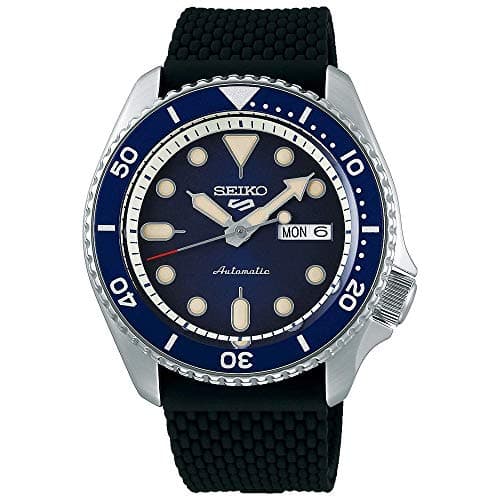
Seiko
Seiko 5 Sports SRPD93
No buyable offer at the last price check (October 21, 2026). We show nothing rather than a stale number.
#ad · we may earn a commission from this link to Seiko 5 Sports SRPD93
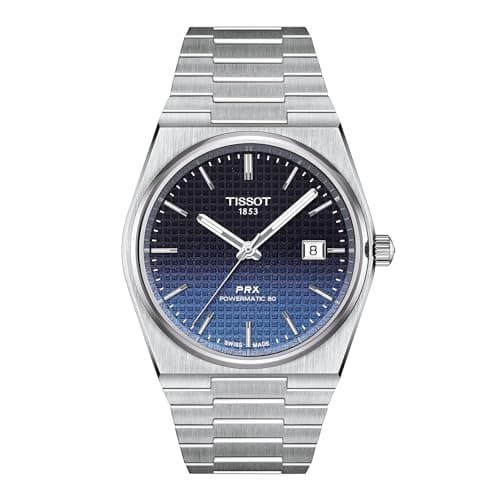
Tissot
Tissot PRX Powermatic 80
Price as of October 21, 2026. Prices change — Amazon's is the one that counts.
#ad · we may earn a commission from this link to Tissot PRX Powermatic 80
The three specifications that explain the price
| Spec | Seiko 5 Sports SRPD93 | Tissot PRX Powermatic 80 |
|---|---|---|
| Movement | 4R36, 24 jewels | Powermatic 80, Swiss |
| Power reserve | ~41 hours | 80 hours |
| Published accuracy | -35 to +45 sec/day | No daily figure published |
| Crystal | Hardlex (mineral) | Sapphire |
| Water resistance | 100m | 100m |
| Case | 42.5mm | 40mm |
| Bracelet | Standard steel, basic clasp | Integrated, tapered |
1. The crystal
Seiko fits Hardlex, its own hardened mineral glass, to almost everything under $400. Tissot fits sapphire. Sapphire is dramatically harder and will still look new after years of desk diving and doorframes; Hardlex picks up fine scratches and eventually a deep one. Neither shatters in normal use.
This is the difference most owners actually notice, and it compounds over years rather than weeks. The full argument, including the one real drawback of sapphire, is in sapphire vs mineral vs Hardlex.
2. The power reserve
The 4R36 holds about 41 hours. The Powermatic 80 holds 80. That gap sounds like a doubling and behaves like something bigger, because 41 hours from Friday evening runs out on Sunday morning and 80 hours does not run out until Tuesday.
If you own one watch and wear it daily, this is worth nothing to you - a watch on your wrist never runs down. If you own two, or wear the same watch only at weekends, it is the single most practically useful upgrade money can buy at this level. The full reasoning is in power reserve explained.
3. The bracelet
The PRX's integrated bracelet is a substantial part of what you are paying for and a substantial part of why it looks like a much more expensive watch. It tapers, it is solid, the clasp is properly engineered, and the whole thing is designed as one object with the case.
The Seiko 5's bracelet is the weakest part of the watch. It is functional and nothing more, and a large number of owners replace it immediately - which, at Seiko's standard lug width, costs very little and is a five-minute job (how to change a watch strap). The PRX cannot be modified this way at all: the bracelet is integrated into the case and does not accept a standard strap.
What Swiss does not buy you
Accuracy, mostly. Both watches are ordinary mechanical movements that will drift by tens of seconds a day depending on how you wear and store them. The Powermatic 80 is not a chronometer, and Tissot does not publish a daily tolerance for it; Seiko does publish one for the 4R36, and it is a wide -35 to +45 seconds. In practice both usually run better than their worst case and neither keeps time like a $20 quartz. See automatic watch accuracy, and what COSC certification actually is for the standard neither of these watches is tested against.
Nor does it buy you water resistance - both are 100m - or servicing economics. A Swiss service costs more than a Japanese one and considerably more than the Seiko is worth; we walk through that math in what it costs to service an automatic.
The range problem
Seiko's advantage that has nothing to do with specs is choice. The Seiko 5 Sports line runs to dozens of dial, bezel and strap combinations, plus the 39.4mm field-style SRPG for smaller wrists and the GMT versionsfor a second time zone. Tissot's PRX comes in 40mm and 35mm, in a handful of dials, and that is the range.
Seiko also has a resale market. If you buy a Seiko 5 and decide mechanical watches are not for you, someone will buy it. That is a real, if unglamorous, argument for starting there.
Which should you buy?
- First automatic, unsure if you will like it → Seiko. Spend $200, find out, and you have lost very little if the answer is no. This is the reasoning behind the beginners list.
- One watch, worn every day, for years → Tissot. The sapphire is the argument; the reserve is irrelevant to you but the crystal is not.
- More than one watch in rotation → Tissot, for the 80 hours.
- You like swapping straps and tinkering → Seiko, without hesitation. The PRX is a closed system by design.
- Small wrist → both have an answer - the 39.4mm Seiko SRPG or the 35mm PRX - but the 42.5mm SRPD93 is not it.
If the Swiss argument has persuaded you, the wider field is in the best Swiss automatics under $1,000. If the Japanese one has, start at the best Japanese picks.
At model level the fight almost everybody actually has is the Seiko 5 Sports against the PRX. Seiko 5 vs Tissot PRXtakes it head on, and the finding that decides it is that both movements beat at 21,600 vph — so the Swiss premium buys reserve, sapphire and the bracelet, not a faster engine.
Orient belongs in this conversation too, because it undercuts both brands while publishing the tightest accuracy window of the three — Seiko vs Orient vs Tissot is the three-way version of this page.
Questions
FAQ
Is a Tissot worth three times the price of a Seiko?
It is if you want all three of the sapphire crystal, the 80-hour power reserve and the integrated bracelet. If you only want one of them, the money is better spent elsewhere - a sapphire Orient or Citizen gets you the crystal for far less.
Is Tissot more accurate than Seiko?
Not meaningfully. Neither is a chronometer. Seiko publishes -35 to +45 seconds a day for the 4R36; Tissot does not publish a daily figure for the Powermatic 80. Both are ordinary mechanical movements that drift by tens of seconds a day.
Can you put a different strap on a Tissot PRX?
Not a standard one. The bracelet is integrated into the case, so you are limited to Tissot's own quick-release bracelet and straps. A Seiko takes any standard strap you like.
Is the Seiko 5 too big at 42.5mm?
On a wrist under about 6.75 inches, yes. Seiko's own answer is the 39.4mm SRPG field style, which uses the same 4R36 movement. Tissot's equivalent answer is the 35mm PRX.
Specs & sources
Specifications on this page are compiled from manufacturer datasheets, official product pages, and published standards. Prices are pulled live from Amazon and date-stamped; nothing is invented.
Keep reading