Buying guide
Orient Ray II Review
The cheapest way into a 200m diver with a genuine in-house movement. Its twin, the Mako II, gets more attention; the difference between them is smaller than the internet suggests.
Orient makes its own movements. That sentence does more work than any other fact about this watch. At a price where most brands buy a Miyota or a Seiko module and put their name on the dial, Orient - owned by Seiko Epson, but running its own caliber line - fits the in-house F6922: a 22-jewel automatic that hacks, hand-winds and carries a day-date.
Wrap that in a 200m case with a screw-down crown and a unidirectional bezel and you have the Ray II, a real dive watch for the price of a mid-range pair of sneakers. Specs below come from the F6922 caliber reference and Orient's published movement documentation; scoring follows our method.
Disclosure
Some links here are affiliate links — mostly to Amazon. If you buy through one we may earn a small commission, at no extra cost to you. It never changes which watch we pick or the price you pay. Prices are pulled live and date-stamped; where we can't verify one, we show none. Full disclosure.
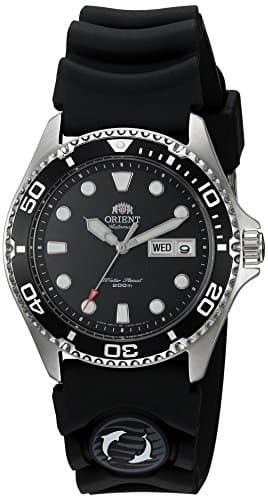
Orient
Orient Ray II
The Mako's twin with a different dial and bezel: in-house F6922, 200m, mineral crystal. Same value story, pick on looks.
$279.9823% off
Price as of October 21, 2026. Prices change — Amazon's is the one that counts.
#ad · we may earn a commission from this link to Orient Ray II
Specs at a glance
| Movement | Orient F6922, in-house automatic, 22 jewels, 21,600 bph |
|---|---|
| Power reserve | 40+ hours |
| Accuracy spec | -15 to +25 seconds per day |
| Complications | Day and date at 3:00 |
| Case | Stainless steel, approximately 41.5mm |
| Crystal | Mineral |
| Water resistance | 200m, screw-down crown |
| Bezel | Unidirectional dive bezel |
The movement is better than the price suggests
The F6922's published tolerance is -15 to +25 seconds a day. Compare that with the -35 to +45 of Seiko's 4R36, which powers watches costing the same or more. On paper Orient specifies its cheap movement more tightly than Seiko specifies its cheap movement, and that is not a marketing quirk - it is the practical benefit of a company that builds calibers rather than buying them.
It hacks and it hand-winds, so setting it is precise and reviving it after a week off the wrist takes thirty seconds at the crown rather than a shake. The day-date at three is a genuine convenience and, on this dial, does not crowd the layout. If those terms are new, movements explained covers what hacking and hand-winding actually change day to day.
Ray II vs Mako II: the real difference
Orient sells two near-identical divers. The Mako II and the Ray II share the same F6922, the same 200m case, the same mineral crystal and the same approximate 41.5mm diameter. What differs is the dial and bezel treatment - the Mako runs Arabic numerals at 6, 9 and 12 with a busier dial, the Ray is cleaner and more minimal - and the strap they usually ship on.
That is it. There is no movement upgrade, no water-resistance difference and no meaningful build gap. Buy the one you prefer looking at, and buy whichever is cheaper on the day if you genuinely cannot choose. We laid the two out side by side in Ray II vs Mako II.
The mineral crystal is the real compromise
Not the movement, not the case - the glass. The Ray II ships mineral, which sits below sapphire on every hardness scale and will collect hairline scratches over a few years of daily wear. Orient's own Kamasu is essentially this watch with a sapphire crystal for a modest step up in price, and that is the single best upgrade available in this part of the market.
Our position is straightforward: if the extra outlay is comfortable, buy the Kamasu. If it is not, the Ray II is still a 200m in-house automatic and the crystal is a cosmetic issue, not a functional one. The crystal guide explains exactly what you are trading.
Is it a real dive watch?
It has the hardware: 200m rating, screw-down crown, and a unidirectional bezel that turns only one way, so a mistimed nudge can shorten your notion of elapsed time but never extend it. Orient does not market it as an ISO 6425 certified diver, which is the standard that governs the term formally - for that, the Citizen Promaster Fugu is the certified pick on our dive list. For swimming, snorkeling and anything short of scuba, the Ray II is comprehensively over-specified.
Who should buy it
Buy the Ray II if you want the most watch for the least money and you can live with a crystal that will eventually show wear: an in-house movement with a tighter accuracy spec than Seiko's, 200m, day-date and a bezel. It is one of the best value propositions on the under-$300 list.
Skip it if you want sapphire (buy the Kamasu), if you want the strongest lume in the class (that is the Seiko Turtle), or if a 41.5mm dive case is more watch than your wrist wants - the small-wrist list has smaller options.
Questions
FAQ
Is the Orient Ray II the same as the Mako II?
Mechanically, yes. Same in-house F6922, same 200m case, same mineral crystal, same approximate 41.5mm diameter. The differences are dial and bezel styling and the strap they usually ship on. Choose on looks and on the live price.
Does the Orient Ray II have sapphire?
No. It has a mineral crystal. If you want sapphire from Orient at a similar price, the Kamasu is the same movement and the same 200m case with a sapphire crystal fitted.
How accurate is the Orient F6922?
Orient publishes -15 to +25 seconds per day, which is tighter than Seiko's -35 to +45 spec for the 4R36. That is a manufacturing tolerance rather than a promise about your individual watch, but it is a meaningfully better starting point at this price.
Can you dive with an Orient Ray II?
It is a 200m watch with a screw-down crown and a unidirectional bezel, which covers swimming, snorkeling and recreational water use with room to spare. Orient does not advertise ISO 6425 certification, so for actual scuba we would point you at a certified watch such as the Citizen Promaster Fugu.
Specs & sources
Specifications on this page are compiled from manufacturer datasheets, official product pages, and published standards. Prices are pulled live from Amazon and date-stamped; nothing is invented.
Keep reading