Buying guide
Tissot PRX vs Hamilton Khaki Field
The two watches people upgrade to. Both are Swiss, both hold 80 hours, both have sapphire. The decision isn't about quality — it's about which kind of watch you actually want on your wrist.
Once you've owned an affordable Japanese automatic and decided to spend more, these are the two watches that come up. Both are Swiss, both use 80-hour movements (Tissot's Powermatic 80 and Hamilton's H-10 are close relatives), both have sapphire crystals with anti-reflective coating, and both sit around the same money.
The short answer:this isn't a quality comparison, it's a genre comparison. The PRX is a dress-sport watch with an integrated bracelet that reads as expensive; the Khaki Field is a 38mm military-derived tool watch that reads as understated. Buy the PRX if you want to be seen wearing a nice watch. Buy the Hamilton if you want a watch that disappears and just works. Both are correct answers.
Disclosure
Some links here are affiliate links — mostly to Amazon. If you buy through one we may earn a small commission, at no extra cost to you. It never changes which watch we pick or the price you pay. Prices are pulled live and date-stamped; where we can't verify one, we show none. Full disclosure.
The contenders
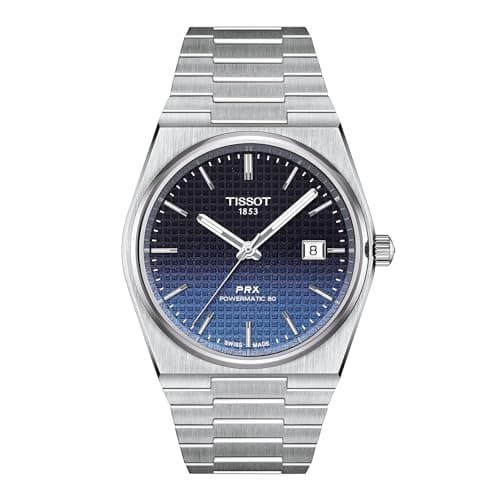
Tissot
Tissot PRX Powermatic 80
Price as of October 21, 2026. Prices change — Amazon's is the one that counts.
#ad · we may earn a commission from this link to Tissot PRX Powermatic 80
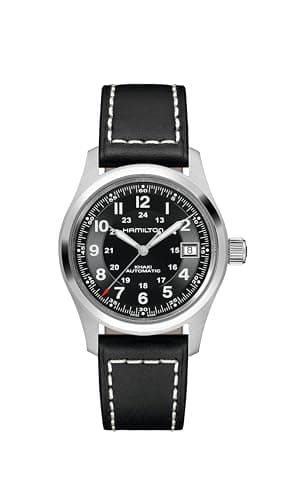
Hamilton
Hamilton Khaki Field Auto 38mm
Price as of October 21, 2026. Prices change — Amazon's is the one that counts.
#ad · we may earn a commission from this link to Hamilton Khaki Field Auto 38mm
Head-to-head
| Factor | Tissot PRX | Hamilton Khaki Field |
|---|---|---|
| Movement | Powermatic 80 | H-10 |
| Power reserve | Up to 80 hours | 80 hours |
| Crystal | Sapphire, AR-coated | Sapphire |
| Water resistance | 100m | 100m |
| Case | 40mm (35mm also made) | 38mm |
| Style | Integrated-bracelet dress-sport | Military field watch |
| Strap options | Integrated — limited | Standard lugs — anything fits |
| Hairspring | Nivachron antimagnetic | Nivachron antimagnetic |
What they share
More than they don't. The 80-hour power reserve is the headline in both cases, and it's the reason to spend here at all: take either off on Friday and it's still running on Monday, where a 40-hour Japanese automatic has stopped. Both use Nivachron antimagnetic hairsprings, which engineer out the single most common cause of a mechanical watch suddenly running fast. Both are 100m water resistant — everyday-safe, but neither is a dive watch.
The case for the PRX
It is the more impressive watch. The integrated bracelet — the unbroken line from case to clasp — is a design language previously reserved for watches costing five times as much, and the PRX pulls it off convincingly. It also hugs the wrist rather than perching, so it wears smaller than 40mm suggests. If you want one watch that works with a suit and a t-shirt and looks like real money, this is it. Full PRX review.
The cost: you cannot fit a standard strap. The bracelet is the watch, and you're committed to it.
The case for the Khaki Field
It is the more useful watch. At 38mmit's the size a field watch should be, it's thin enough to slide under a cuff, and the high-contrast dial with a 24-hour inner track is ruthlessly legible. Standard lugs mean you can put it on nylon, leather or a bracelet for the cost of a strap, so one watch becomes three.
The cost: nobody will notice it. That's the point of a field watch, and for some buyers it's exactly the wrong outcome for this much money. It also leads our field-watch list as the reach pick.
Size is the practical tiebreaker
The Hamilton at 38mm suits smaller wrists more easily than the PRX at 40mm — though the PRX's integrated bracelet closes much of that gap, and a 35mm PRXexists if you want a genuinely small one. If you're between 6 and 6.5 inches, either the 38mm Hamilton or the 35mm PRX is a safer bet than the 40mm. Our fit guide has the numbers.
The question we'd rather you asked
Should you buy either? On a value-first site the honest answer is: only if you've owned an affordable automatic first and know what you like. An Orient Kamasuat around $345 does most of what these do, with a better water-resistance rating, and leaves several hundred dollars in your pocket. The 80-hour reserve, the AR sapphire and the Swiss finishing are real — they're just not necessary. The full upgrade-tier argument.
Questions
FAQ
Tissot PRX or Hamilton Khaki Field?
Buy the PRX if you want a dress-sport watch with an integrated bracelet that reads as expensive. Buy the Hamilton Khaki Field if you want a 38mm military-style tool watch you can put on any strap. Both are Swiss automatics with 80-hour reserves, sapphire crystals and 100m water resistance — the difference is genre, not quality.
Do both have an 80-hour power reserve?
Yes. Tissot's Powermatic 80 and Hamilton's H-10 are closely related movements, both rated at around 80 hours and both using a Nivachron antimagnetic hairspring. That reserve is the main practical advantage over a typical 40-hour Japanese automatic.
Are either of these worth it over a $345 Orient Kamasu?
Only if you specifically want the 80-hour reserve, the anti-reflective sapphire and the Swiss finishing. The Kamasu has a better water-resistance rating (200m vs 100m) and costs a fraction as much. Buy up for the ownership experience, not because you expect better timekeeping.
Specs & sources
Specifications on this page are compiled from manufacturer datasheets, official product pages, and published standards. Prices are pulled live from Amazon and date-stamped; nothing is invented.
Keep reading