Buying guide
Tissot PRX 35mm vs 40mm
Same 80-hour Swiss movement, same sapphire, same 100m, same integrated bracelet. Five millimeters of case is the entire decision, and it is a bigger decision than it sounds.
The Tissot PRX is the most cross-shopped watch in the $400-$700 band, and the single most common question about it is not whether to buy one - it is which size. Tissot sells the Powermatic 80 automatic in a 40mm case and a 35mm case, and on paper they are the same watch.
They are, mechanically. The 35mm is not a de-specified version, not a quartz, and not a compromise: it is the same Swiss movement with the same 80-hour reserve, the same sapphire and the same 100m rating in a smaller case. So the decision is purely about proportion.
Disclosure
Some links here are affiliate links — mostly to Amazon. If you buy through one we may earn a small commission, at no extra cost to you. It never changes which watch we pick or the price you pay. Prices are pulled live and date-stamped; where we can't verify one, we show none. Full disclosure.
The contenders
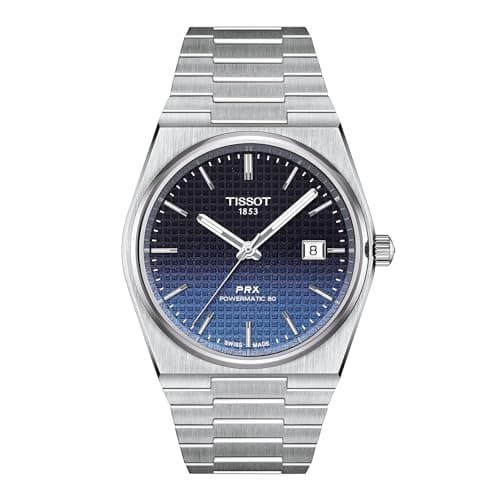
Tissot
Tissot PRX Powermatic 80
Price as of October 21, 2026. Prices change — Amazon's is the one that counts.
#ad · we may earn a commission from this link to Tissot PRX Powermatic 80
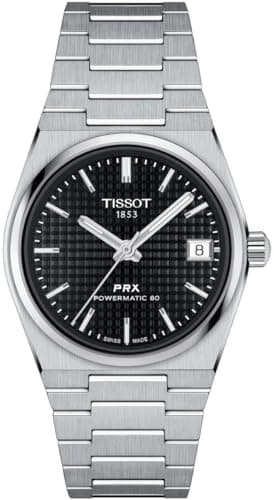
Tissot
Tissot PRX Powermatic 80 35mm
Price as of October 21, 2026. Prices change — Amazon's is the one that counts.
#ad · we may earn a commission from this link to Tissot PRX Powermatic 80 35mm
What is identical
| Spec | PRX 40mm | PRX 35mm |
|---|---|---|
| Movement | Powermatic 80 | Powermatic 80 |
| Power reserve | 80 hours | 80 hours |
| Crystal | Sapphire | Sapphire |
| Water resistance | 100m | 100m |
| Bracelet | Integrated, quick-release | Integrated, quick-release |
| Case diameter | 40mm | 35mm |
One row differs. That is unusual and it is worth stating plainly, because in most lineups the small version is where the specification gets cut.
Why the 35mm is not just for small wrists
The PRX is a design from the 1970s, and 1970s integrated-bracelet watches were small - typically in the mid-30s. The 35mm is the more historically correct proportion, and on the wrist it reads as the more deliberate of the two rather than the more timid.
It is also the version that most obviously escapes the modern default of a large watch. If you have wrists of any size and you want the watch to look designed rather than sized-up, the 35mm is a legitimate first choice - not a fallback.
Why the 40mm is still the default
Because most buyers want a watch that reads as a full-size modern watch, and because the 40mm dial is more legible. The dial furniture is the same design at both sizes; on the 40mm it is simply bigger and easier to read at a glance.
On a wrist above about 7 inches, the 35mm will look small in a way that some people love and others will find distracting after a week. If you are unsure and cannot try one on, the 40mm is the safer purchase.
The integrated bracelet changes how size works
An integrated bracelet flows straight out of the case with no lugs, so the transition from case to bracelet is continuous and the watch has no protruding points to overhang your wrist. This is why integrated-bracelet watches generally wear smaller than their diameter suggests - the effect is real and it applies to both sizes here.
It also means neither version accepts a standard strap. You get Tissot's own quick-release bracelet and Tissot's own straps, and that is the range. If swapping straps is part of what you enjoy about watches, that is an argument against the PRX at any size - the size and fit guide covers how integrated cases bend the usual rules.
Sizing the bracelet
Both arrive on a bracelet that will almost certainly need links removed. It is a simple job with a pin pusher and ten minutes, and doing it yourself saves a trip to a jeweler - how to resize a watch bracelet walks through it. Keep the removed links; you will want them if you ever sell the watch.
Which should you buy?
- Wrist under 6.5 inches → 35mm, comfortably.
- Wrist 6.5 to 7 inches → either genuinely works. Pick on look, not fit.
- Wrist over 7 inches → 40mm, unless you specifically want the small-watch look.
- You want the most historically correct version → 35mm. That is the size the design came from.
- It is your only watch and legibility matters → 40mm.
If you have not yet settled on the PRX at all, its closest rival is covered in PRX vs Citizen Tsuyosa, and the whole category is in the integrated bracelet shortlist.
Questions
FAQ
Is the 35mm Tissot PRX the same movement as the 40mm?
Yes. Both automatic versions use the Swiss Powermatic 80 with an 80-hour power reserve, a sapphire crystal and 100m water resistance. The 35mm is not a de-specified version.
Is the 35mm PRX a women's watch?
Tissot does not market it that way and we would not describe it that way. 35mm is the size 1970s integrated-bracelet watches actually were, and it is a legitimate choice on any wrist that suits it.
Can you put a leather strap on a Tissot PRX?
Only Tissot's own. The bracelet is integrated into the case, so standard straps do not fit - though the quick-release system makes swapping between Tissot's own options easy.
Which PRX size wears bigger than it measures?
Neither, and that is the point of an integrated bracelet. With no protruding lugs the case flows straight into the bracelet, so both versions wear closer to - or slightly smaller than - their stated diameter.
Specs & sources
Specifications on this page are compiled from manufacturer datasheets, official product pages, and published standards. Prices are pulled live from Amazon and date-stamped; nothing is invented.
Keep reading