Buying guide
Khaki Field Auto vs Mechanical
Same case, same 38mm, same 80 hours, same sapphire. One winds itself and swims; the other you wind every morning. That ritual is the entire decision.
Hamilton sells two 38mm Khaki Fields that look almost identical in photographs, cost broadly similar money, and are bought for opposite reasons. Buyers routinely order the wrong one, because the product names differ by a single word and the listings rarely explain what that word does.
Auto means there is a rotor: the watch winds itself as you move. Mechanical means there is not: you wind it by hand, every day, or it stops. Everything below follows from that one difference - including, surprisingly, the water rating.
Disclosure
Some links here are affiliate links — mostly to Amazon. If you buy through one we may earn a small commission, at no extra cost to you. It never changes which watch we pick or the price you pay. Prices are pulled live and date-stamped; where we can't verify one, we show none. Full disclosure.
The contenders
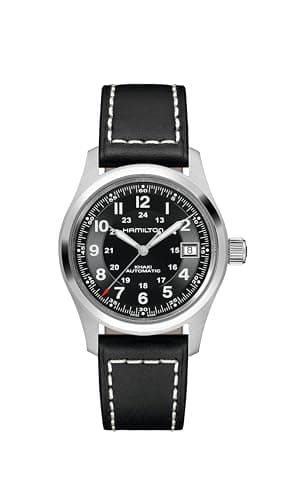
Hamilton
Hamilton Khaki Field Auto 38mm
Price as of October 21, 2026. Prices change — Amazon's is the one that counts.
#ad · we may earn a commission from this link to Hamilton Khaki Field Auto 38mm
Hamilton
Hamilton Khaki Field Mechanical 38mm
We don't have a verified live price for this right now, so we aren't showing one.
#ad · we may earn a commission from this link to Hamilton Khaki Field Mechanical 38mm
Side by side
| Spec | Khaki Field Auto 38mm | Khaki Field Mechanical 38mm |
|---|---|---|
| Caliber | H-10, automatic | H-50, hand-wound |
| Rotor | Yes - self-winding | No |
| Power reserve | 80 hours | 80 hours |
| Crystal | Sapphire | Sapphire |
| Water resistance | 100m | 50m |
| Case | 38mm | 38mm |
| Hacking | Yes | Yes |
Two rows differ. That is genuinely the whole comparison, and it is why this decision comes down to how you want to live with the watch rather than which is the better object.
The rotor, and what it costs
An automatic movement carries a weighted rotor that swings as your arm moves and winds the mainspring for you. A hand-wound movement does not have one. That single component is the reason for every other difference here.
Without a rotor the movement is thinner, which is why the Mechanical is the flatter watch on the wrist and reads as the more elegant of the two under a cuff. It is also the reason the Mechanical shows you a cleaner view through its caseback: there is no oscillating weight covering the gear train.
With a rotor you never think about winding. Wear it, and it runs. On an 80-hour reserve, an automatic Khaki Field survives an entire weekend in a drawer and is still running on Monday - see power reserve explained for why 80 hours changes ownership more than the number suggests.
Why the hand-wound one is only 50m
This is the specification that catches people out, and it is the one real argument against the Mechanical. The Auto is rated to 100m; the Mechanical to 50m.
A hand-wound watch means the crown gets operated every single day, and every operation is a cycle on the crown gasket - the seal that keeps water out. A watch designed around daily crown use is specified more conservatively than one whose crown gets touched twice a month. In practice: the Auto is a swimming watch and the Mechanical is not. Water resistance ratings explained covers what 50m does and does not permit.
The ritual argument
A good number of people buy the Mechanical precisely because it needs winding. Twenty turns of the crown each morning is a thirty-second ritual that connects you to the object in a way an automatic never quite does - and a hand-wound watch is always fully wound, which is when a mechanical movement keeps its most consistent time.
An equal number of people find that charming for three weeks and irritating for the following three years. Be honest with yourself about which you are. The general version of this argument, without the Hamilton specifics, is at automatic vs hand-wound.
What they share, and why both are good
Both use Swiss movements with an 80-hour power reserve - twice what a Japanese 4R36 holds. Both have sapphire crystals. Both are 38mm, which is the size the field watch was designed around and the reason this line remains the reference point for the category. Both hack, so you can set them to the second.
On specification, they sit at the top of the field watch shortlist and among the best Swiss automatics under $1,000.
Which should you buy?
- One watch for everything, including water → Auto. 100m is the difference between a watch you take off at the pool and one you do not.
- You want the thinnest, most elegant version → Mechanical. No rotor, flatter case, cleaner caseback view.
- You like the daily ritual → Mechanical, and you will enjoy it.
- You already own several watches → either, but the Mechanical is the more interesting second or third watch, and the 80-hour reserve means it survives a week off the wrist if you do wind it fully.
- Buying for someone else → Auto, every time. Never gift a watch that stops if the recipient forgets it - the gift list follows the same rule.
Questions
FAQ
What is the difference between the Hamilton Khaki Field Auto and Mechanical?
The Auto uses the H-10, which has a rotor and winds itself from wrist movement, and is rated to 100m. The Mechanical uses the H-50, which is hand-wound with no rotor, and is rated to 50m. Both hold 80 hours, both have sapphire, and both are 38mm.
Do you have to wind the Khaki Field Mechanical every day?
In practice yes, though the 80-hour reserve means it will survive two full days if you wind it all the way. Most owners wind it each morning as a habit, which also keeps the movement running at its most consistent.
Why is the Mechanical only 50m water resistant?
Because the crown is operated every day, and every operation is a wear cycle on the gasket that keeps water out. Hamilton specifies it conservatively as a result. The self-winding Auto, whose crown is barely touched, is rated to 100m.
Which one is thinner?
The Mechanical. A hand-wound movement carries no rotor, so it is a slimmer caliber and produces a flatter watch - the main reason people choose it over the Auto.
Specs & sources
Specifications on this page are compiled from manufacturer datasheets, official product pages, and published standards. Prices are pulled live from Amazon and date-stamped; nothing is invented.
Keep reading