Buying guide
Automatic vs Hand-Wound
Both are mechanical. Both have no battery. The difference is whether the watch depends on your wrist or on you - and that single distinction changes the ownership experience completely.
Every mechanical watch stores energy in a coiled mainspring and releases it through an escapement. The only question is how that spring gets wound. An automatic has a weighted rotor that spins as your arm moves and winds the spring for you. A hand-wound - also called manual, or manual-wind - has no rotor, so you wind it from the crown.
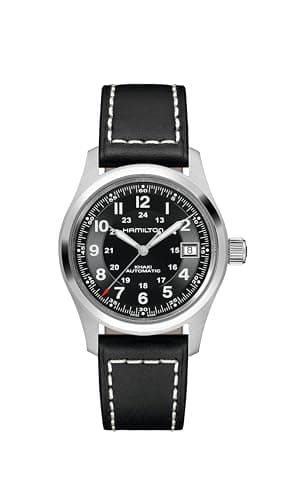
That is the whole technical difference, and it produces two genuinely different ways of owning a watch. We are using Hamilton's two Khaki Field models as the example because they are the cleanest possible comparison: the same case, the same size, the same sapphire crystal, the same 80-hour reserve, and one has a rotor.
Disclosure
Some links here are affiliate links — mostly to Amazon. If you buy through one we may earn a small commission, at no extra cost to you. It never changes which watch we pick or the price you pay. Prices are pulled live and date-stamped; where we can't verify one, we show none. Full disclosure.
The contenders
Hamilton
Hamilton Khaki Field Auto 38mm
Price as of October 21, 2026. Prices change — Amazon's is the one that counts.
#ad · we may earn a commission from this link to Hamilton Khaki Field Auto 38mm
Hamilton
Hamilton Khaki Field Mechanical 38mm
We don't have a verified live price for this right now, so we aren't showing one.
#ad · we may earn a commission from this link to Hamilton Khaki Field Mechanical 38mm
Head-to-head
| Factor | Automatic | Hand-wound |
|---|---|---|
| Winding | From wrist motion, plus the crown | From the crown only |
| Daily routine | None if worn daily | A few seconds of winding |
| After a week off | Reset and shake or wind | Reset and wind |
| Thickness | Thicker - the rotor adds height | Thinner |
| Caseback | Often a display back, rotor visible | Solid, or a clear view of the movement |
| Choice at this price | Very wide | Narrow |
| Winder useful? | Sometimes | Never - a winder cannot wind it |
What the rotor costs you
Height, mainly. A rotor is a semicircular weight that sits on top of the movement and spins on a pivot, and it adds real thickness to the watch. It is one reason almost everything on this site sits between 12mm and 14mm, and why genuinely slim mechanical watches tend to be either hand-wound or expensive.
It also adds parts, and parts eventually need servicing. Neither of these is a strong argument against automatics - the convenience is worth it for most people - but they explain why a manual movement is not simply an inferior version of the same thing.
What hand-winding gives back
- Thinness. No rotor, less height, a watch that slides under a cuff.
- A cleaner view of the movement. On a display-back manual watch you see the gear train and balance rather than a rotor covering two-thirds of it.
- The ritual. This is the honest reason most people buy one. Winding a watch each morning is a deliberate, tactile thirty seconds, and a lot of owners come to like it.
- Simplicity. Fewer moving parts in the winding system.
What automatic gives back
Not thinking about it. Wear the watch daily and it never stops, never needs a routine, and never asks anything of you. For a watch you put on every morning and take off every night, an automatic is simply the better tool.
The catch is the opposite case: an automatic left in a drawer stops just as surely as a manual one, and if you own several watches you will spend time resetting them. That is where a long power reserve earns its keep, and where people start asking about winders - usually the answer is no.
The 80-hour twist
Here is the detail that changes the classic advice. Both Hamilton calibers - the automatic H-10 and the hand-wound H-50 - hold 80 hours. That means the hand-wound watch survives a full weekend untouched, which historically was the manual watch's biggest weakness.
At 80 hours the practical gap between the two narrows to almost nothing for a watch worn a few times a week. If you are choosing between them, you are choosing between a rotor and about 1.5mm of case height - not between convenience and inconvenience. Power reserve explained covers why this figure matters more than most spec-sheet numbers.
How to wind either one correctly
For a hand-wound watch, turn the crown clockwise in its resting position until you feel firm resistance, then stop. Do not force it past that point - the mainspring is fully wound and you risk damage. For an automatic, wind gently in the same way to start it, then let your wrist do the rest; most automatics have a slipping clutch that prevents overwinding, but there is no reason to test it. The step-by-step is in hacking and hand-winding explained, and setting is covered in how to set one.
The verdict
Buy automatic if this is your only mechanical watch, or the one you wear most days. It is the practical choice and it is why almost everything we recommend on the master list is self-winding.
Buy hand-wound if you want the thinnest possible mechanical watch, you like the ritual, or you want the cheapest entry into Swiss mechanical ownership - which is exactly what the Khaki Field Mechanical is. Just go in knowing it will stop if you ignore it.
And if you are still deciding whether to go mechanical at all, automatic vs quartz is the argument that comes first.
Questions
FAQ
What is the difference between automatic and hand-wound watches?
An automatic has a weighted rotor that winds the mainspring from the motion of your wrist. A hand-wound watch has no rotor, so the only way to wind it is from the crown. Both are fully mechanical and neither uses a battery.
Are hand-wound watches thinner than automatics?
Generally yes. The rotor sits on top of the movement and adds height, so removing it lets the watch be slimmer. That is why many genuinely slim mechanical watches are hand-wound.
Can you overwind an automatic watch?
Most automatics have a slipping clutch that prevents it, so hand-winding one is safe. A hand-wound movement has no such protection: wind until you feel firm resistance, then stop and do not force it further.
Does a watch winder work on a hand-wound watch?
No. A winder works by rotating the watch so an automatic's rotor spins. A hand-wound movement has no rotor, so a winder does nothing at all for it.
Specs & sources
Specifications on this page are compiled from manufacturer datasheets, official product pages, and published standards. Prices are pulled live from Amazon and date-stamped; nothing is invented.
Keep reading