Buying guide
Orient Mako II Review
A 200m dive watch with an in-house movement that hacks and hand-winds, for well under $300. The catch is a mineral crystal - and a sibling that fixes it for a little more.
Orient is the quiet answer to a question most first-time buyers ask about Seiko. It has made its own movements for decades, it is now part of the Seiko Epson group, and it consistently prices watches below what their specification sheets suggest. The Mako II is the clearest example: an in-house automatic that hacks and hand-winds, in a genuine 200m dive case, for well under $300.
There is one obvious compromise — the crystal — and one obvious complication, which is that Orient sells a nearly identical watch that fixes it. This review covers both, plus what the Mako is actually like to own. Specification figures come from the published F6922 caliber reference and Orient's movement documentation; scoring is editorial judgment under our method.
Disclosure
Some links here are affiliate links — mostly to Amazon. If you buy through one we may earn a small commission, at no extra cost to you. It never changes which watch we pick or the price you pay. Prices are pulled live and date-stamped; where we can't verify one, we show none. Full disclosure.
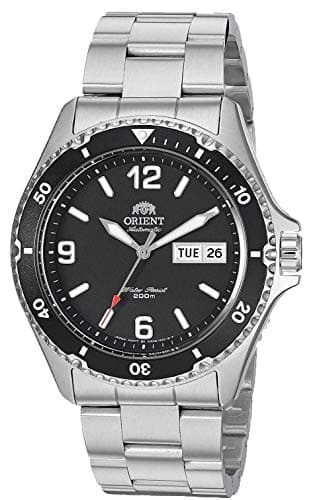
Orient
Orient Mako II
The Kamasu's cheaper sibling: same in-house F6922 and 200m case, but mineral crystal instead of sapphire. A dive-watch bargain if you don't need the sapphire.
Price as of October 21, 2026. Prices change — Amazon's is the one that counts.
#ad · we may earn a commission from this link to Orient Mako II
Specs at a glance
| Movement | Orient F6922, in-house automatic |
|---|---|
| Accuracy (published) | -15 to +25 seconds per day |
| Hacking / hand-winding | Yes / yes |
| Case diameter | 41.5mm |
| Crystal | Mineral |
| Water resistance | 200m, screw-down crown |
| Bezel | Unidirectional dive bezel |
The movement is the story
The F6922 is Orient's own caliber, and it does the two things that matter: it hacks (the seconds hand stops for precise setting) and it hand-winds (you can start a stopped watch with the crown rather than shaking it). At this price that combination is not guaranteed — the Miyota 8215 in an Invicta Pro Diverhand-winds but doesn't hack, and the older Seiko 7S26 in an SNK809 does neither.
Its published accuracy tolerance is −15 to +25 seconds a day, which is noticeably tighter on paper than the −20/+40 quoted for Seiko's 4R and 7S calibers. Don't over-read that: real-world results depend on regulation, position and how you wear it, and a good 4R36 will often beat a mediocre F6922. But it does tell you Orient is confident enough to publish a tighter number.
200m, and what that actually means
The Mako II has a screw-down crown and a 200m rating, which is real dive-watch territory rather than dive styling. In practical terms: swim in it, shower in it, take it in the sea, stop thinking about it. That is a materially different proposition from the 100m Seiko 5 Sports or the 50m dress watches, and it is the main reason a diver is the right first automatic for most people. The ratings guide spells out the thresholds.
The bezel is a unidirectional 120-click dive bezel — it only turns one way, so an accidental knock can only ever make your elapsed time read longer, never shorter. That's a safety design, not a manufacturing limitation.
The mineral crystal, and the Kamasu question
Here is the compromise. The Mako II ships with a mineralcrystal, and Orient's own Kamasu — same F6922, same 200m case architecture, similar size — ships with sapphire for a modest step up in price.
Mineral resists shattering well and scratches noticeably more easily than sapphire. Over a couple of years of daily wear on a watch you deliberately bought to knock about, you will probably see a hairline or two. Whether that's worth the price difference is the entire decision, and we come down on the side of the Kamasu for most buyers — the direct comparison lays out both cases. Buy the Mako if the lower price genuinely matters or if you prefer its dial and bezel; they are not the same watch cosmetically.
Fit and finishing
At 41.5mm the Mako II sits in the middle of the affordable diver range: bigger than a Seiko 5 Sports feels on the wrist but far more manageable than a 45mm Turtle. For most wrists between 6.75 and 7.5 inches it's an easy fit. If you want the smallest Orient diver instead, the AC0Q Diver — the one sold as the Mako 40 — is 39.9mm with a sapphire crystal, at the cost of the day window.
The finishing is where the price shows. The clasp is stamped rather than milled, the bracelet has some rattle, and the end links are not as tightly fitted as a Seiko's. None of that affects how the watch runs, and a $30 strap fixes most of it — a rubber or NATO strap suits the Mako well and takes five minutes to fit with a spring bar tool.
Lume is adequate rather than exceptional. Seiko's LumiBrite is the class leader at this price and the Orient doesn't match it — bright enough to read at night, dimmer after a few hours than a Seiko would be.
Living with it
Worn daily it never stops. Leave it off from Friday and it will have run down by Sunday — Orient's F-series reserve is in the same 40-hour territory as Seiko's 4R family — at which point you wind the crown, reset it and carry on. Because the F6922 hand-winds, that restart takes seconds rather than the thirty-second shake an SNK809 demands. It is a small thing you appreciate every single week. The setting guide covers the screw-down crown sequence, which matters more here than on a 30m dress watch.
Expect the usual affordable-mechanical accuracy behavior: a rate that settles within the published band and shifts a few seconds depending on how the watch is stored overnight. If yours suddenly gains minutes a day rather than seconds, that is almost always magnetism rather than a fault — the troubleshooting guide has the compass test and the fix.
What we'd change
Two things, neither fatal. The clasp is the obvious cost saving — stamped, a little sharp on the underside, and the part of the watch that most gives the price away. And the lume, while perfectly usable, is the one specification where Seiko's equivalent is clearly better rather than arguably better. Neither is a reason to avoid the watch; both are reasons the Mako costs what it costs.
Mako, Ray, or Kamasu?
Orient's naming causes genuine confusion, so plainly: the Mako II and Ray II are the same watch with different dials, hands and bezels — the Ray typically has applied markers and a slightly sportier look. The Kamasu is the newer model that adds a sapphire crystal and a redesigned case. All three run the F6922 and all three are 200m. Pick the Kamasu if you want sapphire; pick between the Mako and Ray on looks alone, because there is no meaningful specification difference.
Who should buy it
Buy the Mako II if you want the cheapest honest route to an in-house automatic that hacks and hand-winds inside a real 200m dive case, and you are not precious about the crystal. It is one of the best value watches we list and a strong first automatic — it leads our under-$300 list for exactly that reason.
Who should skip it
Skip it if a scratched crystal will nag at you — spend the small extra on the Kamasu's sapphire. Skip it if you want the best lume at this price, which is Seiko's. And skip it if you want a slim watch for a cuff: it is a 200m diver and it wears like one.
Questions
FAQ
Is the Orient Mako II a good watch?
Yes — it is one of the best value dive watches available, with Orient's in-house F6922 movement that hacks and hand-winds, a genuine 200m case with a screw-down crown, and a published accuracy tolerance of −15 to +25 seconds a day. The main compromise is a mineral crystal rather than sapphire.
Orient Mako or Orient Kamasu?
The Kamasu, for most buyers. It runs the same in-house F6922 in a similar 200m case but adds a sapphire crystal for a modest price increase. Buy the Mako II if the lower price matters or you simply prefer its dial and bezel design.
What is the difference between the Orient Mako and Ray?
Cosmetics. The Mako II and Ray II share the same F6922 movement, 200m case and mineral crystal; they differ in dial, hands and bezel design. Choose on looks — there is no meaningful specification difference between them.
Specs & sources
Specifications on this page are compiled from manufacturer datasheets, official product pages, and published standards. Prices are pulled live from Amazon and date-stamped; nothing is invented.
Keep reading