Buying guide
Bulova Classic Aerojet 98A187 Review
A 41mm dress automatic with a window cut over the balance wheel, a box crystal and a see-through back. Bulova prints the jewel count on the dial and leaves it off the spec sheet - and that gap is the review.
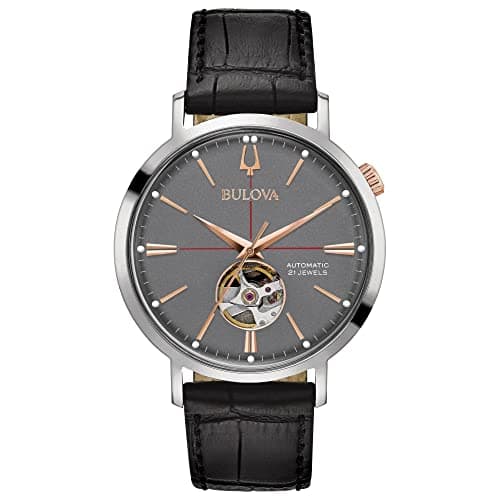
Look at the dial of a Bulova Aerojet 98A187 and it tells you two things about its movement: AUTOMATIC and 21 JEWELS, printed at three o'clock in rose gold. Then open Bulova's own product page for the same reference and neither number is there. You get "automatic heart-beat self-winding movement" and a 40-hour power reserve, and that is the end of the disclosure.
That is a strange way to sell a watch whose whole appeal is that you can see the movement working, and it is what this review spends most of its time on - because everything else about the Aerojet is straightforward. It is the cheaper of the two Bulovas on our open heart and skeleton shortlist, it looks considerably more expensive than it is, and it has one specification most of its rivals skip: a crystal shaped like something from 1962. Below is what Bulova publishes, what the movement almost certainly is, why we still will not print that as a specification, and the one thing to check in the first ten seconds of owning it.
Disclosure
Some links here are affiliate links — mostly to Amazon. If you buy through one we may earn a small commission, at no extra cost to you. It never changes which watch we pick or the price you pay. Prices are pulled live and date-stamped; where we can't verify one, we show none. Full disclosure.
Bulova
Bulova Classic Aerojet 98A187
Bulova's cheaper open-aperture automatic: a 41mm dress case with a box crystal, an exhibition back and a 40-hour reserve. Style-led rather than spec-led, and priced accordingly.
Price as of October 21, 2026. Prices change — Amazon's is the one that counts.
#ad · we may earn a commission from this link to Bulova Classic Aerojet 98A187
Specs at a glance
| Movement | Self-winding automatic, 40-hour power reserve (Bulova publishes no caliber name and no jewel count) |
|---|---|
| Dial | Open-aperture gray dial, rose gold-tone hands and applied markers, red central seconds |
| Case | Stainless steel, 41mm, crown at two o'clock - no thickness or lug-to-lug published |
| Crystal | Double-curved box mineral |
| Caseback | Exhibition (see-through) |
| Water resistance | 30m / splash resistant |
| Strap | Croco-embossed black leather, 20mm lugs, three-piece buckle |
| Warranty | 3-year limited |
Every figure above comes from Bulova's own product page for the 98A187 - except the jewel count, which is printed on the dial and appears nowhere in the published specification.
The caliber Bulova will not name, and what it almost certainly is
Bulova has been owned by Citizen since 2008, and Citizen owns Miyota. The obvious candidate for an open-aperture 21-jewel automatic from that group is the Miyota 82S0, the open-heart branch of the 8215 family - and this is not guesswork on our part. The caliber reference we cite for movements across this site lists Bulova Aerojet among the known models for the 82S0, and an authorized European Bulova retailer prints CALIBRE 82S0 in its specification table for this exact reference number.
Miyota publishes the 82S0 openly, which is more than Bulova does: 21 jewels, 21,600 beats per hour, approximately 42 hours of running time, an accuracy band of -20 to +40 seconds a day, automatic plus hand-winding, with the open balance sitting at seven o'clock relative to a crown at three. On this watch the crown sits at two and the aperture sits low on the dial, which is what that movement looks like rotated in its case. The 82S0 is one branch of a larger family, and the Miyota 8 series explained maps the rest of it.
We are still not printing 82S0 as a specification, for the same reason we did not print Miyota 8N26 in our Bulova Sutton review: Bulova does not confirm it, and a retailer data feed is not a manufacturer datasheet. There is also a small discrepancy worth noticing - Bulova states a 40-hour reserve where Miyota states approximately 42. Close, but not the exact match the Sutton's figures made.
The practical consequence is the same either way: there is no Bulova-published accuracy tolerance to hold this watch to. Treat the -20/+40 figure as background rather than a promise, and measure your own example over a week using the method in automatic watch accuracy. If jewel counts and caliber numbers still read as noise, what the jewels actually do and the movements guide are the two pages that make the rest of this site legible.
The ten-second check: does yours hack?
Here is the practical cost of an unnamed caliber, and it is the most useful thing on this page. The 82S0 exists in two versions. The original does nothack - pull the crown out and the seconds hand keeps sweeping, so you cannot set the watch to the second. Around mid-2019 Miyota added a stop-seconds device, and the caliber's current published specification lists one.
Because Bulova names no caliber, nothing on the box, the listing or the product page tells you which version is in the watch you were sent - and both are still in circulation. So do this when it arrives: pull the crown to its final position and watch the seconds hand. If it stops, you have the later movement. If it keeps running, your watch is not broken - it is the earlier version, behaving exactly as designed. Hand-winding works on both. Hacking and hand-winding explained covers why one of those matters more than the other in daily use.
For contrast, the reason the Orient Bambino Open Heart outranks this watch on our shortlist is that Orient names its open-heart caliber and publishes its specification, which leaves you nothing to check.
The crystal is a box, and it is mineral
Bulova fits a double-curved box mineral crystal, and it is the best-value thing on the watch. A box crystal stands proud of the bezel with a flat top and square shoulders, the way crystals were made before flat sapphire became the default, and it does more for how expensive a watch looks from the side than any amount of case polishing. Nothing else on our open heart shortlist has one.
The catch is the material. Mineral glass is harder than acrylic and much softer than sapphire, so it collects hairlines from door frames and desk edges over a few years - and a proud box shape puts the crystal first in the queue for exactly those knocks. There is a second problem specific to the shape: a double-curved box crystal is a non-standard part, so replacing a scratched one is a service job rather than a five-dollar generic. Sapphire vs mineral vs Hardlex sets out how much that difference is really worth.
If the crystal is the deciding factor, the answer in this category is Bulova's own Sutton 96A330, which fits anti-reflective domed sapphire over a full skeleton dial for more money - the only sub-$500 skeleton we have found that does.
41mm, 20mm lugs, and a crown at two o'clock
Two honest things about the size. First, 41mm is large for a dress watch, and the thin bezel and edge-to-edge dial make it read larger still - this is not a discreet watch under a cuff. Second, Bulova publishes neither a case thickness nor a lug-to-lug, and lug-to-lug is the measurement that decides whether a watch overhangs your wrist. Two European retailer feeds list the case at 12mm thick; no source we found publishes a lug-to-lug, so we are not going to state one. Our sizing guide explains how to measure your own wrist and why diameter on its own misleads.
What does help is the strap fitment. 20mm lugsare the most common size there is, so when the supplied croco-embossed leather wears out - and at this price it will - you can replace it for very little from almost any maker. That is a real advantage over the Bambino Open Heart's awkward 21mm lugs, and changing a strap is a ten-minute job.
The crown sits at two o'clock rather than three, in rose gold to match the hands. It is a styling quote from the mid-century Aerojet, and it has a genuine ergonomic side effect: a crown at two is less likely to press into the back of your hand when you bend your wrist. It also means the watch does not look like everything else in the display case, which is presumably the point.
30m of water resistance - and the listings that claim more
Bulova rates this watch splash resistant, 30 meters. In practice that covers rain, hand-washing and a spilled drink, and nothing beyond that: no swimming, no shower, no washing up with your sleeves rolled back.
Be careful here, because the retailer data feeds are not consistent. At least one European dealer listing for this reference states 5 bar (50m), and another describes the crystal as sapphire - both contradict Bulova's own published specification for the same reference number. When a marketplace listing and the manufacturer disagree, the manufacturer wins, and the manufacturer says 30m and mineral. The water-resistance guide sets out what each rating really permits; if you want one watch you never take off, a 200m diver is the honest answer.
What the aperture actually shows you
This is an open aperture - a small window cut low on an otherwise normal dial, showing the balance wheel swinging back and forth several times a second. It is not a skeleton dial, which is cut away across most of its surface, and it is not the same thing as the see-through back. This watch happens to have both: aperture at the front, exhibition caseback at the rear, so you can watch the escapement while you wear it and the rotor when you take it off.
The legibility cost is small, which is the argument for an aperture over a full skeleton. The hands run over a solid gray dial with applied rose gold markers, so telling the time is never a puzzle - the compromise is confined to one small area. Do not expect usable lume, though: the markers are polished metal rather than luminous blocks, and this watch is unreadable in a dark room. If that matters, the lume rankings are a different shortlist entirely.
What you give up against the alternatives
Against the rest of the open heart shortlist: the Orient Bambino Open Heart gives you a published in-house caliber that hacks and hand-winds, in a case that wears smaller despite measuring 40.5mm, for similar money - the trade is 21mm lugs and a plainer dial. The Bulova Sutton 96A330 gives you sapphire and a full skeleton for more. The Fossil Townsman is cheaper still and publishes even less than Bulova does.
Against the wider market the comparison is brutal, and worth making. For similar money the Seiko 5 Sports gives you a named 4R36 with a published tolerance and 100m of water resistance, and the Orient Kamasu gives you an in-house F6922, sapphire and 200m. Both are more watch by every measurable standard on the under-$300 roundup. Neither lets you see the movement from the dial side, and neither has a box crystal. That is the whole trade the Aerojet asks you to make: you are buying a look, and paying for it in specification rather than in money.
The list price is not the price
Bulova lists this reference at an MSRP nobody actually pays - its own store discounts it, and the street price sits well below even that - which is exactly the crossed-out-list-price trap the Timex Marlin review and our quality checklist warn about. Judge the watch on what it costs today rather than on the size of the discount, and take the live figure in the buy box above rather than any number quoted in prose - ours included. Our affiliate disclosure explains how the links on this page work.
Who should buy it
Buy the Aerojet if you want the cheapest tidy way to own a watch that shows its own movement from both sides, and you care more about how it looks on the wrist than about what is documented on paper. The box crystal, the gray dial and the two o'clock crown do a convincing impression of a far more expensive vintage-styled watch, the 20mm lugs make it cheap to re-strap, and Bulova backs it with a three-year limited warranty.
Skip it if you want a caliber you can look up, an accuracy figure you can hold the watch to, a crystal that survives a decade, or anything more than splashes of water. In those cases buy the Orient Bambino Open Heart for the published movement, the Bulova Sutton for the sapphire, or leave this category entirely and read where the value in this market genuinely peaks.
Side by side with the sapphire-crystal Sutton: Bulova Sutton vs Bulova Aerojet. For the movement family behind both, see the Miyota 9-series guide, which explains what the 8-series calibers in these watches are a tier below.
Questions
FAQ
What movement is in the Bulova Aerojet 98A187?
Bulova publishes only "automatic heart-beat self-winding movement" with a 40-hour power reserve - no caliber name, and no jewel count in the specification, even though the dial itself is printed "Automatic 21 Jewels". The caliber reference we cite lists the Bulova Aerojet among the known models for the Miyota 82S0, and an authorized European retailer prints 82S0 in its specification table for this reference. Miyota publishes the 82S0 at 21 jewels, 21,600 bph, about 42 hours and -20/+40 seconds a day. We report that as a dealer and reference claim rather than a specification, because Bulova does not confirm it - and Bulova's stated 40-hour reserve does not exactly match Miyota's 42.
Does the Bulova Aerojet hack (stop the seconds when you set it)?
It depends which movement is inside, and you cannot tell from the listing. The Miyota 82S0 originally had no stop-seconds device; Miyota added one around mid-2019 and the current published specification lists it. Both versions are still in circulation, and Bulova names no caliber. Pull the crown out fully and watch the seconds hand: if it keeps sweeping you have the earlier movement, and that is not a fault. Hand-winding works either way.
Is the Bulova Aerojet 98A187 a real automatic watch?
Yes. It is self-winding and mechanical: no battery, a sweeping seconds hand, a balance wheel visible through the dial aperture and a rotor visible through the exhibition caseback. Wear it daily and it stays wound; leave it off the wrist and it stops after roughly 40 hours, at which point you wind it by hand and reset the time.
Does the Bulova Aerojet have a sapphire crystal?
No. Bulova specifies a double-curved box mineral crystal. Some retailer listings for this reference describe it as sapphire; they contradict the manufacturer, and the manufacturer specification is what we go by. If sapphire is the requirement in this category, the Bulova Sutton 96A330 is the one that has it.
Can you swim with a Bulova Aerojet?
No. Bulova rates it splash resistant at 30 meters, which covers rain and hand-washing. We treat 30m as splashes only and reserve swimming for 100m and above, whatever a marketplace listing claims.
Bulova Aerojet or Bulova Sutton - which should I buy?
Sutton if you want the crystal to last and you like a full skeleton dial: it is 40mm with anti-reflective domed sapphire, and it costs more. Aerojet if you want a conventional dress watch with a small window in it, a box crystal and a lower price. Neither has a caliber Bulova will name, so on that measure they are equally undocumented - and the Orient Bambino Open Heart beats both if a published movement matters more to you than a crystal.
Is an open aperture the same as a skeleton dial?
No. An open aperture is a small window cut into an otherwise normal dial over the balance wheel, so the watch stays easy to read - that is what this Bulova has. A skeleton dial is cut away across most of its surface, which shows more and reads worse. An exhibition caseback is a window in the back and is a separate feature again. The differences are set out on the open heart shortlist.
Specs & sources
Specifications on this page are compiled from manufacturer datasheets, official product pages, and published standards. Prices are pulled live from Amazon and date-stamped; nothing is invented.
- Bulova Classic Aerojet 98A187 (official) ↗
- Bulova Aerojet 98A187 authorized-retailer specification (calibre 82S0, 21 jewels, 12mm case) ↗
- Miyota 82S0 open-heart caliber (official) ↗
- Miyota caliber 82S0 reference (hacking added mid-2019; Bulova Aerojet listed among known models) ↗
- ISO 22810 / water-resistance meaning ↗
Keep reading