Buying guide
Fossil Townsman Automatic Review
A genuine mechanical watch from a fashion brand, at a price that undercuts most of the specialists. It earns its place on our lists - with two caveats we will not bury.
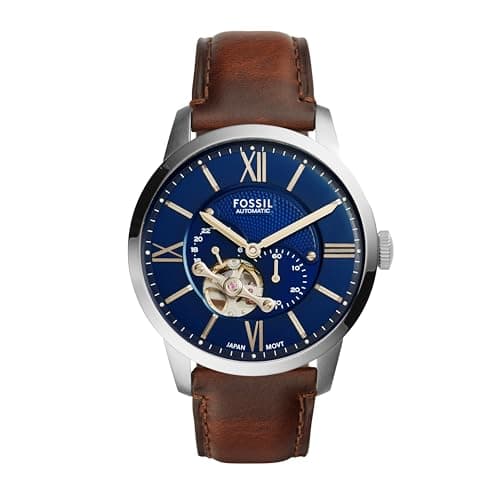
Fossil is a fashion brand, and enthusiasts reflexively dismiss it. That reflex is mostly right and occasionally wrong, and the Townsman Automatic is where it is wrong. This is a genuine self-winding mechanical watch with an open-heart dial that shows the balance wheel oscillating, sold for roughly the price of two Casio Duros.
We list it because it is the cheapest way we know to buy a watch where you can actually watch the mechanism work, and because pretending it does not exist would make the under-$200 list less useful. What follows is what it is, what it is not, and what Fossil declines to tell you.
Disclosure
Some links here are affiliate links — mostly to Amazon. If you buy through one we may earn a small commission, at no extra cost to you. It never changes which watch we pick or the price you pay. Prices are pulled live and date-stamped; where we can't verify one, we show none. Full disclosure.
Fossil
Fossil Townsman Automatic
A budget skeleton-dial automatic with an exhibition caseback. Style-led rather than spec-led, but a cheap way to get moving parts on your wrist.
$160.0713% off
Price as of October 21, 2026. Prices change — Amazon's is the one that counts.
#ad · we may earn a commission from this link to Fossil Townsman Automatic
Specs at a glance
| Movement | Japanese automatic - Fossil does not publish the caliber |
|---|---|
| Dial | Skeleton / open-heart aperture showing the balance |
| Case | Stainless steel, approximately 44mm |
| Crystal | Mineral |
| Water resistance | Approximately 50m |
| Caseback | Exhibition |
Caveat one: the undisclosed caliber
Fossil states that the Townsman Automatic is a Japanese automatic movement and does not publish a caliber number. Open-heart watches at this price are typically built on the Miyota 82-series, which is the skeletonized branch of the 8215 family, but Fossil does not say so, so neither will we. We do not print a caliber we cannot cite.
What that costs you in practice is a published accuracy tolerance, a stated power reserve and a documented service interval. Every watch on the Japanese picks list from Seiko, Orient and Citizen gives you all three. If you like knowing what is inside your watch, that is a real argument for spending more - and the movements guide explains why the caliber number is the most useful number on a spec sheet.
Caveat two: 44mm and 50m
The case is around 44mm, which is large by current taste and larger still on a dressier watch like this. And the water resistance is roughly 50m, which in real terms means rain, hand-washing and an accidental dunk - not swimming, and definitely not the shower. If you want a watch you never have to think about near water, this is not it; that is what a 200m diver is for.
What it genuinely does well
- It is really mechanical. No battery, no quartz tick. The seconds hand sweeps, the balance visibly oscillates through the dial aperture, and it winds itself from your wrist. For a lot of people that is the entire point of the hobby, and this is the cheapest ticket to it we are willing to recommend.
- The open heart earns its keep. Most cheap skeleton dials are printed decoration. This one is a real aperture over a real escapement, and it is genuinely interesting to look at - see how automatic watches work for what you are actually watching, and the open-heart shortlist for where this watch ranks against the rest of the category.
- The exhibition caseback. You get the rotor view as well as the dial view, which is unusual at the price - the display-back shortlist collects everything else we list that has one.
- It is priced honestly. Around $140 buys a mechanical watch. Nobody is pretending it is a Grand Seiko.
What you give up against Seiko or Orient
A published caliber, a stated accuracy tolerance, a real water rating and a movement with a documented service path. For roughly $100 more, an Orient Ray II gives you an in-house F6922 specified to -15/+25 seconds a day, 200m of water resistance and a screw-down crown. That is a substantially better watch by every measurable standard.
The Townsman's answer is that it costs less and shows you its balance wheel. That is a legitimate answer for a first mechanical watch, or a second one bought for the look.
If it is specifically the see-through dial you want and you would rather it still looked good in five years, the step up inside this category is the Bulova Sutton 96A330: a 40mm skeleton with an anti-reflective sapphire crystal instead of mineral. It costs roughly twice as much and Bulova is no more forthcoming about its caliber than Fossil is.
Who should buy it
Buy the Townsman if you want a real automatic for the least money, you like open-heart dials, you have the wrist for 44mm and you are not going swimming in it. As a gift it is hard to get wrong, which is why it sits on the gift list.
Skip it if you want documented specifications, water resistance you can trust, or the best movement your money can buy - in which case go straight to the under-$300 roundup, where the value curve in this market genuinely peaks.
Questions
FAQ
Is the Fossil Townsman a real automatic watch?
Yes. It is a genuine self-winding mechanical watch - no battery, sweeping seconds hand, and a visible balance wheel through the dial aperture. It winds from the motion of your wrist like any automatic.
What movement is in the Fossil Townsman Automatic?
Fossil describes it as a Japanese automatic and does not publish a caliber number. We will not print one we cannot cite. The practical consequence is that there is no published accuracy specification or power reserve figure for it, unlike a Seiko or Orient.
Can you swim with a Fossil Townsman?
No. At roughly 50m it covers rain, hand-washing and an accidental splash. We treat 50m as a rain-and-splashes rating and reserve swimming for 100m and above - the reasoning is in water resistance explained.
Is the Fossil Townsman worth it over a Seiko or Orient?
Only on price and looks. For about $100 more an Orient Ray II gives you a documented in-house movement, 200m water resistance and a screw-down crown. Buy the Fossil because you want an open-heart dial cheaply, not because you expect it to out-spec the specialists.
Specs & sources
Specifications on this page are compiled from manufacturer datasheets, official product pages, and published standards. Prices are pulled live from Amazon and date-stamped; nothing is invented.
Keep reading