Buying guide
Timex Marlin Automatic Review
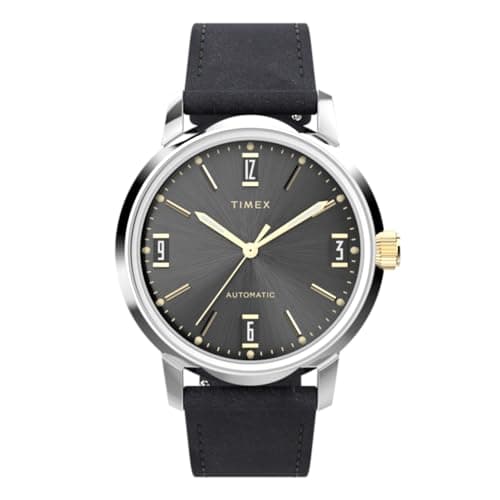
A 40mm mid-century case, a domed acrylic crystal and a window onto a self-winding movement — for the price of a Seiko 5. It loses every spec argument on this site, and it is still worth buying.
Almost every watch on this site earns its place with a number: sapphire instead of mineral, 200m instead of 50m, a published accuracy tolerance you can hold the manufacturer to. The Timex Marlin Automatic loses all of those arguments, and it is still one of the more interesting things you can buy for around $250.
What it has instead is a 1960s Timex dress case redrawn at 40mm, a domed acrylic crystal that distorts the dial at the edges the way vintage watches do, and an exhibition casebackat a price where most brands give you a stamped steel disc. Specifications below come from Timex's published product data; scoring follows our method, which is why this watch scores where it does and why we are recommending it anyway.
Disclosure
Some links here are affiliate links — mostly to Amazon. If you buy through one we may earn a small commission, at no extra cost to you. It never changes which watch we pick or the price you pay. Prices are pulled live and date-stamped; where we can't verify one, we show none. Full disclosure.
Timex
Timex Marlin Automatic
A genuinely charming American-heritage automatic: a 40mm mid-century case, domed crystal and exhibition caseback. Style over spec — and that's the point.
Price as of October 21, 2026. Prices change — Amazon's is the one that counts.
#ad · we may earn a commission from this link to Timex Marlin Automatic
Specs at a glance
| Movement | Mechanical automatic, 21 jewels (caliber not published by Timex) |
|---|---|
| Power reserve | Approximately 40 hours |
| Case | Stainless steel, 40mm wide, 13mm high, polished |
| Caseback | Exhibition — the movement is visible |
| Crystal | Domed acrylic |
| Water resistance | 50m |
| Strap | Leather with buckle, 20mm lug width |
The thing Timex won't tell you
Timex publishes "21-jewel mechanical automatic" and a roughly 40-hour power reserve. It does not publish the caliber, and it does not publish a daily accuracy tolerance. Every other automatic we cover states both: Seiko specifies the 4R36 at −35/+45 seconds a day, Orient specifies the F6922 at −15/+25.
That absence is a genuine buying consideration and we are not going to gloss it. It means you have no published figure to hold Timex to if your watch runs badly, and no way to know before you buy whether you are getting a good example or a poor one. It also means we can't score its movement against the field on equal terms — so we score it low, which is the honest treatment of missing data rather than a guess about the hardware. If a stated, checkable accuracy spec is something you care about, buy a Seiko 5 instead and the decision is made.
Acrylic is a feature here, not a corner cut
The crystal will divide people, so here is the case for it. Acrylic scratches easily — far more easily than mineral glass and not remotely comparably to sapphire. It also polishes out. A scratch in an acrylic crystal comes out in about two minutes with a tube of plastic polish and a cloth, which is not true of any other crystal material: a scratched sapphire crystal is a replacement job.
And acrylic is the only material that domes cheaply, which is the entire visual point of this watch. The distortion at the edge of the dial, the way the numerals stretch as you tilt your wrist — that is the mid-century effect Timex is selling, and a flat sapphire crystal would erase it. On a $250 dress watch this is the right choice. On a $250 dive watch it would be the wrong one.
50m is a dress-watch rating, and that's the correct rating
Fifty meters means rain, hand-washing and an accidental splash. It does not mean swimming, and it certainly doesn't mean the pool or the sea. That is the right specification for a leather-strapped dress watch you wear under a cuff — the leather would object to swimming long before the case did — but it does mean this cannot be your only watch if you are in water regularly. The full ratings guide spells out where each number stops.
Fit: 40mm that actually wears like 40mm
At 40mm wide and 13mm high with 20mm lugs, the Marlin is a genuinely middle-sized watch. The 13mm height is the number worth pausing on — that is not thin for a dress watch, and it is thicker than the Orient Bambino. In practice the domed crystal accounts for a good part of it and the case itself sits reasonably flat, but if you want something that slides under a shirt cuff without catching, this is not the thinnest option on the site.
The 20mm lug width is a practical bonus: it is the most common strap size there is, so the watch is trivially cheap to re-strap. Swapping the stock leather for a brown suede or a grosgrain changes its character more than any other $20 you can spend on it — the strap guidehas the five-minute method. If you don't know your size, the sizing guide covers the lug-to-lug math.
The exhibition caseback at this price
Being able to see the rotor spin is the cheapest way a watchmaker can show you what your money bought, and it is unusual at this price point on a dress watch. Seiko fits display backs to the 5 Sports and Presage lines, but plenty of watches in the $200–$400 band do not — the Hamilton Khaki Field Auto, for example, is solid-backed. If watching the movement is part of why you want an automatic, that's a real point in the Marlin's favor, and the display-back shortlist collects the rest.
Where the Bambino beats it
The obvious cross-shop, and the honest answer is that on paper the Orient Bambino wins. It has an in-house F6922 with a published tolerance, it hacks and hand-winds, and it typically costs slightly less. If you are building a spreadsheet, buy the Bambino and stop reading.
What the Marlin has that the Bambino doesn't is a specific, unrepeatable look. The Bambino is a well-executed generic dress watch; the Marlin is a reissue of something Timex actually made, with the small-case proportions and the sharp lugs and the printed logo to match. If that look is what you want, no amount of spec advantage makes the Bambino the same watch. This is one of the few places on this site where we will tell you to buy the lower score.
What it costs to own
Realistically, nothing until it stops. A movement overhaul on a watch in this price band costs a meaningful fraction of the watch — often more than half — so the sane approach is to wear it, and replace or repair only if it actually fails. The service-cost guide has the numbers and the reasoning. The one running cost that is worth it: a strap every couple of years, because leather is the part that wears out first and it is the cheapest thing on the watch.
Who should buy it
Buy the Marlin if you want a mechanical watch that looks like something rather than like a spec sheet — a specific 1960s American dress watch, at 40mm, with a domed crystal and a visible movement, for around the price of an entry Seiko. Buy it as a second or third watch, or as a dressy counterweight to a diver. It is also one of the easier watches on this site to buy as a gift, because the appeal is immediate and visual rather than something the recipient has to already understand.
Who should skip it
Skip it if this is your only watch and you swim, shower in it or work outdoors — 50m and an acrylic crystal are the wrong tools. Skip it if you need a published accuracy figure, because Timex doesn't give you one. Skip it if you want sapphire, if 13mm of case height is more than you want on a dress watch, or if you would rather have the objectively better movement, in which case the Bambino is right there. And skip it if you are buying your first automatic and want maximum capability per dollar — the beginner list is a better starting point.
The Marlin's two closest rivals at this money are both Japanese, and both publish more than Timex does. Timex vs Seiko vs Orient puts all three side by side on caliber, published accuracy, crystal and whether the movement hacks.
Questions
FAQ
What movement is in the Timex Marlin Automatic?
Timex publishes only that it is a 21-jewel mechanical automatic with roughly a 40-hour power reserve. It does not name the caliber and does not publish a daily accuracy tolerance, which is unusual — Seiko, Orient, Citizen, Tissot and Hamilton all publish both. Treat the missing figure as a known unknown rather than assuming the worst or the best.
Is an acrylic crystal a problem on the Timex Marlin?
It scratches much more easily than mineral or sapphire, but scratches polish out in a couple of minutes with plastic polish — which is not true of sapphire. Acrylic is also the only material that domes affordably, and the domed profile is the whole visual point of the watch. It is the right choice on this watch and would be the wrong one on a diver.
Can you swim with a Timex Marlin Automatic?
No. It is rated 50m, which covers rain, hand-washing and splashes but not swimming, and it ships on a leather strap that would not survive it anyway. If you want one watch that handles water, buy a 200m diver such as the Orient Kamasu or Seiko Prospex Turtle instead.
Timex Marlin or Orient Bambino?
On specification, the Bambino: an in-house movement with a published tolerance that hacks and hand-winds, usually for slightly less money. On design, the Marlin, which is a reissue of a real 1960s Timex rather than a generic dress watch, with a domed acrylic crystal and an exhibition caseback. Buy the Bambino if you are comparing numbers and the Marlin if you have already fallen for the look.
Specs & sources
Specifications on this page are compiled from manufacturer datasheets, official product pages, and published standards. Prices are pulled live from Amazon and date-stamped; nothing is invented.
Keep reading