Buying guide
Bulova Sutton Automatic Review
A full skeleton dial under a sapphire crystal for the price of a mid-range Seiko. The crystal is the reason to buy it; the unnamed movement is the reason to think first.
Skeleton dials are the cheapest thing in watchmaking to fake and one of the more expensive things to do properly. Under $500 the category is mostly quartz watches with a decorative cut-out, or mechanical watches from brands that will not tell you what is inside them. The Bulova Sutton 96A330 is neither of those things, quite: it is a genuine self-winding mechanical watch with a fully open dial, and - unusually for anything at this price - an anti-reflective domed sapphire crystal.
That one specification is why it ranks where it does on our open heart and skeleton shortlist. What follows is everything Bulova actually publishes about this watch, the one important thing it does not, and the honest case for and against buying it.
Disclosure
Some links here are affiliate links — mostly to Amazon. If you buy through one we may earn a small commission, at no extra cost to you. It never changes which watch we pick or the price you pay. Prices are pulled live and date-stamped; where we can't verify one, we show none. Full disclosure.
Bulova
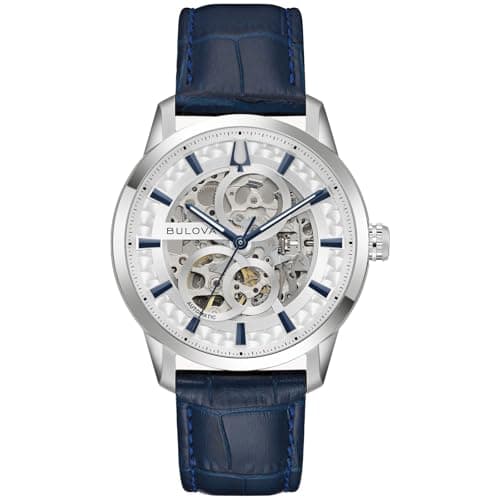
Bulova Sutton Automatic 96A330 40mm
The only genuinely skeletonized dial we can find under $500 with a sapphire crystal — a 40mm 21-jewel automatic with a 42-hour reserve. Bulova names no caliber, and that is the trade.
$625.0045% off
Price as of October 21, 2026. Prices change — Amazon's is the one that counts.
#ad · we may earn a commission from this link to Bulova Sutton Automatic 96A330 40mm
Specs at a glance
| Movement | 21-jewel skeletonized automatic, 42-hour power reserve (Bulova publishes no caliber name) |
|---|---|
| Dial | Multilayered open skeleton, applied blue indices and hands with luminescent fill |
| Case | Stainless steel, 40mm - no thickness published |
| Crystal | Anti-reflective domed sapphire |
| Water resistance | 30m / splash resistant |
| Strap | Blue alligator-embossed leather, 20mm lugs |
| Warranty | 3-year limited |
The sapphire is the whole argument
Buy this watch for the crystal. A skeleton dial is a display case for a movement, and a display case that hazes over defeats itself - which is exactly what happens to the mineral glass fitted to almost everything else in this category, including the Fossil Townsman and Bulova's own cheaper Classic Aerojet 98A187. For the cross-brand version of that decision, Bulova vs Orientputs this sapphire crystal against Orient's named in-house calibers and published fit figures. Sapphire does not pick up the hairline scratches that a door frame, a desk edge or a gym bar leave on softer crystals.
Bulova specifies it as anti-reflective domed sapphire, which is two useful things at once: the dome gives the watch a slightly vintage silhouette from the side, and the coating cuts the mirror effect that makes a busy skeleton dial hard to read in bright light. Why that material gap matters more than the price gap suggests is set out in sapphire vs mineral vs Hardlex.
For context on how rare this is: the ranked picks on our sapphire shortlist are Orient, Citizen, Tissot and Hamilton. No Seiko under $500 gives you sapphire, and no other skeleton dial we could find under $500 does either.
The movement: what Bulova publishes, and what it will not
Bulova states two numbers and stops: 21 jewels and a 42-hour power reserve. There is no caliber name on the product page, no daily accuracy tolerance, and no statement about whether the movement hacks or hand-winds. For a site that treats the caliber number as the most useful line on a spec sheet, that is a real mark against it - the reasoning is in the movements guide, and what the jewel count actually means is worth two minutes if 21 sounds like a specification rather than a bearing count.
Here is what can be said honestly. Bulova has been owned by Citizen since 2008, and Citizen owns Miyota, whose 8N series is the skeletonized branch of the 8-series family. Authorized Bulova dealers list this reference as running the Miyota 8N26, and the published figures for that family - 21 jewels, a 42-hour reserve, 21,600 beats per hour - match Bulova's own two numbers exactly.
We are still not going to print it as a specification, because Bulova does not confirm itand a dealer listing is not a manufacturer datasheet. The practical consequence for you is the same either way: there is no Bulova-published accuracy tolerance to hold the watch to. If it is an 8N, Miyota's stated tolerance for the family is roughly -20 to +40 seconds a day, which is ordinary for the price - but treat that as background, not as a promise. Measure your own example over a week using the method in automatic watch accuracy.
Living with a skeleton dial
The honest cost of an open dial is legibility, and anyone telling you otherwise has not worn one. There is no solid background behind the hands, so in low light or against a busy backdrop you will occasionally read the time twice. Bulova has done what can be done about it - the indices are applied rather than printed, and both they and the hands carry a luminescent fill, so there is some contrast at the edges rather than a flat printed pattern.
Do not expect dive-watch lume. This is decorative fill on slim applied markers, not the thick blocks of LumiBrite that put Seiko at the top of the lume rankings. It will glow briefly after strong light and be gone well before morning.
What you get in exchange is the thing you actually bought: the escapement, the balance wheel and the gear train visible while the watch is on your wrist, plus a stainless steel exhibition caseback on the reverse so you can watch the rotor swing as well. That is the same appeal set out on the display-back shortlist, delivered from both sides at once.
Size and fit: 40mm, and why that matters here
The Sutton line has been a 43mm watch for most of its life. This reference is 40mm on 20mm lugs, which is the difference between a watch that fits the average wrist and one that does not - and 20mm is the easiest strap size in the world to replace when the supplied leather wears out.
Two caveats. Bulova publishes neither a case thickness nor a lug-to-lug measurement for this reference, and lug-to-lug is the number that actually decides fit - our sizing guide explains how to measure your own wrist and why diameter alone misleads. And a skeleton dial reads larger than a solid one, because your eye follows the openwork to the edge of the case.
30m of water resistance, and what that rules out
Bulova rates it splash resistant - 30 meters. In practice that is rain, a spilled drink and hand-washing, and nothing more. Not swimming, not the shower, not the washing-up bowl with your sleeves rolled up.
That is normal for a dress-leaning watch and it is not a defect, but it does decide what this watch can be: a second watch, or a first watch for someone whose life is dry. If you want one watch for everything, a 200m diver is the honest answer, and the water-resistance guide sets out what each rating really permits.
What you give up against Seiko or Orient
At this money the specialists will sell you a documented movement. The Seiko 5 Sports gives you a named 4R36 that hacks and hand-winds, a published tolerance and 100m of water resistance. The Orient Kamasu gives you an in-house F6922 specified to -15/+25 seconds a day, 200m and a sapphire crystal of its own. Both are more watch by every measurable standard.
Neither of them shows you the movement through the dial. That is the entire trade the Sutton asks you to make, and it is a narrower question than it looks: you are choosing a dial style, and paying for it in movement documentation and water resistance rather than in money.
Who should buy it
Buy the Sutton if you want the skeleton look and you want it to still look good in five years. It is the only watch we have found under $500 that pairs an openworked mechanical dial with a sapphire crystal, and at 40mm on 20mm lugs it is the most wearable watch in that category. It is also a straightforward gift - a recognizable brand, a three-year warranty and a dial that explains itself.
Skip it if you need a published caliber and accuracy figure, if you want to swim in your watch, or if you read the time in a hurry all day. In those cases the under-$300 roundup is where the value in this market genuinely peaks, and the open heart shortlist has the Orient alternative that trades the sapphire back for a documented in-house movement.
The direct comparison with its cheaper sibling is Bulova Sutton vs Bulova Aerojet, and the Miyota 9-series guide covers the premium movement tier that watches like this one never quite reach.
Questions
FAQ
What movement is in the Bulova Sutton Automatic?
Bulova publishes only that it is a 21-jewel skeletonized automatic with a 42-hour power reserve - no caliber name and no accuracy tolerance. Authorized dealers list it as a Miyota 8N26, the skeletonized branch of Miyota's 8-series, and that family's published figures match Bulova's two numbers. We report that as a dealer claim rather than a specification, because Bulova itself does not confirm it.
Does the Bulova Sutton have a sapphire crystal?
Yes - Bulova specifies an anti-reflective domed sapphire crystal on the 96A330. That is unusual under $500 and it is the main reason we recommend this reference over the cheaper mineral-crystal skeletons, including Bulova's own Aerojet.
Can you swim with a Bulova Sutton?
No. Bulova rates it splash resistant, 30 meters, which covers rain and hand-washing. We treat 30m as splashes only and reserve swimming for 100m and above.
Is Bulova a good watch brand?
It is a long-established American brand, owned by Citizen since 2008, and its automatics are genuine mechanical watches rather than fashion-brand quartz. The fair criticism is disclosure: Bulova does not publish caliber numbers or accuracy tolerances the way Seiko, Orient and Citizen do for their own movements, which is why no Bulova appears on our brand ranking.
Is the 40mm Sutton better than the 43mm version?
For fit, almost always yes - 43mm is a lot of watch for a dress-leaning skeleton, and the 40mm sits on far more wrists. Check the specific reference before you buy, though: the Sutton line spans several dials, straps and crystals, and not every version gets the sapphire.
Is the Bulova Sutton a real automatic watch?
Yes. It is self-winding: no battery, a sweeping seconds hand, and a visible balance wheel and gear train through the open dial. The exhibition caseback shows the rotor turning as you move.
Specs & sources
Specifications on this page are compiled from manufacturer datasheets, official product pages, and published standards. Prices are pulled live from Amazon and date-stamped; nothing is invented.
Keep reading