Buying guide
Seiko Presage SSA425 Review
Every open-heart watch we rank under $500 hides its movement behind an unnamed caliber. Seiko documents this one down to the jewel count and the setting procedure. It also leaves out the date - and Seiko says so in writing.
The awkward truth about affordable open-heart watches is that almost nobody who builds one will tell you what is inside it. Our open-heart shortlist under $500 ranks the Orients first for exactly that reason: they are the only picks whose maker publishes a caliber name. Bulova states a jewel count and stops. Fossil states nothing at all. You are buying a window onto a movement whose identity is a secret.
The Seiko Presage Style60's SSA425 is the answer to that complaint, and it costs what the answer costs. Seiko names the caliber - the 4R39 - publishes its jewel count, beat rate, power reserve and daily rate in an official instruction manual, and prints a setting procedure for it. Then it leaves the date out of the watch entirely, keeps the crystal Hardlex, and asks just under $600 at its own store. Everything below is traced to Seiko's own specification and manual, or to the caliber references, and scored by our method.
Disclosure
Some links here are affiliate links — mostly to Amazon. If you buy through one we may earn a small commission, at no extra cost to you. It never changes which watch we pick or the price you pay. Prices are pulled live and date-stamped; where we can't verify one, we show none. Full disclosure.
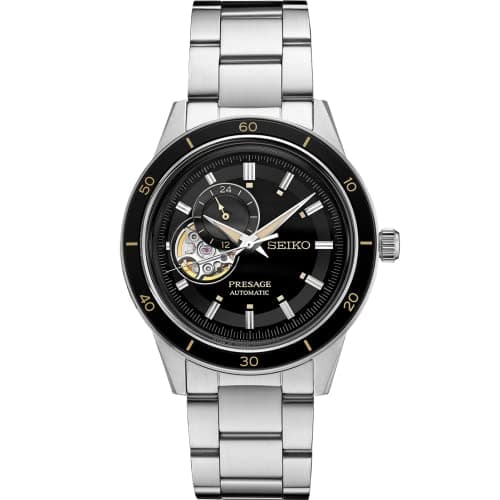
Seiko
Seiko Presage Style60's SSA425
The only open-heart automatic in this class whose maker names the caliber, publishes its rate and documents how to set it — the 24-jewel 4R39. What it does not give you is a date, or sapphire.
Price as of Sep 29, 2026. Prices change — Amazon's is the one that counts.
#ad · we may earn a commission from this link to Seiko Presage Style60's SSA425
Specs at a glance
| Reference | Seiko Presage Style60's SSA425 (SSA425J1) |
|---|---|
| Movement | Seiko 4R39, automatic with manual winding, hacking |
| Jewels / beat | 24 jewels, 21,600 vibrations/hour |
| Power reserve | Approximately 41 hours |
| Stated rate | +45 to -35 sec/day, worn, 5°C to 35°C |
| Complications | Hours, minutes, seconds, 24-hour hand. No date. |
| Case | Stainless steel, 40.8mm diameter, 12.8mm thick |
| Lug to lug / width | 47mm (Seiko USA) / 20mm |
| Crystal | Box-shaped Hardlex |
| Water resistance | 50m (5 bar) |
| Dial | Black open aperture at 9:00, 24-hour subdial at 10:30, beige LumiBrite |
| Caseback | Screw-down see-through |
| Bracelet | Stainless steel, tri-fold push-button clasp |
The documentation is the product
It sounds like a weak thing to buy. It is not. When a maker will not name a caliber you cannot look up its tolerance, you cannot find out whether it hacks before the parcel arrives, you cannot price a service, and you cannot buy the right replacement part in eight years' time. That is the standing complaint we make against the Bulova Sutton, the Bulova Aerojet and the Fossil Townsman, and it is the whole reason the category's cheap end feels like a gamble.
Seiko closes all of it. Its published instruction manual for the 4R family lists the 4R39 alongside the 4R35, 4R36, 4R37, 4R38, 4R71 and 4R72, and states one specification block for the group: 21,600 vibrations/hour, an automatic winding type with manual winding mechanism, a reserve of approximately 41 hours, and a daily rate of +45 to -35 seconds at a normal temperature range of 5°C to 35°C. The same document puts the 4R38 and 4R39 at 24 jewels where the 4R35, 4R36 and 4R37 get 23. Seiko's own setting page for the 4R39 then confirms the thing people most want to know about a mechanical watch: pull the crown to the first click and the seconds hand stops on the spot. It hacks. It also hand-winds.
That rate figure deserves reading carefully, because it is not a bench number. Seiko's condition is a watch worn on the wrist in that temperature band, and the manual adds that actual rates vary with how long you wear it, temperature, arm movement and how wound the mainspring is. Our NH-series guide untangles why the unbranded NH39 version of this same movement is advertised at a tighter -20/+40 without a single part being different, and the accuracy guide shows how to measure your own over a week rather than a morning.
There is no date, and that is the decision
This is the fact that should decide whether you buy this watch, and it is stated plainly in Seiko's own manual. The features column for the 4R39 reads: "3 hands (hour, minute, second), 24-hour hand". No date. No day. No calendar of any kind. Seiko's product page for the SSA425 does not mention a date either - not as an omission to apologize for, simply as something the watch does not have.
So the honest framing is this: at just under $600 you are getting fewer complications than a Seiko 5 Sports costing a fraction of it. The 5 Sports runs the 4R36 and gives you a day and a date. The Presage Cocktail Time, which is dressier still and meaningfully cheaper, runs the 4R35 and gives you a date. Move up to this watch and the calendar goes away.
Plenty of people will call that a feature. A dial without a date window is cleaner and symmetrical, and if you have ever owned an automatic you left in a drawer for a week you know that resetting a date is the tax you pay for owning one. If you never look at the date, this is the watch that stops charging you for it. But it is a real subtraction, and you should make the choice deliberately rather than discover it on day two. Our day-date roundup is the page to read if the answer is that you do use it.
More jewels, fewer functions - inside one collection
The Style60's collection makes this unusually easy to see, because Seiko sells the same case with two different calibers. The time-and-date models run the 4R35. The open-heart models, this one among them, run the 4R39.
| Spec | SSA425 (open heart) | Style60's time-and-date |
|---|---|---|
| Caliber | 4R39 | 4R35 |
| Jewels | 24 | 23 |
| Calendar | None | Date |
| Extra hand | 24-hour, geared to the hour hand | None |
| Beat / reserve | 21,600 vph, ~41h | 21,600 vph, ~41h |
| Stated rate | +45 / -35 sec/day | +45 / -35 sec/day |
| Case thickness | 12.8mm | 12mm (at launch) |
| Launch price | Higher of the two | Lower of the two |
Read the jewel row and then ignore it. The open heart costs more, carries one more jewel and does less - because a jewel is a low-friction bearing placed where the gear train needs one, not a quality score. The 4R39 has an extra pinion to support and no calendar works to drive, so the count lands at 24. If the number has ever looked like a ladder to you, the jewels guide is the two minutes that fixes it. What the extra money genuinely buys here is the aperture, the extra hand and the finishing - not a better engine.
The 24-hour hand is not a second time zone
The SSA425's subdial at 10:30 looks like a complication and gets described like one. It is not. Seiko's own setting instructions for the 4R39 say it outright: the hour hand and the 24-hour hand move in conjunction, and you are told to use the 24-hour hand to check whether you have set AM or PM correctly. There is no crown position that moves it on its own. It is a day/night indicator for the time the watch is already telling you.
That is worth being blunt about because the site has met this exact trap twice. The NH37 - the unbranded twin of the 4R37 - has the same 24-hour read-out and the same absence of an independent setting position. The watch that does give you a real second time zone is the Seiko 5 Sports GMT, which runs the 4R34 and which leads our GMT shortlist - and even that one is a caller GMT, not a flyer. If a second zone is the reason you are here, this is the wrong watch and the cheaper one is the right one.
There is a second, purely visual consequence. The caliber puts the balance wheel aperture at 9:00 and the 24-hour subdial at 10:30, close enough that the caliber references describe the 24-hour hand as sweeping over the open heart. The watch's two signature features share the same corner of the dial, so the left side is busy and the right side is empty - the effect the missing date window would otherwise have balanced.
Just under $600, and the crystal is still Hardlex
Seiko's specification for the SSA425 lists a box-shaped Hardlex crystal. Not sapphire. This is the one criticism of Seiko that this site makes on every brand page and it does not get less true as the price climbs - the Seiko brand guide puts it in the same words.
A box crystal makes it sting a little more. The shape stands proud of the bezel, which is what gives the dial that vintage, slightly liquid distortion at the edges, and it is also what puts the crystal first in line for every door frame you misjudge. Hardlex resists a sharp impact better than sapphire does, but it picks up fine scratches far more readily, and a box crystal is a shaped part - not a flat disc a local watchmaker has in a drawer. Read sapphire vs mineral vs Hardlex before you decide how much that bothers you.
The awkward comparison is inside our own open-heart list. The Bulova Sutton 96A330 puts a domed anti-reflective sapphire crystal over a full skeleton dial for a small fraction of this watch's price. It will not tell you what movement is underneath, which is precisely the trade this page is about: Seiko sells you documentation and finishing, Bulova sells you the crystal. If it is the crystal you care about, the sapphire shortlist is the better page.
A dress watch with a diver's thickness
Seiko publishes 40.8mm across, 12.8mm thick, a 47mm lug-to-lug and 20mm lugs. The diameter and the lug-to-lug are well judged: 47mm across the wrist is a mid-size dress case, and 20mm is the most common strap width there is, so the bracelet is easy to replace - the strap guide covers the swap.
The thickness is the number to sit with. 12.8mm is exactly what Orient publishes for the Kamasu, a 200m dive watch, and it is a millimeter more than Seiko's own Cocktail Time in a similar case. On a watch rated to 50m and styled for a cuff, that is a genuine compromise rather than a rounding error. It will clear most shirt sleeves, but you will feel it there. Our sizing guide has the wrist numbers.
One discrepancy to flag, because a reader who checks will find it. Seiko USA publishes the lug-to-lug as 47mm; the hands-on coverage from the collection's launch recorded 46.5mm. Half a millimeter changes nothing on the wrist, and we publish the manufacturer's figure when the two disagree - the same rule we applied to the Bambino Open Heart, whose caliber Orient prints as FT622 where the references catalog it as F6T22.
Where you can actually buy one
Worth knowing before you shop, because it caught us out too. Seiko's own US store lists the SSA425 at $595 and shows it sold out - which is what our open-heart roundup recorded when we last checked the reference. Amazon has it in stock. The live price above is the one to judge it on, and when we verified availability for this review the marketplace figure matched Seiko's list rather than undercutting it.
That closes a question our own page left open. The open-heart shortlist speculated that street prices might dip under its $500 ceiling; on the evidence in front of us they do not, so the Orients keep their places there and this watch stays off that list on price. It belongs on the under-$1,000 tier instead. If you are buying from a marketplace listing rather than a Seiko dealer, our guide to buying watches on Amazon covers the checks worth making first.
What it gives up
- The date. Not a small dial simplification - the caliber has no calendar works. Cheaper Seikos in the same family do.
- Sapphire. Box Hardlex at a price where a much cheaper Bulova ships domed sapphire, and a shaped crystal is a harder part to replace than a flat one.
- Thickness. 12.8mm, the same as a 200m Orient diver, on a 50m dress watch.
- A usable second time zone. The 24-hour hand is geared to the hour hand. Treat it as an AM/PM indicator and you will not be disappointed by it.
- Dial balance. Aperture at 9:00, subdial at 10:30, nothing at 3:00. It is a deliberate look, and it is not a symmetrical one.
- Water resistance. 50m. Fine for rain and hand-washing, and Seiko does not describe the crown as screw-down, so we would keep it out of the pool - what each rating permits has the detail.
Which open heart should you actually buy?
Buy the SSA425 if the unnamed movement in every cheaper option is what has stopped you buying one, and you want Seiko's finishing, its LumiBrite and a caliber you can look up. You are paying for disclosure and for the way the case and dial are made, and both are real.
Buy the Orient Bambino Open Heart if you want the same reassurance for far less money. Orient names its caliber too, the movement hacks and hand-winds, and it is the pick that leads our open-heart list - a smaller spend for most of the same argument.
Buy the Bulova Sutton if you want the full skeleton look and a sapphire crystal and you can live with a movement nobody will name.
Buy the Presage Cocktail Time if what actually drew you to this watch was Seiko's Presage dial work rather than the window. It keeps the box crystal, adds the date, and costs less. And if you are still deciding how much to spend at all, the value list is the honest counterweight to this whole price band.
Questions
FAQ
Does the Seiko Presage SSA425 have a date?
No. Seiko's own instruction manual lists the 4R39's features as three hands plus a 24-hour hand, with no calendar of any kind. If you want a date in the same family, the Presage Cocktail Time runs the 4R35 and has one, for less money.
What movement is in the Seiko SSA425?
Seiko's caliber 4R39: automatic with manual winding, 24 jewels, 21,600 vibrations an hour, roughly a 41-hour reserve, and a stated rate of +45 to -35 seconds a day when worn between 5°C and 35°C. It hacks - pull the crown to the first click and the seconds hand stops.
Is the 24-hour subdial on the SSA425 a GMT?
No. Seiko's setting instructions state that the hour hand and the 24-hour hand move in conjunction, so it reads the same time the main hands do and works as an AM/PM indicator. For a real second time zone, the Seiko 5 Sports GMT and its 4R34 are the cheaper and correct answer.
Does the Seiko SSA425 have a sapphire crystal?
No - Seiko specifies a box-shaped Hardlex crystal. Hardlex takes a hard knock well but scratches more readily than sapphire, and a box shape stands proud of the bezel, so it is exposed. The Bulova Sutton gives you domed sapphire over an open dial for far less, at the cost of an unnamed movement.
How big is the Seiko SSA425 on the wrist?
Seiko publishes 40.8mm across with a 47mm lug-to-lug, 20mm lugs and a 12.8mm thickness. The footprint is a well-judged mid-size dress case; the thickness is the compromise, matching what Orient publishes for the 200m Kamasu diver. Launch coverage recorded 46.5mm lug-to-lug rather than 47mm - we publish Seiko's figure.
Is the Seiko Presage SSA425 worth it over a cheaper open heart?
It is worth it if a documented caliber is the thing you have been missing, and if you value Seiko's dial and case finishing. It is not worth it for the specification alone: you get fewer complications than a Seiko 5 Sports, the crystal is still Hardlex, and the Orient Bambino Open Heart also names its caliber for far less.
Specs & sources
Specifications on this page are compiled from manufacturer datasheets, official product pages, and published standards. Prices are pulled live from Amazon and date-stamped; nothing is invented.
- Seiko Presage Style60's SSA425, caliber 4R39 (official) ↗
- Seiko official instruction manual, calibers 4R35 / 4R36 / 4R37 / 4R38 / 4R39 / 4R71 / 4R72 - specifications ↗
- Seiko official instructions - how to set the time and 24-hour hand (4R39) ↗
- Seiko caliber 4R39 reference (24 jewels, 21,600 A/h, open heart at 9:00, 24-hour subdial at 10:30) ↗
- Seiko Presage Style60's collection, hands-on at launch (Monochrome) ↗
- Seiko Presage SRPB41 (official) ↗
- Seiko caliber 4R35 reference ↗
Keep reading