Buying guide
Japanese vs Swiss Automatic Movements
Two engineering cultures, two different bargains. The Japanese publish an accuracy tolerance and keep service cheap; the Swiss publish an 80-hour power reserve and keep quiet about daily rate.
If this is your first automatic, buy Japanese — an Orient Kamasu or a Seiko 5 Sports. Both publish a daily accuracy tolerance you can hold them to, both hack and hand-wind, and both cost a fraction of a Swiss service bill. Buy Swiss — a Tissot PRX or a Hamilton Khaki Field Auto — when you want the 80-hour power reserve, sapphire as standard and an antimagnetic balance spring, and you accept that neither Tissot nor Hamilton publishes a daily rate for the movement you are buying.
That asymmetry is the whole story, and almost nobody states it plainly: the Japanese tell you how accurate the watch is allowed to be, the Swiss tell you how long it runs. Below is what each side actually publishes, and the one engineering trade that explains the difference.
Disclosure
Some links here are affiliate links — mostly to Amazon. If you buy through one we may earn a small commission, at no extra cost to you. It never changes which watch we pick or the price you pay. Prices are pulled live and date-stamped; where we can't verify one, we show none. Full disclosure.
The contenders
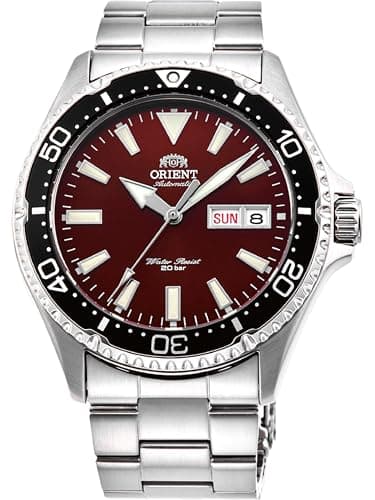
Orient
Orient Kamasu
Price as of October 5, 2026. Prices change — Amazon's is the one that counts.
#ad · we may earn a commission from this link to Orient Kamasu
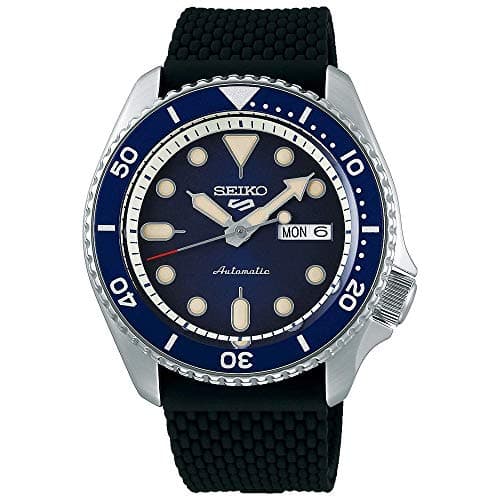
Seiko
Seiko 5 Sports SRPD93
$350.0020% off
Price as of October 5, 2026. Prices change — Amazon's is the one that counts.
#ad · we may earn a commission from this link to Seiko 5 Sports SRPD93
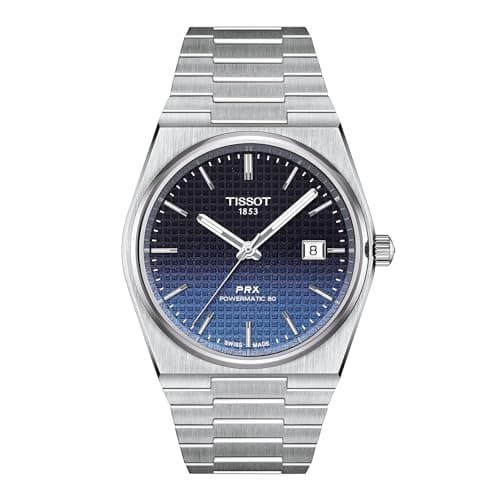
Tissot
Tissot PRX Powermatic 80
Price as of October 5, 2026. Prices change — Amazon's is the one that counts.
#ad · we may earn a commission from this link to Tissot PRX Powermatic 80
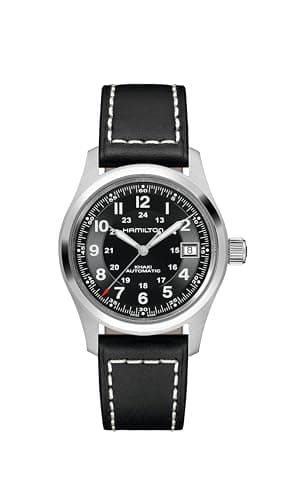
Hamilton
Hamilton Khaki Field Auto 38mm
Price as of October 5, 2026. Prices change — Amazon's is the one that counts.
#ad · we may earn a commission from this link to Hamilton Khaki Field Auto 38mm
Published specs
Two Japanese, two Swiss — side by side
Each watch here is the cleanest example of its movement family. Every figure is the manufacturer's or caliber reference's published number — see Sources.
| Watch | Published specs | Best for | Price |
|---|---|---|---|
| OrientOrient Kamasu | F6922 · in-house-15/+25 sec/day200m WRSapphire41.8mm | The best spec-for-dollar dive watch, full stop | $329.09 |
| SeikoSeiko 5 Sports SRPD93 | 4R36 · 24J-35/+45 sec/day100m WRHardlex42.5mm | The one automatic to own if you own one | $280.00 |
| TissotTissot PRX Powermatic 80 | Powermatic 8080h reserve100m WRSapphire40mm | The 'if you can stretch past $500' upgrade | $850.00 |
| HamiltonHamilton Khaki Field Auto 38mm | H-10 · 80hSapphire100m WR38mmHacking | The definitive field watch, if the budget stretches | $795.00 |
#ad · we may earn a commission · Specs as published by the manufacturer (see Sources). Live prices from the Amazon Product API, as of October 5, 2026 — where we have no verified live price we show none rather than a number that has rotted.
What each side publishes
| Spec | Japanese (4R36 / F6922) | Swiss (Powermatic 80 / H-10) |
|---|---|---|
| Published daily rate | 4R36: -35/+45. F6922: -15/+25 | Not published by Tissot or Hamilton |
| Power reserve | About 41h (4R36), about 40h (F6922) | 80 hours, both |
| Beat rate | 21,600 vph | 21,600 vph (Powermatic 80) |
| Hacks / hand-winds | Yes, both | Yes, both |
| Crystal on the host watch | Hardlex or mineral; sapphire on some | Sapphire as standard |
| Antimagnetic spring | Not published | Nivachron on the Hamilton H-10 |
| Chronometer certified | No | No, though the C07 family can be |
| Typical service cost | The cheaper half of the market | The dearer half |
The 80 hours is bought, not invented
The Powermatic 80 is not a new movement. The caliber references record it as ETA C07.111, derived from the ETA 2824-2, and the way it gets to 80 hours is a documented trade: the beat rate was dropped from 4Hz to 3Hz (21,600 vph) and a high-performance synthetic material was used in the escapement to cut friction. A slower balance consumes less of the mainspring per hour, so the same barrel runs far longer.
That matters because it quietly removes the one advantage a Swiss 2824 used to have over a Japanese 4R36: beat rate. Both now run at 21,600 vibrations an hour, six per second — the Swiss movement has come down to the Japanese number. What beat rate actually does covers why the seconds hand sweep looks identical as a result.
The family has variants: the C07.611 keeps a conventional escapement and the C07.811 uses a silicon balance spring, and the line can be chronometer certified — though not in the watches at this price. COSC certification explained covers what that would mean. There is a full Powermatic 80 guide if you want the movement on its own terms.
The Japanese publish a number; the Swiss do not
Seiko rates the 4R36 at -35 to +45 seconds a day worn on the wrist. Orient rates the F6922 at -15 to +25. Those are weak-sounding tolerances and that is exactly why they are useful: they are a floor you can hold the watch to, and a returnable fault if it misses badly.
Tissot publishes no daily accuracy figure for the Powermatic 80, and Hamilton publishes none for the H-10. In practice both are regulated tightly and commonly run within a few seconds a day — but "commonly" is a report, not a specification, and we are not going to print a number nobody published. How to read a daily tolerance converts these figures into minutes per month, and why a watch loses time covers what to do when yours drifts outside spec.
Vertical integration is the Japanese trump card
Seiko and Orient (Orient has been part of Seiko Epson since 2017) make their own movements, cases, dials, hands and crystals. Nothing in the supply chain has to make a margin twice. That is the structural reason an in-house Orient movement with a tighter published tolerance than Seiko's can sit under a sapphire crystal and a 200m case for under $300, while the Swiss watches here start at roughly double.
The Japanese also have the specialist supplier the Swiss do not: Seiko's Time Module NH family and Citizen's Miyota 8-series sell the same mechanisms to anybody, which is why every microbrand on the market runs one. Miyota's 9-series is the thin, 28,800-vph premium tier of that trade.
Service cost is the part people discover late
A mechanical watch needs servicing eventually, and the two sides are not close. The service-cost guide has the published figures from Seiko and Hamilton side by side — on a sub-$300 Japanese watch a full service can approach the price of the watch, which is a real argument for treating it as disposable; on a Swiss watch it is a smaller fraction of a larger number.
Where the Swiss genuinely wins
- 80 hours off the wrist. Take a Powermatic 80 or H-10 off on Friday evening and it is still running Monday morning. Power reserve explained covers why that changes how you live with a watch, and the 80-hour shortlist ranks every pick that offers it.
- Sapphire as standard. Not an upgrade, not a variant — it is simply fitted.
- An antimagnetic balance spring. Hamilton publishes Nivachron on the H-10. No Japanese movement at this price publishes an equivalent.
- Finishing and perceived value. The reason watches that look expensive skews Swiss.
Which should you buy?
- First automatic, best value → Orient Kamasu. Sapphire, 200m, -15/+25 published, in-house.
- One watch, widest support → Seiko 5 Sports.
- You hate resetting a watch → Swiss, for the 80 hours. Tissot PRX for the steel-bracelet look, Hamilton Khaki Field Auto for the 38mm field case.
- You want it settled brand by brand → Seiko vs Orient vs Citizen on the Japanese side, Tissot vs Hamilton on the Swiss, and Seiko vs Tissot straight across the divide.
- You want a 37-40mm Japanese alternative to the PRX → Citizen Tsuyosa vs Seiko 5 Sports.
Full ranked fields: best Japanese automatic watches and best Swiss automatics under $1,000.
Questions
FAQ
Are Swiss movements more accurate than Japanese ones?
Nobody has published figures that let you say so at this price. Seiko publishes -35/+45 sec/day for the 4R36 and Orient publishes -15/+25 for the F6922; Tissot publishes no daily rate for the Powermatic 80 and Hamilton publishes none for the H-10. Swiss movements are widely reported to run tighter, but a report is not a specification.
Why does the Powermatic 80 run for 80 hours?
Because its beat rate was lowered. The caliber references record the ETA C07.111 as a development of the ETA 2824-2 whose frequency dropped from 4Hz to 3Hz (21,600 vph), with a synthetic escapement to reduce friction. A slower balance drains the mainspring more slowly, so the same barrel lasts far longer.
Do Japanese automatics hack and hand-wind like Swiss ones?
The modern ones do. The Seiko 4R36, Orient F6922 and F6724, Citizen 8204, and the Swiss Powermatic 80 and H-10 all hack and hand-wind. Older Seiko 7S26 movements did neither, which is where the myth comes from.
Is a Swiss watch worth double the Japanese price?
For the 80-hour reserve, sapphire as standard and Hamilton's published Nivachron antimagnetic spring, some buyers will say yes. On pure specification per dollar the Japanese win, and the service bill later is lower too.
Specs & sources
Specifications on this page are compiled from manufacturer datasheets, official product pages, and published standards. Prices are pulled live from Amazon and date-stamped; nothing is invented.
- Seiko caliber 4R36 reference ↗
- Seiko official instruction manual, calibers 4R35 / 4R36 / 4R37 / 4R38 / 4R39 / 4R71 / 4R72 - specifications ↗
- Orient caliber F6922 reference ↗
- Orient Kamasu RA-AA0003R39B, official specifications (41.88mm, 47mm lug to lug, 12.8mm) ↗
- ETA C07.111 / Tissot Powermatic 80 caliber reference (3Hz / 21,600 vph, 80-hour reserve, based on the ETA 2824-2, synthetic escapement, index regulator) ↗
- Tissot PRX Powermatic 80 (official) ↗
- Hamilton Khaki Field Auto (official) ↗
- Seiko Service Center USA — estimated price for movement service ↗
- Hamilton — watch interventions & complete maintenance service ↗
Keep reading