Buying guide
Citizen Tsuyosa vs Seiko 5 Sports
Sapphire and an integrated bracelet against water resistance and endless choice. These two are aimed at completely different buyers, and the specs say which one is you.
These two watches get cross-shopped constantly because they occupy the same shelf in the same mental category: a Japanese automatic on a steel bracelet, in-house movement, somewhere between $200 and $400. Sit them next to each other and that is where the similarity ends.
The Tsuyosa is a design object with a sapphire crystal and a bracelet built into the case. The Seiko 5 is a tool watch you can swim in and modify endlessly. Neither is trying to be the other, and the right answer depends entirely on what you want the watch to do.
Disclosure
Some links here are affiliate links — mostly to Amazon. If you buy through one we may earn a small commission, at no extra cost to you. It never changes which watch we pick or the price you pay. Prices are pulled live and date-stamped; where we can't verify one, we show none. Full disclosure.
The contenders
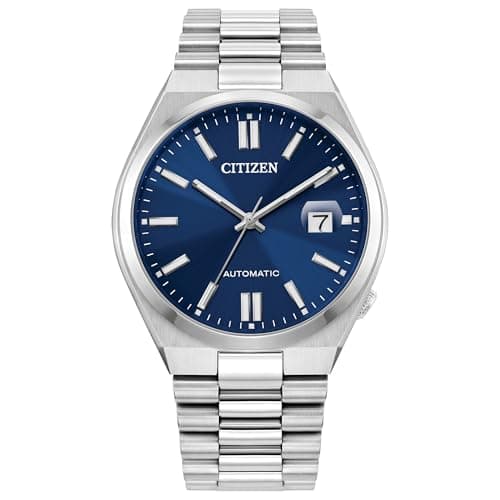
Citizen
Citizen Tsuyosa NJ0150
$495.0030% off
Price as of October 21, 2026. Prices change — Amazon's is the one that counts.
#ad · we may earn a commission from this link to Citizen Tsuyosa NJ0150
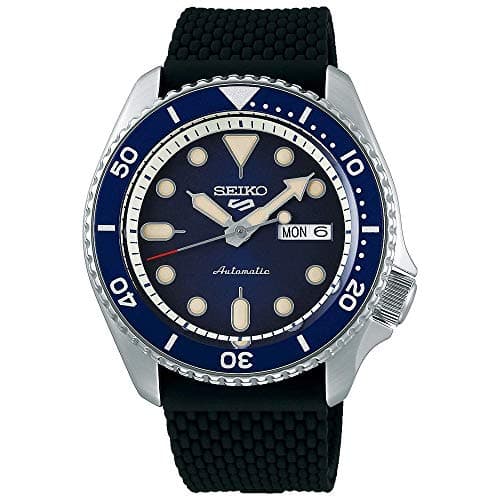
Seiko
Seiko 5 Sports SRPD93
No buyable offer at the last price check (October 21, 2026). We show nothing rather than a stale number.
#ad · we may earn a commission from this link to Seiko 5 Sports SRPD93
Side by side
| Spec | Citizen Tsuyosa NJ0150 | Seiko 5 Sports SRPD93 |
|---|---|---|
| Movement | Citizen 8210, in-house | Seiko 4R36, 24 jewels |
| Published accuracy | Not published | -35 to +45 sec/day |
| Power reserve | ~42 hours | ~41 hours |
| Crystal | Sapphire | Hardlex (mineral) |
| Water resistance | 50m | 100m |
| Case | 40mm | 42.5mm |
| Bracelet | Integrated - no strap swaps | Standard lugs - any strap |
The crystal is the Citizen's headline
Sapphire at this price is genuinely uncommon, and it is the single specification most likely to matter to you in five years. Seiko fits Hardlex to essentially everything under $400 - a hardened mineral that resists a lot but not a doorframe. The Tsuyosa arrives with the crystal you would otherwise pay Swiss money for.
If a scratch-free crystal is the priority and you do not need the Tsuyosa's looks, note that Seiko is not your only Japanese option - the Orient Kamasu has sapphire and 200m, and the whole field is ranked in the sapphire shortlist.
The Seiko's headline is that you can swim in it
100m against 50m sounds like a doubling and functions as a category change. 50m covers rain and hand-washing and is not a swimming rating in practice, whatever the number suggests. 100m is. If this is going to be your only watch and you would like to keep it on at the beach, that row of the table settles the argument on its own - the water resistance guide explains why the numbers overstate what they permit.
The bracelet decides more than it looks like it does
The Tsuyosa's bracelet is integrated into the case. It is a large part of why the watch reads as far more expensive than it is - and it means you will never put a leather strap, a NATO or a rubber dive strap on this watch. What you buy is what you own.
The Seiko has ordinary lugs. Its bracelet is the weakest part of the package, and that barely matters, because a strap costs very little and takes five minutes to fit (how to change a watch strap). One watch becomes three looks. For a lot of buyers that flexibility is worth more than the sapphire.
Movements: both in-house, one documented
Citizen's 8210 and Seiko's 4R36 are both genuinely in-house calibers, both hack and hand-wind, and both hold roughly the same power reserve. The difference is disclosure: Seiko publishes a daily tolerance of -35 to +45 seconds and Citizen publishes no daily figure for the 8210 at all.
That is an information gap rather than a quality verdict - Citizen owns Miyota and knows how to build a movement. But if you like being able to check your watch against a published spec, only one of these lets you. See automatic watch accuracy for how to measure yours either way.
Size and fit
40mm against 42.5mm, and the gap on the wrist is bigger than the numbers because the Seiko is a thicker sports case with a bezel. The Tsuyosa is the safer choice on a smaller wrist, and Citizen also makes it in 37mm - one of very few genuinely small automatics with sapphire.
Seiko's answer for smaller wrists is the 39.4mm SRPG field style, same 4R36 inside. Judge both by lug-to-lug rather than diameter - the size and fit guide shows why the diameter number lies.
Which should you buy?
- You want the watch to look more expensive than it is → Tsuyosa. The integrated bracelet does the work, and it is the cheapest honest route into that look.
- You want one watch for everything, including water → Seiko 5. 100m, standard lugs, and a strap for every occasion.
- You care most about the crystal → Tsuyosa, or an Orient if you also want a dive rating.
- You like modifying watches → Seiko, easily. There is an entire aftermarket for this case; the Tsuyosa has none by design.
- Smaller wrist → Tsuyosa at 40mm or 37mm, or the Seiko SRPG at 39.4mm. Not the 42.5mm SRPD.
If it is specifically the integrated-bracelet look you are after, the whole category under $500 is ranked in the integrated bracelet shortlist.
Questions
FAQ
Is the Citizen Tsuyosa better than a Seiko 5?
It is better made and better looking, with a sapphire crystal the Seiko does not have. The Seiko is more useful: 100m of water resistance, a published accuracy spec and the ability to take any strap. They are aimed at different buyers rather than ranked against each other.
Can you swim with a Citizen Tsuyosa?
It is rated to 50m, which in practice covers rain, hand-washing and an accidental soaking rather than deliberate swimming. If you want to swim in your watch, the 100m Seiko is the safer of the two.
Can you change the bracelet on a Citizen Tsuyosa?
No. The bracelet is integrated into the case design, so it does not accept a standard strap. That is a deliberate part of the look, and it is the main practical trade against the Seiko.
Which is smaller?
The Tsuyosa, at 40mm against 42.5mm, and the difference on the wrist is larger than that because the Seiko is a thicker sports case. Citizen also offers the Tsuyosa in 37mm.
Specs & sources
Specifications on this page are compiled from manufacturer datasheets, official product pages, and published standards. Prices are pulled live from Amazon and date-stamped; nothing is invented.
Keep reading