Buying guide
Hamilton Khaki Navy Scuba Review
Forty millimeters, 12.95mm thick and 20mm lugs: a dive-styled Swiss automatic proportioned like a normal watch. The specification that will bother purists is the water rating.
Most dive watches are big because they have to be. Water resistance costs case height, the bezel costs diameter, and the result is the 44mm and 45mm slabs that dominate the affordable dive category. The Khaki Navy Scuba takes the opposite approach: 40mm across, 12.95mm thick, 20mm lugs, and a water rating that stops at 100m rather than chasing 200m or 300m.
That is a deliberate trade and it produces the most comfortable dive-styled watch we list. Specifications come from Hamilton's published data; scoring follows our method.
Disclosure
Some links here are affiliate links — mostly to Amazon. If you buy through one we may earn a small commission, at no extra cost to you. It never changes which watch we pick or the price you pay. Prices are pulled live and date-stamped; where we can't verify one, we show none. Full disclosure.
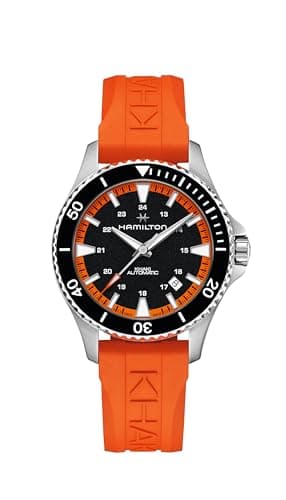
Hamilton
Hamilton Khaki Navy Scuba Auto 40mm
Hamilton's dive-styled automatic: the 80-hour H-10, sapphire and 100m in a 40mm case that wears far more comfortably than most divers.
Price as of October 21, 2026. Prices change — Amazon's is the one that counts.
#ad · we may earn a commission from this link to Hamilton Khaki Navy Scuba Auto 40mm
Specs at a glance
| Movement | Hamilton H-10, Swiss automatic |
|---|---|
| Power reserve | 80 hours |
| Hairspring | Nivachron antimagnetic |
| Case | Stainless steel, 40mm diameter, 12.95mm thick |
| Crystal | Sapphire |
| Water resistance | 100m |
| Lug width | 20mm |
The dimensions are the point
40mm and 12.95mm with 20mm lugs is, by the standards of this genre, remarkably restrained. For comparison, the Seiko Prospex SRPF03 needs 44mm and 22mm lugs to deliver its 200m, and the Seiko Turtle is a 45mm cushion. The Hamilton fits under a cuff, sits flat on a mid-size wrist, and takes any 20mm strap - the most common size there is.
If you have wanted the dive-watch look but found every candidate too big, this is the answer inside our price ceiling. It is one of the few watches that appears on both the Swiss shortlist and, by proportions, in the conversation for people shopping smaller cases.
The weak spec: 100m, not 200m
This is where the purists will object, and they have a point. 100m is genuinely everyday-safe - swimming, snorkeling, showering with a screw-down crown, no thinking required. But it is not a dive rating in the sense that a 200m watch is, and it is comfortably beaten by watches costing a fifth as much.
The Casio Duro is 200m for under $70. The Orient Kamasu is 200m with sapphire for a fraction of the Hamilton. If the number on the dial is what you are buying, the Hamilton is the worst-value watch in this comparison by a wide margin. It is dive-styled, not a dive tool - and the honest place to check the difference is water resistance explained. If you want a real 300m Swiss diver, that is the Tissot Seastar.
What the H-10 brings
The same movement as the Khaki Field Auto: a Swiss automatic with an 80-hour reserve and a Nivachron antimagnetic hairspring. It hacks, it hand-winds, and it survives a long weekend off the wrist without stopping - which is the practical benefit people underrate until they own one. See power reserve explained for why 80 hours changes the ownership experience.
Nivachron matters more than it sounds. Magnetization is one of the most common causes of a mechanical watch suddenly running minutes fast, and an antimagnetic hairspring materially reduces the risk - a real advantage over the Japanese calibers, and one you only notice by its absence.
The price problem, stated honestly
This is the most expensive watch we list. It is roughly ten times the cost of a Casio Duro that is rated twice as deep, and several times an Orient Kamasu that has both sapphire and 200m. Everything it does better - the reserve, the hairspring, the finishing, the proportions - is real, and none of it is necessary.
Buy it because you want it, not because you have talked yourself into needing it. That is a legitimate reason to buy a watch, and we would rather say so than dress it up in specifications. The value list is where to go if the arithmetic has to work.
Who should buy it
Buy the Khaki Navy Scuba if you want dive-watch styling in a case that behaves like a normal watch, you want Swiss mechanics with an 80-hour reserve and sapphire, and 100m covers what you actually do in water. On comfort per millimeter it is the best watch on this site.
Skip it if you want a genuine 200m-plus rating, if you are shopping on value, or if you would rather have the field-watch dial - in which case the Khaki Field Auto is the same movement in the shape Hamilton is famous for.
Questions
FAQ
Is the Hamilton Khaki Navy Scuba a real dive watch?
It is dive-styled rather than a dive tool. 100m water resistance covers swimming and snorkeling comfortably, but it is not the 200m-plus rating that defines a proper diver. For that, the Tissot Seastar is 300m and the Orient Kamasu is 200m for far less money.
How big does the Khaki Navy Scuba wear?
Modestly, by dive-watch standards: 40mm across, 12.95mm thick, with 20mm lugs. That is markedly smaller than the 44mm and 45mm Seiko divers, and it is the main reason to choose it.
What is the difference between the H-10 and the H-50?
The H-10 is automatic - it winds itself from wrist motion. The H-50 is hand-wound and has no rotor. Both are Swiss and both hold 80 hours. The Navy Scuba uses the H-10; the Khaki Field Mechanical uses the H-50.
Navy Scuba or Tissot Seastar?
The Seastar is 300m and 12.48mm thick with a rotating bezel and a quick-release bracelet; the Hamilton is 100m at 40mm and 12.95mm with a cleaner, less tool-like presence. Buy the Tissot for capability — note it is the slimmer of the two despite the deeper rating — and the Hamilton for the design. The full head-to-head is here.
Specs & sources
Specifications on this page are compiled from manufacturer datasheets, official product pages, and published standards. Prices are pulled live from Amazon and date-stamped; nothing is invented.
Keep reading