Buying guide
Hamilton Navy Scuba vs Tissot Seastar
Two 40mm Swiss divers, both sapphire, both 80 hours, both from the same group. On the published numbers the deeper-rated one is also the slimmer one, which leaves the Hamilton arguing from design rather than specification.
Buy the Tissot Seastar 1000 if the water rating is the point, and the Hamilton Khaki Navy Scuba if wearability is. Both are 40mm Swiss automatics with a sapphire crystal and a Swatch Group caliber rated at roughly 80 hours. The difference that decides it is blunt: the Seastar is a 300m screw-down dive watch and the Navy Scuba is rated 100m.
And here is the number that should settle it and usually gets left out: the Seastar is the thinner watch. Tissot publishes 12.48mm of case height against Hamilton's 12.95mm. Water resistance normally costs case height — that is why most 200m and 300m divers are tall — so the expectation is that the 300m watch pays for its rating in bulk. It does not. The Seastar is rated three times deeper andsits closer to the wrist, on both makers' own figures.
Both sit above the price band this site mostly works in, so there is a third contender here that neither brand will enjoy: the Orient AC0Q Diver, which has sapphire, a 200m case and a published 46.5mm lug-to-lug for a fraction of either price. If what you want is a dive rating rather than a Swiss one, start there.
Disclosure
Some links here are affiliate links — mostly to Amazon. If you buy through one we may earn a small commission, at no extra cost to you. It never changes which watch we pick or the price you pay. Prices are pulled live and date-stamped; where we can't verify one, we show none. Full disclosure.
The contenders
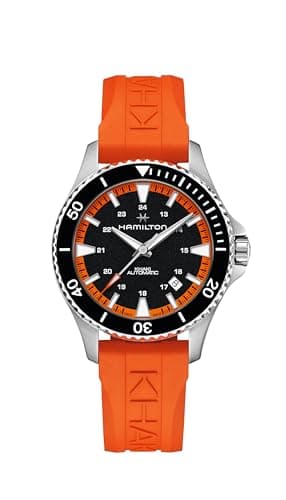
Hamilton
Hamilton Khaki Navy Scuba Auto 40mm
Price as of October 16, 2026. Prices change — Amazon's is the one that counts.
#ad · we may earn a commission from this link to Hamilton Khaki Navy Scuba Auto 40mm
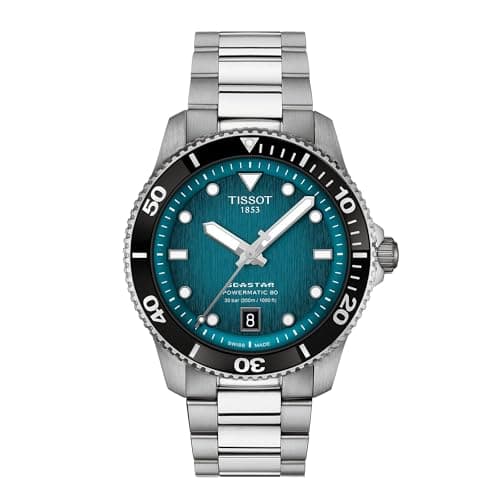
Tissot
Tissot Seastar 1000 Powermatic 80 40mm
Price as of October 16, 2026. Prices change — Amazon's is the one that counts.
#ad · we may earn a commission from this link to Tissot Seastar 1000 Powermatic 80 40mm
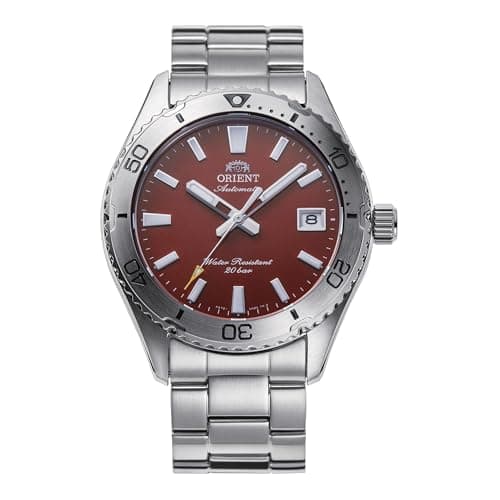
Orient
Orient Mako 40 (AC0Q Diver)
Price as of October 16, 2026. Prices change — Amazon's is the one that counts.
#ad · we may earn a commission from this link to Orient Mako 40 (AC0Q Diver)
Side by side
Swiss, Swiss, and the Japanese watch that undercuts both
Published specifications from Hamilton's, Tissot's and Orient's own product pages, plus the ETA C07.111 caliber reference. Neither Swiss maker publishes a daily accuracy tolerance for these references.
| Watch | Published specs | Best for | Price |
|---|---|---|---|
| HamiltonHamilton Khaki Navy Scuba Auto 40mm | H-10 · 80h100m WRSapphire40mm · 12.95mm20mm lugs | A Swiss diver-styled automatic in a modest 40mm case | $975.00 |
| TissotTissot Seastar 1000 Powermatic 80 40mm | Powermatic 8080h reserve300m WRSapphire AR40mm | A genuine Swiss dive watch under $1,000 | $875.00 |
| OrientOrient Mako 40 (AC0Q Diver) | F6722 · in-house200m WRSapphire39.9mmL2L 46.5mm | A 200m in-house diver on a normal wrist | $253.25 |
#ad · we may earn a commission · Specs as published by the manufacturer (see Sources). Live prices from the Amazon Product API, as of October 16, 2026 — where we have no verified live price we show none rather than a number that has rotted.
What both watches share
It is worth being clear about how much of this comparison is a tie, because it is most of it. Both watches are 40mm across. Both have a sapphirecrystal — the Seastar's with an anti-reflective treatment. Both run a Swiss automatic rated at roughly 80 hours of power reserve: the H-10 in the Hamilton, the Powermatic 80 in the Tissot. Both brands belong to the same parent group, and both calibers descend from the same ETA architecture.
That 80-hour figure is the single biggest practical difference between either of these and a Japanese automatic at half the money. Take a Seiko or Orient off on Friday evening and it is dead by Sunday; take either of these off and it is still running on Monday morning. Our power reserve guide covers why that matters more than it sounds, and the 80-hour list ranks everything we track that manages it.
It is also worth knowing how the 80 hours is achieved, because it is a trade rather than an engineering coup. The Powermatic 80 is the ETA C07.111, a development of the ETA 2824-2 whose frequency was deliberately lowered from 4Hz to 3Hz — 21,600 vibrations an hour, the same rate as a Seiko 4R36 — to buy the longer run. Powermatic 80 explained goes through it properly.
Difference one: 300m against 100m
This is the headline and it is not close. Tissot rates the Seastar 1000 at 300m with a screw-down crown. Hamilton rates the Khaki Navy Scuba at 100m. Both are styled as dive watches; only one carries a rating in dive-watch territory.
What that means in practice is narrower than the numbers suggest. A 100m rating covers swimming, snorkeling and anything you will do at the surface without thinking about it. A 300m rating covers actual scuba use and gives you a margin most owners will never touch. So if you are choosing between these two for a watch that will see a pool and a shower, the Hamilton's 100m is not a real limitation — it is only a limitation relative to what the name "Scuba" implies. Our water-resistance guide sets out what each rating actually permits.
The honest version of this difference: the Seastar is the better watch on paper and the Hamilton is the more honest about what its case is for. If you want to understand the Tissot's rating against its own stablemate, PRX vs Seastar is the in-brand decision.
Difference two: the 300m watch is the thinner watch
This is the finding this page exists for, and it runs against the grain of how dive watches are supposed to work. Tissot publishes 12.48mm for the Seastar 1000. Hamilton publishes 12.95mm for the Khaki Navy Scuba. Same 40mm diameter, same 20mm lug width on both — and the watch rated for 300 meters is roughly half a millimeter slimmer than the one rated for 100.
That matters because thickness is the specification that decides whether a dive-styled watch actually gets worn. A tall 40mm watch catches cuffs, rides up the wrist and feels like more watch than its diameter promised. The usual trade is that you accept that bulk in exchange for depth rating. The Seastar declines the trade: 12.48mm is slim for a 300m case, slimmer than a great many 200m Japanese divers, and it undercuts the Navy Scuba's central argument for itself.
Which leaves the Hamilton making a different case, and a legitimate one: it is the less tool-like watch. The Seastar carries a rotating dive bezel that takes up dial real estate and reads unmistakably as diving equipment. The Navy Scuba is quieter about what it is. That is a design preference, not a specification, and it is worth being clear that it is the main thing the Hamilton is winning on here. Both take 20mm straps, so either re-straps easily — see how to change a watch strap if that is part of your plan.
Difference three: what neither of them will tell you
Both makers leave the same two blanks, and it is worth naming them because the price implies otherwise.
Neither publishes a daily accuracy tolerance. Not for the H-10, not for the Powermatic 80. You are paying Swiss money for an undisclosed rate. Meanwhile Orient publishes -15/+25 seconds a day for the F6922 in a watch costing a fraction as much, and Seiko publishes -35/+45 for its 4R family. That inversion is one of the genuinely odd facts about this price band, and the accuracy shortlist is built entirely from calibers that do publish a figure. If you want a rate that is actually certified rather than merely published, that is COSC certification, and neither of these has it.
Neither publishes a lug-to-lug. Both thickness figures help, but the measurement that actually predicts overhang is missing from both. With two 40mm cases of unknown reach, the reliable approach is to buy where you can return it — or to look at a watch whose maker does publish it. Watch size and fit explains why that number beats diameter, and the 40mm roundup ranks this whole category on it.
The third contender, and why it is here
The Orient AC0Q Diver is on this page because it exposes what the Swiss premium does and does not buy. It is 39.9mm with a published 46.5mm lug-to-lug — the only fit figure any of these three makers publishes — a sapphire crystal, a 200m case, and the in-house F6722, which hacks and hand-winds. It costs a fraction of either Swiss watch.
On water resistance it beats the Hamilton outright and loses to the Tissot. On fit disclosure it beats both. What it gives up is the 80-hour reserve — the F6722 is a conventional Japanese caliber in that respect — along with Swiss finishing and the service network that comes with it. The AC0Q review has the detail, and the affordable diver list puts it against the rest of the Japanese field.
The verdict
- You are choosing on specification → the Tissot Seastar 1000. It wins on water resistance by a factor of three and wins on thickness too, at 12.48mm against 12.95mm, with anti-reflective sapphire, a screw-down crown and 80 hours. On published numbers this is simply the better watch.
- You want dive looks without a dive bezel → the Hamilton Khaki Navy Scuba. Buy it for the cleaner, less tool-like dial and because 100m is more than enough for the life the watch will actually have — not because it wears smaller, which on the published figures it does not.
- You want the dive rating and not the Swiss badge → the Orient AC0Q Diver. Double the Hamilton's rating, the only published lug-to-lug of the three, and a fraction of the money.
If the Swiss tier is where you have landed either way, the best Swiss automatics under $1,000 ranks the field these two sit in, and Tissot vs Hamilton settles the brand question underneath this model one.
Questions
FAQ
Is the Hamilton Khaki Navy Scuba a real dive watch?
It is dive-styled with a rotating bezel, but Hamilton rates it at 100m rather than the 200m or 300m usually associated with a dive watch. That covers swimming and snorkeling comfortably; it is not a scuba rating despite the name. The Tissot Seastar 1000, at 300m with a screw-down crown, is the one of the two with a genuine dive rating.
Do the Hamilton H-10 and the Tissot Powermatic 80 use the same movement?
Not the same caliber, but closely related ones. Both are Swatch Group automatics rated at roughly 80 hours and both descend from the same ETA architecture — the Powermatic 80 is the ETA C07.111, a development of the 2824-2 whose frequency was lowered to 3Hz to buy the long reserve. Neither Hamilton nor Tissot publishes a daily accuracy tolerance for its version.
Which is thicker, the Navy Scuba or the Seastar?
The Hamilton, slightly. Hamilton publishes 12.95mm for the Khaki Navy Scuba and Tissot publishes 12.48mm for the Seastar 1000 — so the watch rated at 300m is about half a millimeter slimmer than the one rated at 100m. That is unusual: water resistance normally costs case height, and 12.48mm is slim for a 300m diver.
Is there a cheaper 40mm automatic diver with sapphire?
Yes — the Orient AC0Q Diver, at 39.9mm with a published 46.5mm lug-to-lug, a sapphire crystal, a 200m case and Orient's in-house F6722. It costs a fraction of either Swiss watch here and out-rates the Hamilton on water resistance. What you give up is the 80-hour reserve and Swiss finishing.
Specs & sources
Specifications on this page are compiled from manufacturer datasheets, official product pages, and published standards. Prices are pulled live from Amazon and date-stamped; nothing is invented.
- Hamilton Khaki Navy Scuba Auto 40mm H82315331 (official) ↗
- Tissot Seastar 1000 Powermatic 80 40mm (official) ↗
- ETA C07.111 / Tissot Powermatic 80 caliber reference (3Hz / 21,600 vph, 80-hour reserve, based on the ETA 2824-2, synthetic escapement, index regulator) ↗
- Orient AC0Q Diver 40mm, RA-AC0Q09R30B (official) ↗
- Orient caliber F6722 reference (in-house, 22 jewels, 21,600 bph, hacks + hand-winds, date only) ↗
- Orient caliber F6922 reference ↗
- Seiko official instruction manual, calibers 4R35 / 4R36 / 4R37 / 4R38 / 4R39 / 4R71 / 4R72 - specifications ↗
- ISO 22810 / water-resistance meaning ↗
- Hamilton — watch interventions & complete maintenance service ↗
Keep reading