Buying guide
Casio Duro MDV106 Review
It isn't automatic. It's a 200m quartz diver for about the price of a takeaway, and it's the value benchmark every mechanical watch under $200 has to beat. Here's when it wins.
This is a site about automatic watches, and this is a review of a quartz one. That deserves an explanation. The Casio MDV106 — the "Duro" — is a 200m dive watch with a screw-down crown, a unidirectional bezel and a mineral crystal, sold for roughly the price of two takeaways. It is the number every affordable mechanical watch is implicitly competing with, and pretending otherwise would make everything else on this site less trustworthy.
So: what the Duro is, what it does better than any automatic under $200, and the specific reasons to spend three times more on something mechanical anyway. Specifications come from Casio's published product data; scoring follows our method, which judges value against what a watch actually delivers rather than what technology is inside it.
Disclosure
Some links here are affiliate links — mostly to Amazon. If you buy through one we may earn a small commission, at no extra cost to you. It never changes which watch we pick or the price you pay. Prices are pulled live and date-stamped; where we can't verify one, we show none. Full disclosure.
Casio
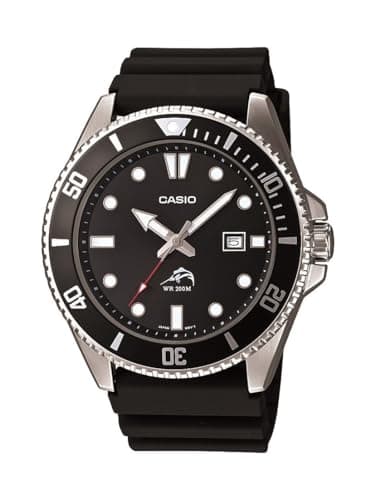
Casio Duro MDV106
Not automatic — QUARTZ — but the honest value benchmark every automatic under $150 has to beat. 200m, screw-down crown, often under $60.
$84.9519% off
Price as of October 21, 2026. Prices change — Amazon's is the one that counts.
#ad · we may earn a commission from this link to Casio Duro MDV106
Specs at a glance
| Movement | Quartz (analog, three-hand with date) |
|---|---|
| Battery | SR626SW, approximately 3 years |
| Case | Stainless steel, approximately 44mm wide |
| Crystal | Mineral glass |
| Water resistance | 200m, screw-down crown and screw-lock case back |
| Bezel | Unidirectional diver's bezel |
| Band | Resin (steel bracelet versions exist) |
What it does better than any cheap automatic
- Accuracy. A quartz watch is rated in seconds per month; an affordable mechanical is rated in tens of seconds per day. The Duro will be roughly correct months after you set it, where a Seiko 4R36 within its published tolerance can drift a minute a week. This isn't a close contest and no honest comparison pretends otherwise.
- Set and forget.No winding, no resetting after a weekend in a drawer, no power reserve to manage. Pick it up in March and it's still running.
- Water resistance per dollar. 200m with a screw-down crown and a screw-lock caseback, at a price where most watches offer 30m and a press-fit back.
- You genuinely won't worry about it. Losing or scratching a $65 watch is an inconvenience, not an event. That freedom is worth something real.
What you give up
Everything that makes a mechanical watch interesting. There is no rotor, no mainspring, no balance wheel doing six beats a second; the seconds hand ticks once per second rather than sweeping. There is nothing to watch through the back, nothing to service, nothing to pass on. A battery dies every three years and gets swapped for a couple of dollars — which is efficient, and completely unromantic.
That's the whole trade. If you want a machine on your wrist, the case for a cheap automatic is about ownership rather than performance, and it is a legitimate case. Just make it knowingly.
Is it a real dive watch?
It is a real 200m watch with the right hardware — screw-down crown, screw-lock caseback, unidirectional bezel. It is not ISO 6425 certified, which is the standard that governs what may be marketed as a diver's watch and which covers testing beyond static pressure. For swimming, snorkeling and general water use, the distinction is academic. For actual scuba diving, buy a certified watch — the Citizen Promaster Fugu is the ISO-rated pick we list.
Fit, and the two easy upgrades
The case is around 44mm wide and moderately thick, so this is not a small watch — it belongs on our large-wrist list as much as anywhere. The dial is high-contrast and extremely legible, which is what the design is for.
Two cheap changes transform it. First, the strap: the stock resin band is the most obviously budget part of the watch, and a $15 NATO or leather strap makes it look considerably more expensive than it is — five minutes with a spring bar tool. Second, if you find a steel-bracelet version at a similar price, take it. The Duro's reputation as a "cheap watch that punches up" is largely built on how well it responds to a better strap.
What the bezel is actually for
Most people never use it, so here is the point of it. The bezel turns in one direction only. You line the triangle up with the minute hand when you start something — a dive, a parking meter, pasta — and the elapsed minutes are then readable straight off the bezel scale. It only turns one way so that a knock can never make your elapsed time read shorter than it really is, which on a dive is the difference that matters. It is the same design on every proper diver we cover, including the Orient Mako II and the Seiko Turtle.
The battery, and what maintenance looks like
Casio specifies an SR626SW cell rated at around three years. Replacing it is a few dollars at any jeweler, and the one thing worth insisting on is that whoever does it replaces the caseback gasket and pressure-tests the watch if you swim in it. A 200m case is only 200m while its seals are intact, and a battery change is exactly when that gets compromised — the same point the water-resistance guide makes about aging gaskets on any watch.
Beyond that there is nothing to maintain. No servicing, no winding, no regulation. That is the entire quartz proposition, and on a watch at this price it is a genuinely strong one.
When we'd tell you to buy this instead of an automatic
Concretely, four situations. If you want a beater for the gym, the beach or manual work. If you need a watch that's right to the minute without thinking about it. If you're buying for a teenager or as a spare and the money genuinely matters. And if you're not yet sure you like wearing a watch at all — spend $65 finding out rather than $300.
Buy an automatic instead when the mechanism is the point: when you want the sweeping seconds hand, the movement visible through the back, the object that runs on your own motion and can be serviced for decades. That is not a rational purchase and it doesn't need to be. The under-$200 list is where that conversation starts, and the direct comparison with the Orient Mako is the sharpest version of the question.
Who should buy it
Buy the Duro if you want maximum watch for minimum money and don't care what's driving the hands. It is the best sub-$100 watch we know of by a wide margin, and recommending it costs us affiliate revenue we'd earn on a pricier pick — which is exactly why it's here.
Who should skip it
Skip it if you came to this site because you want a mechanical watch. The whole appeal of an automatic is the thing the Duro doesn't have, and buying the Casio to save money will leave that itch unscratched. Skip it too if you have a small wrist — at around 44mm it is a large watch — or if you want sapphire, a display back or any kind of heirloom quality.
The head-to-head with the obvious rival at this price is Casio Duro vs Invicta Pro Diver - quartz accuracy against a Miyota automatic, for roughly the same money.
The Duro is also our genuine recommendation for one specific group of buyers: anyone using impact tools all day, where no maker publishes a vibration tolerance for a mechanical movement. That argument, with the automatic alternatives ranked above it, is in best automatic watches for work.
Questions
FAQ
Is the Casio Duro MDV106 a real dive watch?
It has the hardware — 200m water resistance, a screw-down crown, a screw-lock caseback and a unidirectional bezel — but it is not ISO 6425 certified. For swimming and snorkeling that distinction doesn't matter; for scuba diving, buy an ISO-rated watch such as the Citizen Promaster.
Is the Casio Duro automatic or quartz?
Quartz. It runs on a battery rated for around three years, not on a self-winding mechanical movement. We include it on this site because it is the honest value benchmark that every affordable automatic has to justify itself against.
Should I buy a Casio Duro or an automatic watch?
Buy the Duro if you want accuracy, toughness and a watch you never think about, for the lowest possible money. Buy an automatic if the mechanism itself is the reason you want a watch — the sweeping seconds hand, no battery, a serviceable machine. Both are valid; only one of them is rational.
Specs & sources
Specifications on this page are compiled from manufacturer datasheets, official product pages, and published standards. Prices are pulled live from Amazon and date-stamped; nothing is invented.
Keep reading