Buying guide
Tissot Seastar 1000 Review
Three hundred meters, eighty hours and a sapphire crystal in a 12.48mm case. On paper this is the most watch any Swiss brand sells inside our price ceiling - and the paper is right.
Most of this site lives under $500, where the argument is always about what you give up. The Seastar is on the other side of that line, and it is here because it answers a specific question honestly: if you stretch past the Japanese watches, what does the extra money actually buy?
In this case: 300 meters of water resistance, an 80-hour power reserve, a sapphire crystal with anti-reflective coating, a Nivachron antimagnetic hairspring and a 40mm case just 12.48mm thick. Specifications come from Tissot's published product data; scoring follows our method.
Disclosure
Some links here are affiliate links — mostly to Amazon. If you buy through one we may earn a small commission, at no extra cost to you. It never changes which watch we pick or the price you pay. Prices are pulled live and date-stamped; where we can't verify one, we show none. Full disclosure.
Tissot
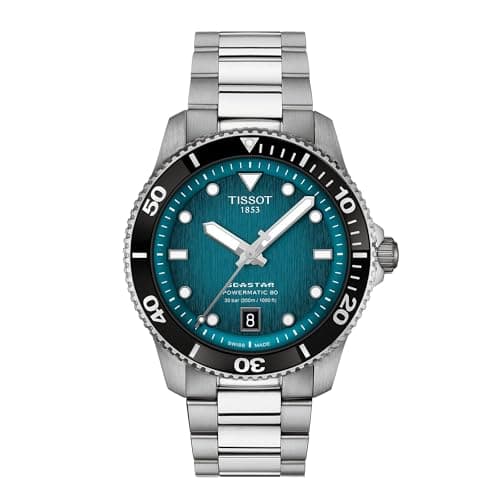
Tissot Seastar 1000 Powermatic 80 40mm
The Swiss diver that makes sense: an 80-hour Powermatic 80, sapphire, a 300m screw-down case and a quick-release bracelet, in a 40mm case that fits normal wrists.
Price as of October 21, 2026. Prices change — Amazon's is the one that counts.
#ad · we may earn a commission from this link to Tissot Seastar 1000 Powermatic 80 40mm
Specs at a glance
| Movement | Swiss automatic, Powermatic 80 |
|---|---|
| Power reserve | Up to 80 hours |
| Hairspring | Patented Nivachron antimagnetic |
| Case | 316L stainless steel, 40mm diameter, 12.48mm thick |
| Crystal | Sapphire with anti-reflective coating on the underside |
| Water resistance | 300m (30 bar), screw-down crown |
| Bezel | Stainless steel, anti-clockwise rotating |
| Bracelet | Steel, quick-release, folding clasp with safety lock, 20mm lugs |
| Caseback | See-through |
The 80-hour reserve changes how you own a watch
This is the single most underrated feature in modern affordable Swiss watchmaking. A typical Japanese automatic holds roughly 40 hours: take it off on Friday evening and it is dead by Sunday lunchtime. The Powermatic 80 holds eighty, which means you can leave it on the dresser all weekend and pick it up on Monday still running and still roughly on time.
Tissot gets there by dropping the beat rate to 3 Hz and fitting a longer mainspring - the same engineering trade Hamilton makes with its H-10. It also removes the main practical argument for a watch winder, which we cover in do you need a winder. If you own more than one watch, this feature is worth more than any amount of dial finishing.
300m in a 12.48mm case is the real trick
Water resistance normally costs thickness. The Seiko Turtle gets 200m in a case you can feel from across the room; the Prospex SRPF03 needs 44mm and 13.4mm to do the same. Tissot delivers 300m at 40mm across and 12.48mm thick, with a screw-down crown and a see-through caseback.
That combination is unusual and it is the strongest single argument for the watch. It means the Seastar is a genuine dive-rated tool that still fits under a cuff and sits comfortably on a mid-size wrist - a versatility that costs most divers their credibility in one direction or the other.
The clearest measure of how unusual it is sits one brand over. Hamilton's Khaki Navy Scuba is also 40mm and also Swiss, is rated 100m rather than 300m, and is 12.95mm thick - about half a millimeter taller than this watch for a third of the depth rating. Navy Scuba vs Seastar works through that head-to-head, and the 40mm roundup places both against the Japanese field at the same size.
Nivachron, and why it is not marketing
The hairspring is the most delicate regulating component in a mechanical watch, and a traditional one can be knocked off rate by a strong magnetic field - a laptop speaker, a handbag clasp, a phone case. Nivachron is Tissot's patented antimagnetic alloy, and it materially reduces that risk.
It is a real, functional advantage over the Japanese calibers at half the price, and it is the sort of thing you never notice until the day your watch suddenly gains three minutes and you have no idea why. That failure mode is covered in why your automatic is losing time.
The honest counter-argument
It costs several times what an Orient Kamasu costs, and the Kamasu also gives you 200m, sapphire and a hacking, hand-winding in-house movement. In pure water-resistance-per-dollar terms the Japanese watch destroys it, and we are not going to pretend otherwise.
What you are paying for is the reserve, the antimagnetic hairspring, the anti-reflective coating, the finishing, the bracelet hardware and the Swiss badge - in roughly that order of practical usefulness. If only the first two matter to you, the honest recommendation is to check whether the PRX suits your taste better, since it shares the movement.
Seastar or PRX?
Both run the Powermatic 80 and both wear about 40mm. The PRX is an integrated-bracelet seventies design at 100m; the Seastar is a proper diver at 300m with a rotating bezel and a quick-release bracelet. Buy the PRX if you want the look and will never go near deep water; buy the Seastar if you want the capability. Our Swiss shortlist ranks both against the Hamiltons, and Tissot vs Hamilton settles the brand-level question.
Who should buy it
Buy the Seastar if you want one Swiss mechanical watch that genuinely does everything - office, ocean, weekend - and you want the best specification sheet available under $1,000. It is the most capable watch on the under-$1,000 list.
Skip it if your budget is the point of the exercise. Everything the Seastar does for water, the Kamasu does for a fraction, minus the reserve and the hairspring. Spending this much should be a decision about what you want, not about what you need.
Questions
FAQ
Is the Tissot Seastar 1000 a real dive watch?
It is rated to 300m (30 bar) with a screw-down crown and a rotating bezel, which is well beyond recreational diving requirements. That is a substantially deeper rating than the 200m of most affordable Japanese divers.
How long does the Powermatic 80 run for?
Up to 80 hours from a full wind. In practice that means you can take it off on Friday evening and it will still be running on Monday morning - roughly double what a typical Japanese automatic manages.
Seastar or Tissot PRX?
Same Powermatic 80 movement, very different watches. The PRX is a 100m integrated-bracelet design; the Seastar is a 300m diver with a rotating bezel and quick-release bracelet. Buy on style and on whether you need the water rating.
What is a Nivachron hairspring?
A patented antimagnetic alloy used for the balance spring. Magnetism is one of the most common causes of a mechanical watch suddenly running fast, and Nivachron materially reduces the watch's sensitivity to it.
Specs & sources
Specifications on this page are compiled from manufacturer datasheets, official product pages, and published standards. Prices are pulled live from Amazon and date-stamped; nothing is invented.
Keep reading