Buying guide
Hamilton Khaki Field Auto Review
The watch every other field watch is measured against: 38mm, sapphire, and a Swiss movement that runs for 80 hours. Here's what it does better, and what it costs you to find out.
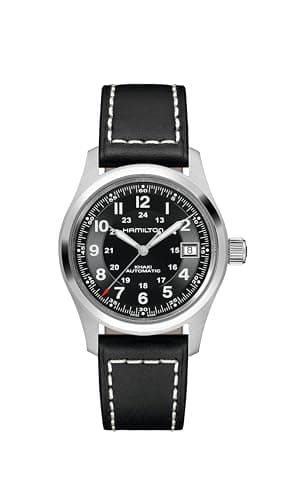
There is a shape every field watch is trying to be, and Hamilton owns it. Matte case, black dial, white Arabic numerals with an inner 24-hour ring, syringe hands, a strap that looks like it came off a kit list. The Khaki Field Auto in 38mm is that shape done properly, by the company whose 1940s military contracts defined it.
On a site about affordable automatics this is a stretch pick, and we're not going to pretend otherwise. It costs roughly three times a Seiko that does the same job. This review is about what that money genuinely buys — the 80-hour movement, the sapphire, the proportions — and about being honest that a Seiko 5 Sportstells the time just as well. Specs are from Hamilton's published specification; scoring follows our method.
Disclosure
Some links here are affiliate links — mostly to Amazon. If you buy through one we may earn a small commission, at no extra cost to you. It never changes which watch we pick or the price you pay. Prices are pulled live and date-stamped; where we can't verify one, we show none. Full disclosure.
Hamilton
Hamilton Khaki Field Auto 38mm
The field-watch benchmark. Swiss H-10 movement with an 80-HOUR reserve, sapphire, and a 38mm case that's the correct size. Usually a stretch past $500 — and usually worth it.
Price as of October 21, 2026. Prices change — Amazon's is the one that counts.
#ad · we may earn a commission from this link to Hamilton Khaki Field Auto 38mm
Specs at a glance
| Movement | Hamilton H-10, Swiss automatic |
|---|---|
| Power reserve | 80 hours |
| Hacking / hand-winding | Yes / yes |
| Case diameter | 38mm |
| Crystal | Sapphire |
| Water resistance | 100m / 10 bar |
| Balance spring | Nivachron (antimagnetic) |
The 80-hour reserve is the headline, and it earns it
Most affordable automatics hold 40 hours. That number decides something you deal with weekly: take a 40-hour watch off on Friday evening and it has stopped before Sunday lunch. The H-10 holds 80 hours — a full three days plus change — so a watch you take off on Friday is still running, still correct, on Monday morning.
If you own one watch and wear it every day, this changes nothing. If you own two and rotate them, it changes something every week. It is the clearest, most practical advantage the Swiss picks have over the Japanese ones at this level, and it's worth more in daily life than most of the specs people argue about. The same architecture appears across the Swiss shortlist.
The H-10 also carries a Nivachronbalance spring, which resists the magnetization that makes a mechanical watch suddenly gain minutes a day after a laptop or a magnetic phone mount. It's an invisible feature until the day it saves you a trip to a watchmaker — see the timekeeping troubleshooting guide for what magnetism actually does.
38mm is the correct size, and that isn't nostalgia
A field watch exists to be read instantly and forgotten otherwise. That argues for a modest case, a flat crystal and a dial with nothing on it but numbers. At 38mm the Khaki Field sits inside almost anyone's wrist, slides under a cuff, and gives you a dial big enough to read at a glance without a bezel eating into it.
It's also why the watch has aged so well. Hamilton has made this design, more or less unchanged, for decades — the 42mm version exists for people who want more presence, but the 38mm is the one the design was drawn for. If you have a larger wrist and want scale, our large-wrist list is a better starting point than sizing up this particular watch.
Sapphire, and what 100m actually covers
The crystal is sapphire, which at this price should be table stakes and often isn't — Seiko still ships Hardlex on watches costing $500. Sapphire won't scratch from a door frame, a desk edge or a year of ordinary wear; the crystal guide covers the difference honestly, including the one thing sapphire is worse at.
100m of water resistance is genuinely everyday: rain, washing up, swimming without thinking about it. It is not a dive rating and the crown does not screw down, so we'd keep it out of the sea and off a dive trip. For that, Hamilton's own Khaki Navy Scuba or the Orient Kamasu at a fraction of the price are the right tools.
What it's like on the wrist
Quiet. The case is matte, the dial is matte, the hands are painted rather than polished — no part of this watch reflects light at you. It is the least attention-seeking watch we review, and that is the point: a field watch that sparkles has misunderstood the assignment.
The lume is functional rather than spectacular. Seiko's LumiBrite on a Turtle will out-glow this by a wide margin, and if lume is a priority for you the Hamilton is not the watch. Legibility in daylight, though, is close to perfect — high-contrast printed numerals, an inner 24-hour scale, and no date window interrupting the dial on the classic references.
Is it worth three Seikos?
Here is the honest answer. A Seiko 5 Sports SRPG field model gives you a hacking, hand-winding automatic, 100m of water resistance and a 39.4mm case for roughly a third of the money. It tells the time exactly as well. If your goal is "own a mechanical field watch", buy the Seiko and spend the difference on something else — we say so in the direct comparison.
What the Hamilton adds is the 80-hour reserve, sapphire, the antimagnetic hairspring, Swiss finishing you can see in the case edges and dial printing, and the fact that this is the original of a design the Seiko is adjacent to. Those are real. Whether they are worth $500 is a question about your budget, not about watchmaking. We think it's the one watch on this site most likely to be someone's last field watch rather than their next one.
Servicing and the long view
A Swiss mechanical service is a few hundred dollars and is realistically due every 5–10 years. On a watch at this price that's a meaningful ongoing cost, where many owners of a $250 Seiko simply replace it. It doesn't change the recommendation, but buying a Swiss mechanical is a longer commitment than buying a Japanese one, and you should know that going in.
Who should buy it
Buy it if you want the definitive field watch and the budget is there: 38mm, sapphire, 80 hours, 100m, and a design that will look exactly as right in twenty years. It is the best single watch we list under $1,000 by our own scoring, and it's the one we'd pick from the Swiss shortlist.
Who should skip it
Skip it if a hard budget matters — the Seiko SRPG does 90% of this for a third. Skip it if you want strong lume or a dive rating. And skip the 38mm specifically if you have a wrist over about 7.5 inches and want presence; it will read as deliberately small, which is either the entire appeal or the dealbreaker.
Questions
FAQ
Is the Hamilton Khaki Field Auto worth the money?
If you want the definitive field watch, yes. The 80-hour H-10 movement, sapphire crystal, 100m water resistance and 38mm proportions are all genuine advantages over a $250 Japanese field automatic. If you simply want a mechanical field watch, a Seiko 5 Sports SRPG does the same job for roughly a third of the price.
What movement is in the Hamilton Khaki Field Auto?
The Hamilton H-10, a Swiss automatic with an 80-hour power reserve and a Nivachron antimagnetic balance spring. It hacks and hand-winds. Hamilton's hand-wound Khaki Field Mechanical uses the related H-50, which also holds 80 hours but has no rotor.
Can you swim with a Hamilton Khaki Field?
It is rated 100m, which covers swimming comfortably. It is not a dive watch — there is no rotating bezel and the crown does not screw down — so we'd keep it out of the sea and away from diving.
Specs & sources
Specifications on this page are compiled from manufacturer datasheets, official product pages, and published standards. Prices are pulled live from Amazon and date-stamped; nothing is invented.
Keep reading