Buying guide
Tissot PRX Powermatic 80 Review
The watch that made integrated bracelets affordable. An 80-hour Swiss movement and anti-reflective sapphire in a case that reads like three times the money — and the one question you should ask before buying it.
The PRX is the watch that dragged the integrated-bracelet design — a 1970s idea previously reserved for four- and five-figure watches — down to a price normal people pay. It works because the design is genuinely good and because Tissot put a real movement behind it: the Powermatic 80, with roughly 80 hours of power reserve and a Nivachron antimagnetic hairspring.
This site is built around the argument that you don't need to spend this much, so treat this review as the fair hearing of the other side. Specs come from Tissot's own product page; we haven't timed a sample. The most useful thing we can tell you is not whether the PRX is good — it is — but whether the gap between it and a $345 Orient Kamasu is worth roughly $500 of your money.
Disclosure
Some links here are affiliate links — mostly to Amazon. If you buy through one we may earn a small commission, at no extra cost to you. It never changes which watch we pick or the price you pay. Prices are pulled live and date-stamped; where we can't verify one, we show none. Full disclosure.
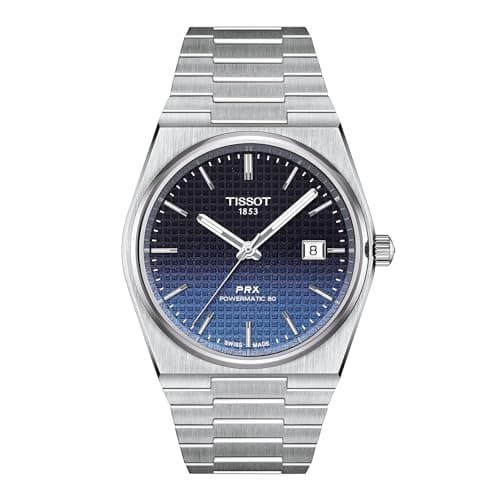
Tissot
Tissot PRX Powermatic 80
The stretch pick that changes the game: a Swiss Powermatic 80 with an 80-HOUR power reserve, sapphire, and an integrated-bracelet case that reads like a luxury watch.
Price as of October 21, 2026. Prices change — Amazon's is the one that counts.
#ad · we may earn a commission from this link to Tissot PRX Powermatic 80
Specs at a glance
| Movement | Swiss automatic, Powermatic 80 |
|---|---|
| Power reserve | Up to 80 hours |
| Hairspring | Nivachron (antimagnetic) |
| Case diameter | 40mm (a 35mm version is also made) |
| Crystal | Sapphire with anti-reflective coating |
| Water resistance | 100m / 10 bar |
| Bracelet | Integrated steel, quick-release, folding clasp |
The 80-hour reserve is the feature you actually feel
Most affordable automatics hold around 40 hours. Take one off on Friday evening and by Sunday it has stopped; Monday morning starts with winding and resetting. The PRX holds roughly 80 hours, which crosses the practical threshold: a full weekend off the wrist and it's still running with the right time. It sounds like a spec-sheet detail. In daily ownership it's the single most noticeable difference between this tier and the $300 tier.
Nivachron, and the problem it solves
The Powermatic 80 in the PRX uses a Nivachron balance spring, which resists magnetism. This matters more than people expect: magnetized hairsprings are the most common cause of a mechanical watch suddenly gaining minutes a day, and modern life is full of magnets — laptop lids, speakers, magnetic phone mounts and cases. A Japanese automatic at a third of the price has no such protection. What to do if your watch does get magnetized.
The integrated bracelet: the best and worst thing about it
The bracelet is not attached to the case, it's an extension of it — that continuous line from case to clasp is the entire aesthetic, and it's why the PRX reads as a much more expensive watch. It also hugs the wrist rather than perching, which makes it wear smaller than 40mm suggests.
The cost is flexibility. You cannot fit a standard 20mm strap; you're limited to Tissot's own quick-release options and a small aftermarket. If you're the kind of owner who enjoys changing straps with the seasons, this is a real constraint — and the opposite of what makes a Seiko 5 fun.
Where it's beaten
- Price, obviously.It's the most expensive watch we list. Whether the 80-hour reserve and Swiss finishing justify roughly $500 over an Orient Kamasu is a personal call, and "no" is a completely defensible answer.
- Water resistance.100m is everyday-safe and fine for swimming, but it isn't a dive watch. A $345 Kamasu has twice the rating and a screw-down crown.
- Lume.Perfectly adequate, nowhere near Seiko's Lumibrite.
- Not a chronometer.The Powermatic 80 is not COSC-certified at this price point. It's a well-made movement, not a precision instrument, and its real-world rate overlaps with good Japanese calibers.
40mm or 35mm?
Tissot makes the PRX in both sizes with the same specification — the same Powermatic 80, the same AR sapphire, the same 100m rating — which is unusually honest; small watches are often quietly given cheaper movements. The 40mm is the default and, because the integrated bracelet starts curving right at the case, it wears smaller than the number suggests. The 35mm is a genuinely small watch and one of very few current mechanicals in that size, which is why it appears on both the small-wrist list and the women's list.
If you're between 6 and 6.5 inches, the 35mm is the safer buy; above that, take the 40mm. Either way this is the one case where diameter is a reasonable proxy for fit, because an integrated bracelet has no lugs to overhang. Our sizing guideexplains why that's the exception rather than the rule.
Living with it
The 80-hour reserve changes the rhythm of ownership more than any other feature. Most affordable automatics need a wind and a reset after a weekend in a drawer; the PRX doesn't. Take it off Friday evening, pick it up Monday morning, and it's running with the right time. If you rotate between two or three watches, this is the one that's always ready — and it's the reason a winder is even less relevant here than elsewhere.
Two practical notes. The bracelet needs sizingon arrival — links come out with a small tool, and a jeweler will do it in minutes if you'd rather not. And the case and bracelet are heavily polished on the flat surfaces, which looks superb and shows swirl marks with wear; that's the trade for the finish, and it's worth knowing before you find your first scratch. The sapphire crystal, at least, will still be clear when the case isn't.
Who should buy it
Buy the PRX if you already own an affordable automatic, know what you like, and specifically want the 80-hour reserve, the AR sapphire and a design that reads far above its price. It's also the strongest milestone gift on our gift list — it unboxes beautifully and needs no resizing knowledge beyond a link tool.
Who should skip it
Skip it if this would be your first mechanical watch: buy something from the under-$300 bracket, wear it for six months, and find out what you actually like before spending this much. Skip it if you want a real dive watch, if you love swapping straps, or if you're holding a hard $500 ceiling — the ceiling is the point of this site, and the under-$500 list is where you should be.
Alternatives worth comparing
- Hamilton Khaki Field Auto — the same 80-hour idea in a 38mm tool watch rather than a dress-sport one. Compared here.
- Citizen Tsuyosa — sapphire and an integrated bracelet for less than half the price, with a 42-hour Japanese movement. Reviewed here.
- Tissot PRX 35mm — the identical specification in a smaller case, on the small-wrist list.
The movement inside is covered in full in the Powermatic 80 explained, and the 80-hour reserve shortlist ranks this watch against every other affordable automatic that runs a full weekend.
The comparison most buyers are really running is against a Seiko 5 Sports at under half the money. Seiko 5 vs Tissot PRXworks through it on both makers' published figures, including the point that the two movements share a beat rate and only one of them has a published daily tolerance.
The PRX's combination of 80 hours, 100m and a 40mm case also makes it the strongest travel watch on this site, which is a use case its integrated bracelet complicates in one specific way — best automatic watches for travel has the full argument.
Questions
FAQ
Is the Tissot PRX Powermatic 80 worth it?
If you value an 80-hour power reserve, anti-reflective sapphire, a Nivachron antimagnetic hairspring and an integrated-bracelet design that reads far above its price — yes. If you're buying your first mechanical watch, no: spend a third as much, learn what you like, and come back to it.
Can you change the strap on a Tissot PRX?
Only to Tissot's own quick-release options and a limited aftermarket — the bracelet is integrated into the case, so a standard 20mm strap won't fit. If frequent strap changes are part of the fun for you, a conventional lugged watch is the better buy.
Is the Tissot PRX a dive watch?
No. It's rated 100m, which is fine for swimming and everyday water contact, but a true dive watch needs 200m and a screw-down crown. For that at a much lower price, the Orient Kamasu or Seiko Turtle are the picks.
Specs & sources
Specifications on this page are compiled from manufacturer datasheets, official product pages, and published standards. Prices are pulled live from Amazon and date-stamped; nothing is invented.
Keep reading