Buying guide
Seiko 5 Sports GMT SSK019 Review
The cheapest mechanical GMT worth owning, in the SKX case. Seiko publishes a 42.5mm diameter and a 46mm lug-to-lug - and that second number is why this wears better than the smaller GMT in the same family.
This is the cheapest way into a mechanical GMT, and the SSK019 is the one in the family we would buy. Seiko publishes the full set of numbers for it: 42.5mm across, 13.6mm thick, a case length of 46mm, 22mm lugs, a Hardlex crystal, 100m of water resistance and the 24-jewel 4R34 with about 41 hours of reserve, under a bi-color 24-hour bezel.
The headline is what that 46mm does. The smaller watch in the same family, the 39.4mm SSK025, has a published case length of 47.9mm - so the wider watch reaches nearly 2mm less far across your wrist. Diameter is the number people shop on and it is the worst predictor of fit there is. On the measurement that actually decides whether a watch overhangs, the chunky-sounding SSK019 is the more wearable of the two.
There is one real limitation, and it is a movement limitation rather than a build one: the 4R34 is a caller GMT, not a traveler GMT. If you fly for a living, that will annoy you every trip, and no amount of enthusiasm about the price changes it. The section below explains exactly what it will and will not do. Specifications come from Seiko's own published SSK019 data and the 4R34 caliber reference; scoring follows our published method.
Disclosure
Some links here are affiliate links — mostly to Amazon. If you buy through one we may earn a small commission, at no extra cost to you. It never changes which watch we pick or the price you pay. Prices are pulled live and date-stamped; where we can't verify one, we show none. Full disclosure.
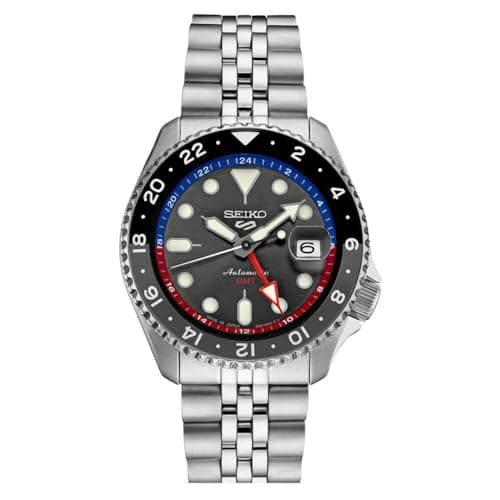
Seiko
Seiko 5 Sports GMT SSK019
The SKX-cased GMT. The same 4R34 caller movement as the SSK025, in the wider SKX Sports Style case with a 24-hour bezel — the one to buy if you want presence.
Price as of October 20, 2026. Prices change — Amazon's is the one that counts.
#ad · we may earn a commission from this link to Seiko 5 Sports GMT SSK019
Specs at a glance
| Movement | Seiko 4R34, automatic GMT, 24 jewels |
|---|---|
| Power reserve | Approximately 41 hours |
| GMT type | Caller GMT - the 24-hour hand is set with the local hand |
| Winding | Hacking seconds and hand-winding, both |
| Case | Stainless steel, 42.5mm diameter, 13.6mm thick |
| Case length | 46mm (Seiko's published figure) |
| Lug width | 22mm |
| Crystal | Hardlex |
| Water resistance | 100m (10 bar) |
| Bezel | Fixed bi-color 24-hour GMT bezel |
| Bracelet | Stainless steel five-row bracelet |
| Seiko list price | $495 |
46mm: why the bigger Seiko GMT fits better than the smaller one
Put the two references side by side on the specifications Seiko publishes and the result reads backwards:
| Seiko 5 GMT | Diameter | Case length | Lug width |
|---|---|---|---|
| SSK019 (this watch) | 42.5mm | 46mm | 22mm |
| SSK025 (Sports Style) | 39.4mm | 47.9mm | Not published |
The SKX case gets there by curving its lugs down hard and keeping the whole package compact front to back, where the Sports Style case has longer, straighter lugs that push the span out past 47mm. The consequence is practical rather than theoretical: on a 6.75-inch wrist the SSK019 sits inside the flats and the SSK025 starts to crowd them, despite looking like the sensible one on paper. Our size and fit guidemakes the general argument; this is the clearest example of it in Seiko's own catalog.
What the diameter does cost you is dial presence and cuff clearance. At 42.5mm this is an unapologetically sporty watch with a thick bezel ring, and it looks like one. If you want the GMT function in something discreet, the family does not offer it - that is a real gap, not an oversight we are papering over.
Caller GMT: what the 4R34 will and will not do
This is the single most important thing to understand before buying any Seiko 5 GMT, and most listings never mention it.
- A traveler GMT lets you jump the local hour hand in one-hour steps while the watch runs, so you land, move the hour hand, and the 24-hour hand still shows home.
- A caller GMT - which is what the 4R34 is - works the other way round. The 24-hour hand is the one you set independently, and the local hour hand cannot be jumped. You quick-set the 24-hour hand to the zone you want to watch and leave it; when you change zones, you reset the main time hands the long way.
In practice: if you stay in one place and want to know what time it is where your family, colleagues or markets are, this is excellent and absurdly cheap for a mechanical GMT - the second zone is a few clicks away. If you cross time zones often and want to snap local time forward on landing without disturbing home time, this movement will frustrate you every trip and you should spend considerably more. The distinction is laid out alongside the alternatives in our GMT shortlist under $500.
The rest of the movement is the familiar modern Seiko package and it is a good one. The 4R34 hacks and hand-winds, so you can stop the seconds hand to set the watch to a reference and wind it from the crown rather than shaking it awake - both of which the old 7S26 refused to do. The quoted reserve is about 41 hours, which means a watch taken off on Friday evening is usually stopped by Sunday morning; why that number matters more than it sounds.
13.6mm is the price of the SKX case
The honest con. At 13.6mm this is a tall watch, and the figure is published rather than estimated - Seiko states it. It is thicker than the 12.5mm SRPK91 and it is thicker than most 200m divers in the affordable band, which is a strange thing to say about a 100m watch. Part of that is the GMT module, part of it is the deep SKX-derived case and the domed Hardlex sitting on top.
What it means day to day is cuffs. A 13.6mm case with a wide bezel does not slide under a dress shirt cuff, and it will catch on a jacket sleeve. Height is also why the watch wears bigger than its 46mm span suggests - the two numbers pull in opposite directions, and anyone telling you the SSK019 wears small is only reading the one that flatters it.
22mm lugs are worth more than they sound
The lug width is a buying argument rather than a spec-sheet footnote. 22mm is the width Seiko used on the SKX, which means the aftermarket for this watch is enormous: every jubilee, oyster, rubber, sailcloth and NATO made for the most-strapped dive watch of the last thirty years fits the SSK019 without hunting.
Compare that with the 18mm lugs on the small Seiko 5s, where options thin out fast and prices are worse. If you are the sort of owner who buys one watch and three straps, 22mm is quietly one of the best reasons to pick this reference over a narrower one - changing one takes about five minutes. The five-row steel bracelet it ships on is decent rather than special, with the stamped clasp you expect at this price.
What Seiko publishes, and what it does not
Seiko is one of the better brands for disclosure in this band - it publishes the caliber, the jewel count, the reserve, the diameter, the thickness, a case length and the lug width, which is more than Bulova, Timex or Tissot give you for a comparable watch. Two gaps are worth naming anyway.
First, Seiko publishes no daily accuracy tolerance on the SSK019 page. The 4R family is specified at roughly -35 to +45 seconds a day in the caliber references, which is a wide window by Swiss standards and entirely normal here; what that range means in practice, and how to narrow it. Second, the published figure is a case length rather than a labeled lug-to-lug measurement. We treat the two as equivalent because that is what the number describes, and we would rather flag the wording than quietly convert it.
On price, Seiko's own list for this reference is $495, and the marketplace sits well under it - which is the only reason a mechanical GMT lands inside this site's brief at all. The family's listings do come and go: the smaller SSK025 is no longer listed, and the blue SSK003 listing was unavailable when we last checked. The SSK019 is the one you can actually buy today, so check the live price above before you treat any figure as fixed.
Who should skip it
- Anyone with a wrist under about 6.5 inches. The span is friendly; the diameter and the 13.6mm height are not.
- Frequent flyers. Caller GMT. Read that section again before you order.
- Anyone who wants sapphire.Hardlex is Seiko's standing compromise at this price - the automatics that do publish sapphire are here.
- Anyone buying a swim watch. 100m covers swimming but this is not a diver - the bezel is fixed and the case is not built for it. Start with the 200m automatics under $300 instead.
The verdict
A mechanical GMT for the money a decent quartz chronograph costs, in the best-loved case shape Seiko makes, with the two movement features that matter and a published set of dimensions you can check against your wrist. The caller limitation and the 13.6mm height are the price of admission, and both are knowable before you spend anything - which is more than most watches at this price offer.
Questions
FAQ
Is the Seiko SSK019 a true GMT?
It is a true mechanical GMT in the sense that a fourth hand tracks a second time zone on a 24-hour scale, driven by the 4R34 caliber. But it is a caller GMT, not a traveler GMT: it is the 24-hour hand that is set independently, while the local hour hand cannot be jumped - so you cannot snap local time forward on landing and leave home time untouched.
SSK019 or SSK025 - which should I buy?
Mechanically they are the same watch. The SSK019 is the SKX-shaped case: 42.5mm wide but a published 46mm long, with 22mm lugs that fit the whole SKX strap aftermarket. The SSK025 is 39.4mm wide and 47.9mm long, so it looks smaller and reaches further. We would buy the SSK019 - and in any case the SSK025 is no longer listed, so it is mostly a secondhand decision now.
How thick is the Seiko 5 GMT SSK019?
Seiko publishes 13.6mm. That is tall for a 100m watch - thicker than most of the 200m divers in this price band - and it is the main reason the watch will not go under a shirt cuff. The height comes from the GMT module and the deep SKX-derived case.
Does the SSK019 have a sapphire crystal?
No. Seiko publishes Hardlex, its own hardened mineral glass, which is more shatter-resistant than sapphire and scratches more easily. It is the standing Seiko compromise at this price, and the one specification most owners eventually wish were different.
Can you swim with a Seiko 5 GMT?
Yes - Seiko publishes 100m, which covers swimming. It is not a dive watch: the 24-hour bezel is fixed rather than a rotating timing bezel, and it carries no ISO dive rating. For actual diving, a 200m case with a screw-down crown is the threshold.
Specs & sources
Specifications on this page are compiled from manufacturer datasheets, official product pages, and published standards. Prices are pulled live from Amazon and date-stamped; nothing is invented.
Keep reading