Buying guide
Casio Duro vs Orient Mako II
Two 200m dive watches, four times apart in price. One is quartz and more accurate; the other is mechanical and more interesting. This is the honest accounting.
Both of these are 200m dive watches with screw-down crowns and unidirectional bezels. One costs roughly four times the other. Everything that separates them comes down to what is driving the hands — and to whether that matters to you.
The short answer: if you want a watch that is accurate, tough and maintenance-free, buy the Casio and spend the difference elsewhere. If you want a mechanical watch — a machine wound by your own movement, with a sweeping seconds hand and no battery — buy the Orient, knowing you are paying for the mechanism rather than the performance.
Disclosure
Some links here are affiliate links — mostly to Amazon. If you buy through one we may earn a small commission, at no extra cost to you. It never changes which watch we pick or the price you pay. Prices are pulled live and date-stamped; where we can't verify one, we show none. Full disclosure.
The contenders
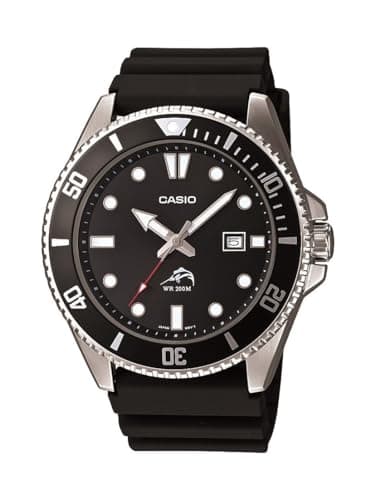
Casio
Casio Duro MDV106
$84.9519% off
Price as of October 21, 2026. Prices change — Amazon's is the one that counts.
#ad · we may earn a commission from this link to Casio Duro MDV106
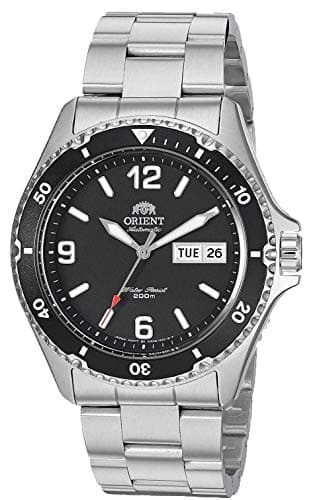
Orient
Orient Mako II
Price as of October 21, 2026. Prices change — Amazon's is the one that counts.
#ad · we may earn a commission from this link to Orient Mako II
Head-to-head
| Factor | Casio Duro MDV106 | Orient Mako II |
|---|---|---|
| Movement | Quartz (battery) | Orient F6922, in-house automatic |
| Accuracy | Seconds per month | -15 to +25 seconds per day |
| Water resistance | 200m, screw-down crown | 200m, screw-down crown |
| Crystal | Mineral | Mineral |
| Case | ~44mm | 41.5mm |
| Maintenance | Battery every ~3 years | Service every 5-10 years |
| Seconds hand | Ticks once per second | Sweeps |
On performance, the cheap one wins
There is no polite way around this. The Casio keeps time to seconds per month; the Orient's published tolerance is −15 to +25 seconds per day. The Casio never stops, needs no winding and asks nothing of you between battery changes. The Orient stops after roughly two days off the wrist and needs resetting.
Both have the same dive-relevant hardware — 200m, screw-down crown, unidirectional bezel — and both use mineral crystals. On any measurable axis except the one below, the $65 watch matches or beats the $250 one. The full quartz argument is worth reading if this is news.
What the Orient gives you that no quartz can
- An in-house mechanical movement that hacks and hand-winds, powered by your own motion, with no battery to ever replace.
- A sweeping seconds hand — the visible signature of a mechanism running at 21,600 beats an hour rather than ticking once a second.
- Serviceability. A mechanical watch can be cleaned, oiled and regulated indefinitely. A quartz module is replaced, not repaired.
- A finished object. Brushed and polished steel, an applied dial, a proper bracelet — the Orient is simply built to a higher standard than a resin-strapped Casio, and it looks it.
None of that is performance. All of it is the reason people buy mechanical watches, and it's a legitimate reason — we make the case at length.
Size and wearing
The Casio is around 44mm and fairly thick; the Orient is 41.5mm and better proportioned. On an average wrist the Orient is the more comfortable watch and the more versatile one — it passes under a shirt cuff where the Casio announces itself. The Casio's resin strap is its weakest point and a $15 strap swap closes much of the visual gap.
Which should you buy?
- Buy the Casio Duroif you want a beater, if accuracy matters, if you're buying for someone who may not wear a watch daily, or if you're not yet sure you like wearing one at all. Full review here.
- Buy the Orient Mako IIif you want a mechanical watch and you've understood what that costs you in accuracy and convenience. It's the top pick on our under-$300 list for good reason. Full review here.
And if you want the Orient's mechanism with a scratch-resistant crystal, the Kamasu adds sapphire for a small step up — compared here.
Questions
FAQ
Is the Orient Mako worth four times the Casio Duro?
Not on performance — the Casio is more accurate, needs no winding and has the same 200m rating. The Orient is worth it if you want an in-house mechanical movement, a sweeping seconds hand, better finishing and a watch that can be serviced indefinitely.
Is a quartz dive watch as good as an automatic one?
For diving and general water use, yes — often better, because quartz is more accurate and never needs winding. The reasons to choose a mechanical diver are the movement itself, the build quality that usually comes with it, and serviceability.
Which is better for a first watch?
If you know you want a mechanical watch, the Orient Mako II. If you're not sure yet, spend $65 on the Casio and find out whether you enjoy wearing a watch at all before spending four times that.
Specs & sources
Specifications on this page are compiled from manufacturer datasheets, official product pages, and published standards. Prices are pulled live from Amazon and date-stamped; nothing is invented.
Keep reading