Buying guide
Casio Duro vs Invicta Pro Diver
The two watches everyone recommends when the budget is $100. One keeps better time than any watch on this site. The other is the only real automatic at the price.
Ask any watch forum what to buy for under $100 and you will get these two names, usually in the same sentence. Both are 200m divers. Both are, by any sane standard, absurd value. And they disagree about the most fundamental thing a watch can disagree about - whether there should be a battery in it.
This site exists to recommend mechanical watches, so you can guess which way we lean. We are still going to tell you the Casio keeps better time, because it does, by a factor of roughly sixty.
Disclosure
Some links here are affiliate links — mostly to Amazon. If you buy through one we may earn a small commission, at no extra cost to you. It never changes which watch we pick or the price you pay. Prices are pulled live and date-stamped; where we can't verify one, we show none. Full disclosure.
The contenders
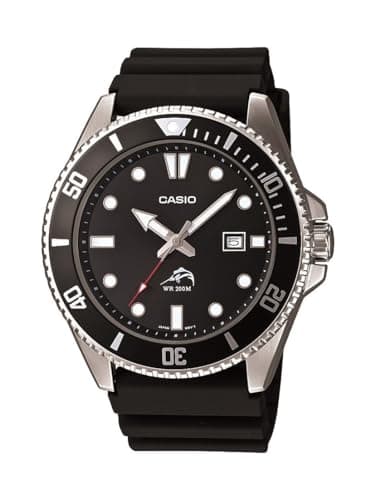
Casio
Casio Duro MDV106
$84.9519% off
Price as of October 21, 2026. Prices change — Amazon's is the one that counts.
#ad · we may earn a commission from this link to Casio Duro MDV106
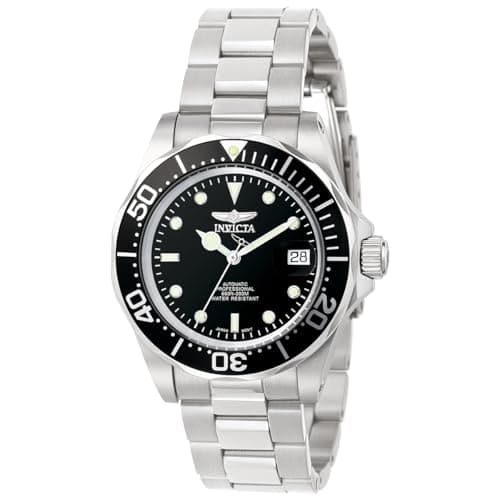
Invicta
Invicta Pro Diver 8926OB
Price as of October 21, 2026. Prices change — Amazon's is the one that counts.
#ad · we may earn a commission from this link to Invicta Pro Diver 8926OB
Side by side
| Spec | Casio Duro MDV106 | Invicta Pro Diver 8926OB |
|---|---|---|
| Movement | Quartz | Miyota 8215, 21 jewels |
| Accuracy | ±15 sec per MONTH | -20 to +40 sec per DAY |
| Winding | Battery - nothing to do | Automatic, hand-winds, no hacking |
| Water resistance | 200m | 200m |
| Crystal | Mineral | Mineral |
| Case | 44mm | 40mm |
| Bezel | Unidirectional | Unidirectional |
Two rows decide this: accuracy and case size. Everything else is a tie or close to it.
The accuracy row is not close
The Duro is specified to ±15 seconds a month. The Invicta's Miyota 8215 is specified to -20 to +40 seconds a day. That is not a rounding difference; the quartz watch is roughly sixty times more accurate, and it will be more accurate than every automatic we recommend at any price, including the Swiss ones.
If you want a watch that tells the right time and never asks anything of you, this comparison is already over. Buy the Casio. We say the same thing in the under-$100 roundup and in automatic vs quartz, and it does not get less true because we would rather sell you a mechanical watch.
So why buy the Invicta?
Because accuracy is not why anybody buys a mechanical watch. The 8215 is a real automatic - a rotor spinning on your wrist, winding a mainspring, driving an escapement that ticks eight times a second. There is no battery, and there never needs to be. If that is the thing you want, the Casio cannot give it to you at any price, and the Invicta is the cheapest honest way to get it with a 200m case around it.
The 8215 has one quirk worth knowing before you commit: it does not hack, so the seconds hand keeps running while you set the time and you cannot sync the watch exactly. It does hand-wind from the crown, which matters more day to day - a stopped watch starts with about forty turns rather than a minute of shaking. Both features are explained in hacking and hand-winding explained, and both are the reason a 4R36 Seiko is worth the step up when the budget allows.
The size row matters more than people expect
40mm against 44mm is a large gap in this category, and it goes the Invicta's way. The Duro is a big, flat 44mm slab - excellent legibility, but it overhangs a smaller wrist and looks like the cheap-and-cheerful watch it is. The Invicta at 40mm is the more wearable of the two by a clear margin, and its dive-watch proportions are conspicuously borrowed from a much more expensive Swiss watch.
That borrowing is worth naming honestly: the Pro Diver is a homage. If that idea is new to you, what is a homage watch covers the difference between a homage, a replica and a counterfeit.
Where both are equal
- 200m and a unidirectional bezel. Both are genuinely swimmable and both bezels turn only counter-clockwise, which is the safety feature that matters - see how to use a dive bezel.
- Mineral crystals. Neither has sapphire. Both will scratch eventually. At this price that is simply the deal.
- Finishing you would not call refined. Both bracelets are basic and both wear their price. Neither is pretending otherwise.
Which should you buy?
- You want a watch that is always right → Casio Duro. Nothing mechanical competes and we are not going to pretend otherwise.
- You want your first real automatic and $100 is the budget → Invicta Pro Diver. It is the only genuine option at the price with a 200m case.
- Wrist under 6.75 inches → Invicta, at 40mm. The 44mm Duro will hang over.
- A beater for the beach, the pool and the toolbox → Casio, and it is not close. Nothing about it is precious.
- You can stretch to $200 → stretch. A Seiko 5 hacks, hand-winds and publishes its specs, which is the real upgrade. Best under $200 has the field.
Questions
FAQ
Is the Casio Duro better than the Invicta Pro Diver?
On timekeeping, yes, overwhelmingly - ±15 seconds a month against -20 to +40 seconds a day. On being a mechanical watch, no, because it is not one. Choose on which of those two things you actually want.
Is the Invicta Pro Diver a real automatic?
Yes. It uses a Miyota 8215, a well-documented Japanese automatic caliber with 21 jewels. It hand-winds from the crown but does not hack, so you cannot set the seconds exactly - it is still a genuine self-winding mechanical movement.
Can you swim with either of these?
Both are rated to 200m with a screw-down crown and a unidirectional bezel, so both are genuinely swimmable. Rinse the salt off afterwards and have the gaskets checked every few years.
Which is bigger?
The Casio, at 44mm against the Invicta's 40mm. The Invicta is the more wearable of the two on most wrists, which is unusual for a watch at this price.
Specs & sources
Specifications on this page are compiled from manufacturer datasheets, official product pages, and published standards. Prices are pulled live from Amazon and date-stamped; nothing is invented.
Keep reading