Buying guide
Orient Bambino vs Tissot Le Locle
The two default answers to 'what dress watch should I buy', separated by a lot of money. What the Swiss one adds, and the specific case where it is not worth it.
Ask for a dress watch recommendation under $200 and the answer is the Orient Bambino. Ask again with the budget raised to $500 and the answer becomes the Tissot Le Locle. These are the two reference points for the category, and the gap between them is one of the clearest value-per-dollar questions on this site.
The Le Locle wins the specification sheet convincingly - sapphire, 80 hours, and a case size that suits far more wrists. Whether it wins your purchase depends almost entirely on how often the watch will actually leave the drawer.
Disclosure
Some links here are affiliate links — mostly to Amazon. If you buy through one we may earn a small commission, at no extra cost to you. It never changes which watch we pick or the price you pay. Prices are pulled live and date-stamped; where we can't verify one, we show none. Full disclosure.
The contenders
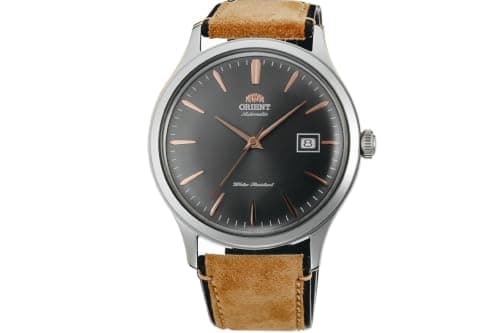
Orient
Orient Bambino V4
Price as of October 21, 2026. Prices change — Amazon's is the one that counts.
#ad · we may earn a commission from this link to Orient Bambino V4
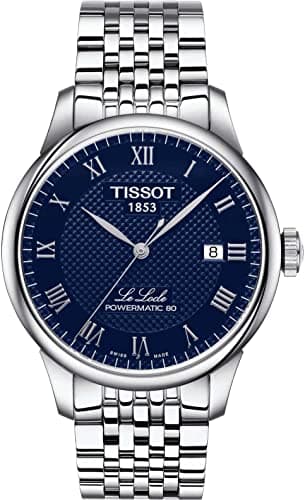
Tissot
Tissot Le Locle Powermatic 80 39.3mm
Price as of October 21, 2026. Prices change — Amazon's is the one that counts.
#ad · we may earn a commission from this link to Tissot Le Locle Powermatic 80 39.3mm
Side by side
| Spec | Orient Bambino V4 | Tissot Le Locle |
|---|---|---|
| Movement | Orient F6724, in-house | Powermatic 80, Swiss |
| Published accuracy | -15 to +25 sec/day | No daily figure published |
| Power reserve | ~40 hours | 80 hours |
| Crystal | Domed mineral | Sapphire |
| Water resistance | 30m | 30m |
| Case | 42.5mm | 39.3mm |
The power reserve is the argument, and it is a dress watch argument
On a diver, an 80-hour reserve is a nice-to-have. On a dress watch it is close to essential, and this is the point most comparisons miss.
A dress watch is, by definition, the watch you wear occasionally. The Bambino's roughly 40-hour reserve means that unless you wore it in the last day and a half, it is stopped - so every single time you reach for it you are resetting the time and the date before you can leave the house. The Le Locle at 80 hours is still running after a long weekend, and if you wear it once a week it needs a wind rather than a full reset.
That is the most underrated benefit of a long reserve and it applies precisely here. The full reasoning is in power reserve explained.
Size: 42.5mm is a lot for a dress watch
The classic Bambino is 42.5mm. For a formal watch that is genuinely large - the whole visual logic of a dress watch is a slim, restrained case that disappears under a cuff, and 42.5mm does not disappear anywhere. The Le Locle at 39.3mm is much closer to the traditional proportion.
Orient does have an answer: the smaller 38.4mm Bambino, with a 44mm lug-to-lug, which fits a normal wrist properly. Which reference is which is genuinely confusing because Orient does not use version numbers at all - we untangle it in Orient Bambino versions explained. If you are buying a Bambino, buy that one.
The crystal, and the one place Orient wins on style
The Le Locle has sapphire; the Bambino has mineral. On durability that is not a debate, and sapphire vs mineral vs Hardlex lays out why.
But the Bambino's crystal is domed, and the distortion it throws at the edges of the dial is the single most charming thing about the watch. It is the reason the Bambino looks like a 1950s watch rather than a modern one. Sapphire is the better material; the domed mineral is the better-looking crystal. That is a real trade and not everyone makes it the same way.
Both are 30m, and that is the same warning twice
Neither of these is a watch you swim in. 30m means splashes and rain and nothing more - it is the standard dress-watch rating, and it applies equally to both. If a dress watch needs to survive a swim, you are actually shopping for something else; the Tissot PRX at 100m is the usual answer.
Movements: documented on both sides
Orient's F6724 is in-house and Orient publishes a tolerance of -15 to +25 seconds a day - a tighter published figure than Tissot gives for the Powermatic 80, which has no published daily spec. The Swiss movement holds twice the reserve and runs a slower balance to do it, but it is not a chronometer and is not certified to keep better time than the Orient. See what COSC certification is for the standard neither meets.
There is one genuine long-term difference: a Swiss service costs more than a Japanese one, and more than a Bambino is worth. The math is in automatic watch service cost.
Which should you buy?
- You need a dress watch for a wedding next month → Bambino, the 38.4mm one. Spend the difference on the suit.
- It will be worn once or twice a month for years → Le Locle. The 80-hour reserve is the difference between a watch that is ready and one that is always stopped.
- You want the vintage look →Bambino, for the domed crystal. Nothing at the Tissot's price does that particular trick.
- Wrist under 7 inches → Le Locle at 39.3mm, or the 38.4mm Bambino. Not the 42.5mm.
- You want one watch for everything → neither. Both are 30m dress watches. Look at the best value picks instead.
The full category, with the rest of the field, is in the best affordable dress watches.
Questions
FAQ
Is the Tissot Le Locle worth the extra over an Orient Bambino?
If the watch will be worn occasionally rather than daily, yes - the 80-hour power reserve means it is still running when you reach for it, where a 40-hour Bambino is always stopped. Add sapphire and a more appropriate 39.3mm case and the case is strong. For a watch bought for one event, no.
Is the Orient Bambino too big?
The classic version is 42.5mm, which is large for a dress watch. Orient makes a 38.4mm version with a 44mm lug-to-lug that fits far better - it is the one we would buy, and the reference numbering is explained in our Bambino versions guide.
Can you swim with either of these?
No. Both are rated to 30m, which covers splashes and rain and nothing more. That is normal for a dress watch and it applies to both equally.
Which has the better movement?
The Powermatic 80 holds twice the power reserve. The Orient F6724 has the tighter published accuracy tolerance, at -15 to +25 seconds a day against no published daily figure from Tissot. Neither is a certified chronometer.
Specs & sources
Specifications on this page are compiled from manufacturer datasheets, official product pages, and published standards. Prices are pulled live from Amazon and date-stamped; nothing is invented.
Keep reading