Buying guide
Tissot PRX vs Seastar 1000
Tissot's two 40mm Powermatic 80 steel sports watches. Same movement, same reserve, same crystal - and completely different amounts of capability.
If you have decided on Tissot and the Powermatic 80, you land on two watches at almost the same money: the PRX and the Seastar 1000. Both are 40mm, both are Swiss automatics with 80-hour reserves, both have sapphire crystals. Then they diverge completely.
The PRX is a design object. The Seastar is a tool. One is bought for the way it looks on a shirt cuff, the other for what it survives. That is a genuine choice, not a spec-sheet ranking.
Disclosure
Some links here are affiliate links — mostly to Amazon. If you buy through one we may earn a small commission, at no extra cost to you. It never changes which watch we pick or the price you pay. Prices are pulled live and date-stamped; where we can't verify one, we show none. Full disclosure.
The contenders
Tissot
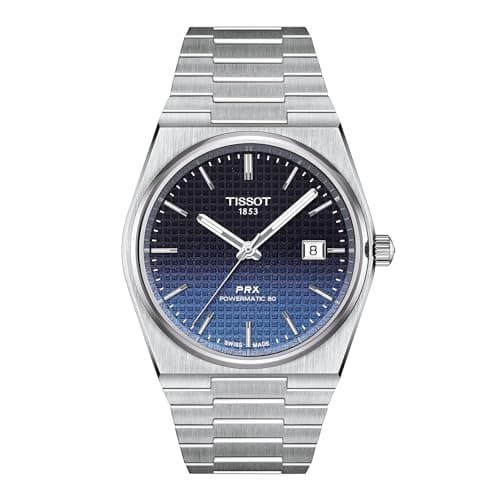
Tissot PRX Powermatic 80
Price as of October 21, 2026. Prices change — Amazon's is the one that counts.
#ad · we may earn a commission from this link to Tissot PRX Powermatic 80
Tissot
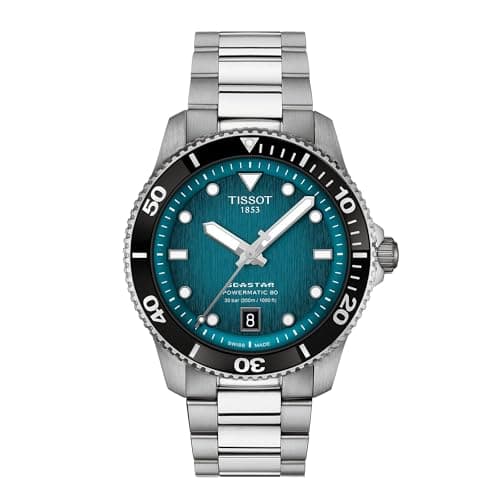
Tissot Seastar 1000 Powermatic 80 40mm
Price as of October 21, 2026. Prices change — Amazon's is the one that counts.
#ad · we may earn a commission from this link to Tissot Seastar 1000 Powermatic 80 40mm
Side by side
| Spec | Tissot PRX | Tissot Seastar 1000 |
|---|---|---|
| Movement | Powermatic 80 | Powermatic 80 |
| Power reserve | 80 hours | 80 hours |
| Crystal | Sapphire | Sapphire, anti-reflective |
| Water resistance | 100m | 300m |
| Bezel | Fixed | Unidirectional dive bezel |
| Case | 40mm | 40mm, 12.48mm thick |
| Bracelet | Integrated - no strap swaps | Quick-release, standard lugs |
300m in 12.48mm is the Seastar's trick
Water resistance costs case height - that is the physics of it, and it is why most 300m divers are thick. The Seastar gets to 300m in a 12.48mm case, which is thinner than a great many 200m Japanese divers and is the most impressive number in this comparison.
It means you get genuine dive capability without the usual penalty of a watch that will not go under a cuff. If you swim, snorkel or want the option, this is the watch and the PRX is not - the water resistance guide covers what each rating actually permits.
The bezel: capability versus cleanliness
The Seastar's unidirectional bezel is a working timer. It turns only counter-clockwise, so a knock can only ever make your elapsed time read longer - the safety principle behind every dive bezel. It is useful well beyond diving: parking, cooking, laundry, anything with an end time.
The PRX has no bezel and does not want one. Its face is a clean, flat, deliberately austere design, and adding a rotating ring would wreck it. This is the aesthetic split in one component.
The bracelet is the real practical difference
The PRX's bracelet is integrated - part of the case design, and the reason the watch looks like it costs several times what it does. It also means you will never fit a rubber strap, a leather strap or a NATO to it. What you buy is what you own.
The Seastar has conventional lugs with a quick-release bracelet, so you can put it on rubber for the summer and steel for the office in about thirty seconds, no tools. For an active watch that flexibility is worth a great deal - see how to change a watch strap.
What is genuinely identical
The movement. Both run the Powermatic 80 with its 80-hour reserve, which means both survive a full weekend off the wrist and are still running on Monday. Neither is a certified chronometer and Tissot publishes no daily accuracy figure for either - COSC certification explained covers what that standard would mean if they had it.
Both also carry the same service economics. A Swiss service costs more than a Japanese one, regardless of which of these you buy - the service cost guide has the numbers.
Which should you buy?
- You want the watch that gets noticed → PRX. The integrated bracelet is the whole reason people stop you about it.
- You swim, dive or work outdoors → Seastar. 300m, a working bezel, and an anti-reflective crystal.
- You want to swap straps → Seastar, easily. The PRX cannot.
- You want one watch that dresses up → PRX. A dive bezel never fully disappears under a jacket.
- Smaller wrist → the 35mm PRX. The Seastar comes in one size here and it is a full 40mm dive case.
Questions
FAQ
Is the Tissot Seastar better than the PRX?
More capable, yes - 300m against 100m, a working dive bezel and an anti-reflective sapphire. The PRX is the better-looking and more versatile dress-leaning watch. They use the same movement, so it comes down to what you need it to survive.
Do the PRX and Seastar use the same movement?
Yes, the Swiss Powermatic 80 with an 80-hour power reserve. Neither is a certified chronometer and Tissot does not publish a daily accuracy figure for either.
How thick is the Tissot Seastar 1000?
12.48mm, which is unusually slim for a 300m dive watch - many 200m Japanese divers are thicker. It is the most impressive specification on the watch.
Can you change the strap on either?
On the Seastar, yes - conventional lugs with a quick-release bracelet, so a swap takes seconds with no tools. On the PRX, no: the bracelet is integrated into the case and only Tissot's own options fit.
Specs & sources
Specifications on this page are compiled from manufacturer datasheets, official product pages, and published standards. Prices are pulled live from Amazon and date-stamped; nothing is invented.
Keep reading