Buying guide
Citizen Tsuyosa Review
The cheapest honest way into the integrated-bracelet look: sapphire, an in-house Citizen automatic and a 40mm case for well under $400. Here's what the price actually costs you.
The integrated-bracelet sports watch was, until recently, a rich person's genre. The Tissot PRXbroke it open at around $850. Citizen's Tsuyosa does the same thing for less than half of that — a continuous case-to-bracelet line, a sapphire crystal and Citizen's own automatic caliber, in a 40mm case.
It has become the default recommendation for people who want that look without the Swiss price, and mostly it deserves to be. But there are two specifications where the gap to the PRX is real, and we'll be specific about both. Specs come from Citizen's published product data for the NJ0150; the scoring is editorial judgment under our method, not lab measurement.
Disclosure
Some links here are affiliate links — mostly to Amazon. If you buy through one we may earn a small commission, at no extra cost to you. It never changes which watch we pick or the price you pay. Prices are pulled live and date-stamped; where we can't verify one, we show none. Full disclosure.
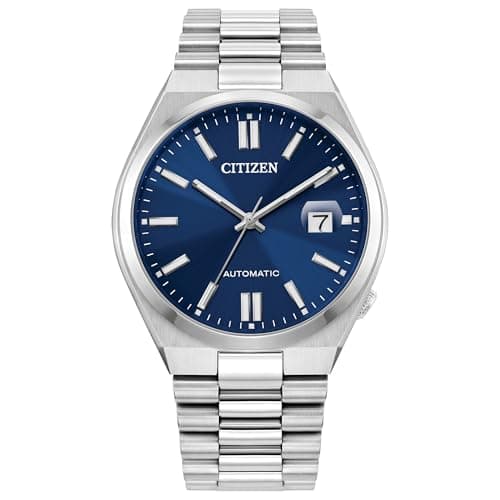
Citizen
Citizen Tsuyosa NJ0150
An integrated-bracelet automatic with a SAPPHIRE crystal and Citizen's in-house 8210 for well under the Swiss equivalents. The cheapest honest way into the integrated-bracelet look.
$495.0030% off
Price as of October 21, 2026. Prices change — Amazon's is the one that counts.
#ad · we may earn a commission from this link to Citizen Tsuyosa NJ0150
Specs at a glance
| Movement | Citizen caliber 8210, automatic |
|---|---|
| Power reserve | 42 hours |
| Case diameter | 40mm (a 37mm version is also made) |
| Crystal | Sapphire |
| Water resistance | 50m / 5 bar |
| Bracelet | Integrated steel, fold-over clasp with push buttons |
| Date | Yes, at 3 o'clock |
Why it looks more expensive than it is
Three things do most of the work. The integrated bracelet gives an unbroken line from case to clasp, which is the visual signature of watches costing five times as much. The sapphire crystalkeeps the dial looking clean rather than hazed after a year. And the dials — Citizen offers a range of strong sunray colors — read as deliberate design rather than a budget compromise. Nothing here is fake luxury; it's a real specification list that happens to be well chosen.
The two places it gives ground
- 50m water resistance.That's hand-washing, rain and a dropped-in-the- sink survival rating. It is not a swimming watch in the way a 100m Seiko 5 Sports is, and it's nowhere near the 200m Kamasu. On a watch styled as a sports piece, this is the spec that most surprises buyers, so know it going in.
- A 42-hour reserve, and no published accuracy figure.The Powermatic 80 in the PRX holds roughly 80 hours; the 8210 holds 42, which means a weekend off the wrist ends with a stopped watch. Citizen also doesn't publish a daily accuracy tolerance for the 8210, where Seiko and Orient both do for their calibers. That's a genuine information gap, not a criticism of the movement.
What 50m actually allows
Worth spelling out, because water-resistance ratings are the most misread numbers in watchmaking. Citizen states WR50 / 5 barand describes it as suitable for still-water swimming. The rating comes from a static pressure test, not a depth guarantee, and real-world swimming adds dynamic pressure that a static test doesn't simulate.
Our practical read: rain, hand-washing, getting caught in a downpour and an accidental dunk are all fine. Deliberate swimming is at the edge of what we'd be comfortable with, especially on a watch without a screw-down crown, and diving is out of the question. If you want a watch you never have to think about near water, that's 200m territory — the dive-watch list explains the thresholds in full.
The integrated-bracelet trade, again
Same as the PRX: the bracelet is part of the case, so you can't fit a standard strap. You buy this watch for the look it has, not the looks you can give it later. The upside is fit — an integrated bracelet starts curving immediately, so the Tsuyosa hugs the wrist and wears smaller than 40mm suggests. Citizen also makes a 37mm version, which is one of the better small mechanical watches on the market and leads our women's list.
Tsuyosa vs PRX, honestly
The PRX gives you an 80-hour reserve, anti-reflective sapphire, a Nivachron antimagnetic hairspring, 100m water resistance and Swiss finishing, for roughly double. Every one of those is a real advantage. Whether they're worth $470 is a question only your budget answers — but if the answer is "I mostly want this to look like a PRX," buy the Tsuyosa and spend the difference on something else. We think that's the honest read, even though the more expensive recommendation would pay us more.
Which size, and which dial
Citizen sells the Tsuyosa in 40mm (the NJ0150/NJ0151 references) and 37mm(NJ0200), with identical specifications — same 8210 caliber, same sapphire crystal, same 42-hour reserve, same 50m rating. There's no penalty for choosing the smaller one and no discount either; they cost the same. If your wrist is under about 6.5 inches, or you simply prefer a modest watch, take the 37mm. It's the top pick on our women's list for exactly that reason.
The dial is where the range gets interesting. Citizen offers strong sunray colors — blues, greens, oranges, a teal — and the dial does most of the work in making this watch feel deliberate rather than derivative. Our only advice is to look at real photographs rather than product renders before committing, because sunray finishes photograph very differently from how they read in a room. The specification is identical whichever you pick.
Living with it
Two practical points. The bracelet needs sizingon arrival — links come out with a small pin tool, or a jeweler will handle it in minutes — and because the bracelet is integrated, that's the only fitting adjustment available to you. There's no fallback strap if the sizing lands awkwardly between links, so get it right.
And the 42-hour reserve means a Tsuyosa left off from Friday evening will have stopped by Sunday. Winding the crown and resetting takes under a minute, and no harm is done — a stopped automatic is simply an automatic that's run down. You don't need a winder for this. The one habit worth forming is keeping it away from laptop lids and magnetic phone mounts, since the 8210 has no antimagnetic hairspring; the accuracy guide covers the cheap fix if it does get magnetized.
Who should buy it
Buy the Tsuyosa if you want the integrated-bracelet look with a sapphire crystal and a real in-house movement, and you don't need serious water resistance. It's an excellent second watch alongside a diver, a strong office watch, and — in the 37mm size — one of the best small automatics you can buy at any price near this.
Who should skip it
Skip it if you swim or want a watch you never have to think about near water — the Kamasugives you 200m and sapphire for less. Skip it if you swap straps constantly. And skip it if you want the longest power reserve you can get at this price — that's the PRX's territory, covered on the upgrade list.
The direct comparison most buyers want is Citizen Tsuyosa vs Seiko 5 Sports - sapphire and an integrated bracelet against Hardlex and a wider range.
Questions
FAQ
Is the Citizen Tsuyosa a good watch?
Yes — it's the cheapest credible integrated-bracelet automatic with a sapphire crystal, built around Citizen's in-house 8210 with a 42-hour reserve. The main limitations are 50m water resistance, which is lower than its sporty looks suggest, and the fact that the bracelet can't be swapped for a standard strap.
Can you swim with a Citizen Tsuyosa?
Citizen rates it 50m / 5 bar, which the maker describes as suitable for still-water swimming. We'd treat it as a rain-and-handwashing watch and keep it out of the pool — if you want to swim without thinking about it, a 100m or 200m watch is the right buy.
Citizen Tsuyosa or Tissot PRX?
The PRX wins on power reserve (80 hours vs 42), anti-reflective sapphire, an antimagnetic hairspring, 100m water resistance and finishing — for roughly double the money. If you mainly want the integrated-bracelet look and a sapphire crystal, the Tsuyosa gets you most of the way for far less.
Specs & sources
Specifications on this page are compiled from manufacturer datasheets, official product pages, and published standards. Prices are pulled live from Amazon and date-stamped; nothing is invented.
Keep reading