Buying guide
Tissot PRX 35mm Review
The small PRX is not the slim PRX. Tissot publishes the identical 10.93mm case height for both sizes - and two numbers most buyers never see explain why the 35mm is still the better small-wrist buy.
If a 40mm integrated-bracelet watch is too much watch for your wrist, this is the one to buy - but not for the reason it is usually sold. Tissot publishes 35.00mm across, 10.93mm of case height, an 11.00mm bracelet attachment, 100m of water resistance, sapphire with an anti-reflective coating, a see-through caseback, a Nivachron balance spring and the Powermatic 80 movement with 80 hours of reserve, at a $795 list price.
The number that reframes the watch is that 10.93mm, because it is exactly what Tissot publishes for the 40mm PRX as well. The two sizes share a case height. So the 35mm is not a slimmer watch - as a share of its own diameter it is proportionally the tallerof the two, 31% against 27%. What it genuinely is, on Tissot's own figures, is lighter: a published 104 grams against 138 for the 40mm. On a small wrist, where a heavy head slides around the side, 34 grams is a bigger deal than half a millimeter.
The second number worth having before you order: Tissot publishes no lug-to-lug for either PRX, and the 11.00mm attachment on this one is not the 12.00mmof the 40mm - different bracelet references, so the two sizes do not share straps or bracelets. Specifications below come from Tissot's own product page for T137.207.11.051.00; scoring follows our published method.
Disclosure
Some links here are affiliate links — mostly to Amazon. If you buy through one we may earn a small commission, at no extra cost to you. It never changes which watch we pick or the price you pay. Prices are pulled live and date-stamped; where we can't verify one, we show none. Full disclosure.
Tissot
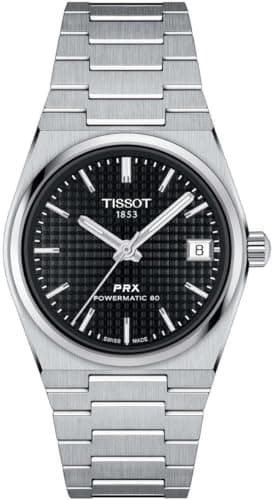
Tissot PRX Powermatic 80 35mm
The 35mm PRX: the same 80-hour Swiss Powermatic 80, sapphire and integrated bracelet as the 40mm, in a case small wrists can actually wear. The stretch pick that isn't a compromise.
Price as of November 23, 2026. Prices change — Amazon's is the one that counts.
#ad · we may earn a commission from this link to Tissot PRX Powermatic 80 35mm
Specs at a glance
| Movement | Swiss automatic, Powermatic 80 |
|---|---|
| Power reserve | 80 hours, published |
| Balance spring | Patented Nivachron |
| Accuracy spec | Not published by Tissot for this reference |
| Case | 316L stainless steel, 35.00mm long by 35.00mm wide, 10.93mm thick |
| Lug-to-lug | Not published |
| Bracelet attachment | 11.00mm (published as case lug width) |
| Crystal | Sapphire, one anti-reflective coating on the underside |
| Caseback | See-through |
| Water resistance | 100m (10 bar) |
| Bracelet | Interchangeable quick-release steel, butterfly clasp with push-buttons |
| Lume | Super-LumiNova on the hands |
| Weight | 104 grams |
| Tissot list price | $795 |
The 35mm and the 40mm are the same height. Here is why that matters
Shrinking a watch usually shrinks everything about it. This one did not. Tissot's own technical data gives both PRX references a 10.93mm case thickness, which has a consequence people only notice after the watch arrives:
| Published spec | PRX 35mm | PRX 40mm |
|---|---|---|
| Case width | 35.00mm | 40.00mm |
| Case length | 35.00mm | 39.50mm |
| Case thickness | 10.93mm | 10.93mm |
| Height as % of width | 31% | 27% |
| Bracelet attachment | 11.00mm | 12.00mm |
| Weight | 104g | 138g |
| Water resistance | 100m | 100m |
| Power reserve | 80h | 80h |
| Lug-to-lug | Not published | Not published |
A case that is 31% as tall as it is wide looks and feels different from one at 27%. The 35mm PRX sits a little prouder off the wrist relative to its footprint, which is the opposite of what "the small one" implies, and it is why we rank it fourth rather than first on our slim-automatics shortlist even though it publishes one of the three lowest millimeter figures on that page.
The flip side is the weight row, and it is the better argument for this watch. 104 grams against 138 is a 25% reduction in head weight. On a wrist under about 6.5 inches, a heavy integrated-bracelet watch is the kind that rotates to the side of your wrist through the day; this one is far less inclined to.
The lug-to-lug Tissot will not publish
It is the most-searched specification for this watch and the one Tissot leaves out. The technical data publishes a case length of 35.00mm - identical to the width - and no lug-to-lug. Those are not the same measurement. On an integrated-bracelet design the first steel links are part of the case profile, so the real tip-to-tip reach across your wrist is longer than the case length, by an amount Tissot does not state.
We are not going to convert it for you. The honest position is that the figure that decides fit is unpublished for this watch, and the 35.00mm case length is the closest thing on the record. For comparison, the watches on this site that do publish a span make the gap visible: Orient publishes 44mm for the 38.4mm Bambino V7, Seiko publishes 44.7mm for the 37.4mm Seiko 5 SRPK91, and Hamilton publishes 47mm for the 38mm Khaki Field Auto. A watch published at 35.00mm of case length is certainly the most compact of that group - we simply cannot tell you by how much. Why lug-to-lug beats diameter is the two-minute version.
The bracelet fitting is 11mm, and that is a buying decision
Tissot publishes the case lug width as 11.00mm for the 35mm and 12.00mm for the 40mm, with a different bracelet reference for each. Two things follow, and neither is obvious from a product photo:
- The two sizes do not share bracelets or straps. A PRX strap bought for a 40mm will not fit this watch. You are shopping a 35mm-specific parts list.
- There is no standard-width option at all.An 11mm integrated fitting is not a lug width in the normal sense - you cannot put a 20mm leather strap on it. What you can do is use Tissot's own quick-release system, which is published for this reference and genuinely tool-free.
If swapping straps on a whim is part of why you buy watches, that is an argument for a conventional case: the leather-strap shortlist collects the automatics with normal lugs, and four of its six picks publish the most-stocked 20mm width.
What the Powermatic 80 gets you, and what Tissot does not say about it
Eighty hours of reserve is the specification that makes this watch easy to live with. Take it off on Friday night and it is still running on Monday morning - no resetting the time, no winding, no date correction. Against the roughly 40 hours that most Japanese automatics in our registry publish, that is the single biggest quality-of-life difference between a Swiss movement at this price and a Japanese one. What the Powermatic 80 actually is covers the caliber in full, including the 21,600 vph beat rate and the synthetic escapement that make the long reserve possible.
What Tissot does not publish is a daily accuracy tolerance. There is no stated seconds-per-day figure for the Powermatic 80 on this product page, and that is not an oversight unique to Tissot: Hamilton publishes none for the H-10 either, and neither does Orient for the F-series references we track. It means the common assumption that Swiss movements keep better time than Japanese ones has no published support in either direction at this price - what accuracy figures mean when they exist and the watches that do publish a tolerance.
100m on a dress watch is the quiet strength
A 10.93mm watch rated to 100mis unusual. The thinner watch in Tissot's own range, the 9.75mm Le Locle, is published at 30m - and 30m is the normal rating for a dress automatic at any price. So the PRX gives you a watch you can wear to a wedding and then wash the car in, which very little else in this shape does. What each rating actually permits is worth reading before you take the 100m as a licence to dive: there is no rotating dive bezel here and Tissot publishes no screw-down crown for this reference, so 100m means swimming and showering, not diving.
Who should skip this watch
- Anyone who buys watches to change straps on them.The 11mm integrated fitting makes this a one-look watch unless you buy Tissot's own parts.
- Anyone chasing the slimmest watch they can get. It is not slimmer than the 40mm, and the 9.75mm Le Locle is more than a millimeter thinner for less money at list.
- Anyone who needs to know the span before ordering. Tissot does not publish it. If an unpublished fit measurement is a dealbreaker, the small-wrist shortlist ranks only watches whose makers do publish one.
- Anyone holding a hard budget line. At a $795 list price this is a stretch buy on a site built around $200 and $500 ceilings. The under-$500 roundup is where the value lives, and PRX versus Citizen Tsuyosa is the argument about whether the Swiss premium is worth it.
The verdict
A genuinely good watch sold with the wrong headline. Buy the 35mm PRX because it is 34 grams lighter than the 40mm, because 100m and 80 hours in a dress case is a rare combination, and because at 35mm it fits wrists that the 40mm overwhelms. Do not buy it expecting a slimmer watch - Tissot publishes the same 10.93mm for both - and go in knowing the lug-to-lug is unpublished and the bracelet fitting is PRX-only. Those are information gaps rather than faults, but they are the kind that cause returns.
Questions
FAQ
Is the Tissot PRX 35mm thinner than the 40mm?
No. Tissot publishes a 10.93mm case thickness for both. Because the case is smaller, that height is a bigger share of the diameter - 31% on the 35mm against 27% on the 40mm - so the small one reads proportionally taller. The real difference is weight: a published 104 grams against 138.
What is the lug-to-lug of the Tissot PRX 35mm?
Tissot does not publish one. The technical data gives a case length of 35.00mm and no lug-to-lug, and on an integrated-bracelet case the first links extend the real reach beyond the case itself by an amount Tissot does not state. Treat 35.00mm as the case, not as the span across your wrist.
Do PRX 35mm and PRX 40mm straps interchange?
No. Tissot publishes an 11.00mm attachment for the 35mm and 12.00mmfor the 40mm, with a different bracelet reference for each size. Both use Tissot's tool-free quick-release system, but the parts are size-specific - so check the size on any strap or bracelet before buying.
Is the Tissot PRX 35mm automatic or quartz?
Both exist, so check the reference. The watch reviewed here - T137.207.11.051.00 - is the Powermatic 80 automatic, with an 80-hour reserve and a see-through caseback. Tissot also sells a 35mm PRX with a quartz movement and a solid back. The quartz is thinner and more accurate; the automatic is the mechanical watch. The difference, in full.
Can you swim with the Tissot PRX 35mm?
Yes. Tissot publishes 100m (10 bar), which covers swimming and showering. It is not a dive watch: there is no rotating dive bezel and Tissot publishes no screw-down crown for the reference, so 200m with a screwed-down crown remains the diving threshold.
Is the Tissot PRX 35mm a women's watch?
Tissot sells it as a unisex reference and the listing title says so. At 35mm with a 100m rating and an 80-hour mechanical movement it is simply a small watch with full specifications, which is rarer than it should be - most genuinely small mechanical watches are sold with lower ratings and cheaper movements. Our women's shortlist is honest about how thin that market is.
Specs & sources
Specifications on this page are compiled from manufacturer datasheets, official product pages, and published standards. Prices are pulled live from Amazon and date-stamped; nothing is invented.
- Tissot PRX Powermatic 80 35mm (official) ↗
- Tissot PRX Powermatic 80 40mm T137.407.11.051.00 (official) - 10.93mm case thickness, 39.50mm case length, 12.00mm lug width, 100m, 80h, 138g ↗
- Tissot Le Locle Powermatic 80 39.3mm T006.407.16.043.00 (official) - 9.75mm case thickness, 19.00mm lug width, 30m, 80h, 67g ↗
- ETA C07.111 / Tissot Powermatic 80 caliber reference (3Hz / 21,600 vph, 80-hour reserve, based on the ETA 2824-2, synthetic escapement, index regulator) ↗
- Hamilton Khaki Field Auto (official) ↗
- Orient Bambino V7 RA-AC0M01S30B (official) ↗
- Seiko 5 Sports SRPK91 published specifications (4R36, 24 jewels, 37.4mm, 12.5mm, 44.7mm lug-to-lug, 18mm lugs, 100m, curved Hardlex, approx. 41h, $415) ↗
- ISO 22810 / water-resistance meaning ↗
Keep reading