Buying guide
Seiko Turtle vs Citizen Fugu
Two big Japanese 200m divers with in-house movements and cult followings. One has the best lume in the class; the other has the crystal and the certification.
These are the two Japanese divers people fall down forum rabbit holes over. Both are 200m. Both run in-house movements. Both have nicknames rather than model names, which tells you something about how they are bought. And both are large enough that fit, not specification, will decide it for a lot of buyers.
The short version: the Turtle owns the dark and the Fugu owns the daylight. Seiko's lume is the best in this class by a wide margin; Citizen answers with a sapphire crystal and a genuine ISO 6425 dive certification the Seiko does not carry.
Disclosure
Some links here are affiliate links — mostly to Amazon. If you buy through one we may earn a small commission, at no extra cost to you. It never changes which watch we pick or the price you pay. Prices are pulled live and date-stamped; where we can't verify one, we show none. Full disclosure.
The contenders
Seiko
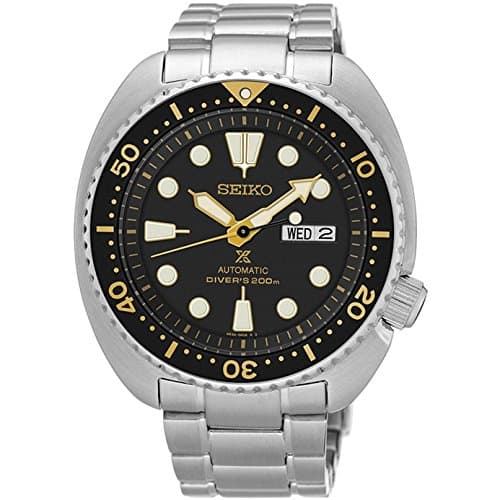
Seiko Prospex Turtle SRP775
Price as of October 21, 2026. Prices change — Amazon's is the one that counts.
#ad · we may earn a commission from this link to Seiko Prospex Turtle SRP775
Citizen
Citizen Promaster Dive 'Fugu' NY0154
We don't have a verified live price for this right now, so we aren't showing one.
#ad · we may earn a commission from this link to Citizen Promaster Dive 'Fugu' NY0154
Side by side
| Spec | Seiko Turtle SRP775 | Citizen Fugu NY0154 |
|---|---|---|
| Movement | Seiko 4R36, 24 jewels | Citizen 8204, 21 jewels |
| Published accuracy | -35 to +45 sec/day | Not published |
| Crystal | Hardlex (mineral) | Sapphire |
| Water resistance | 200m | 200m, ISO 6425 |
| Case | 45mm cushion, ~47.7mm L2L | 44mm |
| Lume | LumiBrite - best in class | Good, not class-leading |
The lume gap is real and it is large
Seiko's LumiBrite is the reason the Turtle has the following it does. Thick applications on fat indices, charged in daylight, still readable in the middle of the night - it is the single most consistently praised thing about Seiko divers and it is not marketing. The Fugu's lume is good. It is not this.
Whether that matters depends on whether you look at your watch in the dark. If you do - night shifts, cinemas, actual diving, waking at 3am - it is the deciding specification and nothing else on the table changes it. If you never do, it is worth nothing. What lume actually is and why thickness beats brand is in watch lume explained.
The crystal gap is also real, and points the other way
The Fugu has sapphire; the Turtle has Hardlex. Over years of ordinary wear that is the difference between a crystal that still looks new and one carrying a collection of fine scratches with, eventually, one deep one. See sapphire vs mineral vs Hardlex.
Seiko's position on this has always been that Hardlex is more shatter-resistant and cheaper to replace. That is true and it is also, unmistakably, the cheaper crystal. At this price point the Citizen simply gives you the better material.
ISO 6425: what the Fugu has that the Turtle does not
Both watches are rated to 200m. Only the Citizen is certified to ISO 6425, the international diver's watch standard - which requires a unidirectional bezel, legibility at 25cm in darkness, a running indicator, magnetic and thermal-shock resistance, and testing of every individual watch rather than a batch sample.
Seiko does build ISO-compliant divers; this particular Prospex reference is rated to 200m without Seiko claiming ISO compliance for it. If you actually dive rather than swim, that is the difference that matters, and the water resistance guide spells out why.
Fit: both are big, but not equally
The Turtle reads as 45mm and wears smaller than that, because the cushion case has no protruding lugs - its lug-to-lug is roughly 47.7mm, short for the diameter. The Fugu is 44mm and does not have that trick working for it.
The Turtle's real problem is height. It is a thick watch that sits high, catches cuffs, and under about a 6.5-inch wrist it is simply too much. Neither of these is a small watch and neither pretends to be - the size and fit guide explains why lug-to-lug, not diameter, is the number to trust. If you want a sapphire Japanese diver at 41.8mm, the Orient Kamasu is the answer to a question neither of these asks.
Movements
Both hack and hand-wind. Seiko's 4R36 adds a day-and-date complication and a published tolerance of -35 to +45 seconds a day; Citizen's 8204 holds around 42 hours and Citizen publishes no daily figure for it. The 4R36 is the more widely serviced of the two simply because it is everywhere - relevant in ten years, irrelevant now.
Which should you buy?
- You read your watch in the dark → Turtle. The lume is the reason this watch has a cult.
- You want it to still look new in five years → Fugu, for the sapphire.
- You actually dive → Fugu. ISO 6425 is a real certification and the Turtle does not claim it.
- You want a day AND a date → Turtle. The 4R36 has both; see the day-date shortlist for why that is a caliber question.
- Wrist under 6.5 inches → neither, honestly. Look at the smaller divers in the category roundup.
Questions
FAQ
Is the Seiko Turtle or the Citizen Fugu better?
The Turtle has far better lume and adds a day complication; the Fugu has a sapphire crystal and genuine ISO 6425 dive certification. If you read your watch in the dark, buy the Seiko. If you want the better crystal and the certification, buy the Citizen.
Does the Seiko Turtle have a sapphire crystal?
No - it uses Hardlex, Seiko's hardened mineral glass. It resists a great deal but will pick up fine scratches over years. The Citizen Fugu is sapphire at a similar price.
Is the Turtle too big at 45mm?
It depends on your wrist rather than the number. The cushion case has no protruding lugs, so the lug-to-lug is about 47.7mm and it wears smaller than it reads - but it is thick and sits high. Under about a 6.5-inch wrist it is too much watch.
What does ISO 6425 mean on the Citizen?
That the watch is built and tested to the international diver's watch standard - a unidirectional bezel, darkness legibility, a running indicator, magnetic and thermal-shock resistance, and individual testing of each watch rather than a sample.
Specs & sources
Specifications on this page are compiled from manufacturer datasheets, official product pages, and published standards. Prices are pulled live from Amazon and date-stamped; nothing is invented.
Keep reading